Showing posts with label Greek polytheism. Show all posts

Tuesday, June 3, 2014

‘300’ (2006) – movie review


I don’t just review any movie. I try to stay somewhat on topic here, with either a cultural or spiritual tie-in. The Spartans had some strong similarities with the Langobards. Both were societies which were based on war and the warrior ethic… “Warrior Socities.” In both societies, boys were trained for war from an early age.

One difference is that the Langobards didn’t use “eugenics,” although it’s probably safe to say that the greatest Langobard warriors probably had more children than most. The Winnili/Langobards had no problem with “odds.” Their kill/loss ratio was staggering, and possibly unequaled in history. The better-known Spartans, however, produced the greatest single known battle effort in the history of warfare.

The movie was about the Battle of Thermopylae in 480 BC, where Spartan King Leonidas leading 300 Spartans against what was described as a Persian imperial army of millions.  Although exaggerated, the odds were in fact incredible. The battle has been described by some as “saving Western civilization,” which may cloud the harder reality that it certainly was part of saving Greek civilization at that time. The movie portrayed other items which were not accurate, of which I will avoid. Most of which are more-or-less obvious.

This battle was just a part of the “Greco-Persian Wars”(499-449 BC). YouTube has documentaries galore about these wars and the Battle of Thermopylae. It could also be noted that, along with the Langobard comparison, there is a clear comparison to the Samurai. The Samurai were another example of a “Warrior Society,” with similar traits to the Spartans. One trait that the Spartans and Samurai had in common was that they seemed to literally wish to die in the glory of battle. They actually would seek it, if the historical accounts are true. The Spartans at Thermopylae at least, must have had absolutely no fear of death.


King Leonidas
Battle of Thermopylae

A Greek force of approximately 7,000 men marched north to block the pass in the summer of 480 BC. The Persian army, alleged by the ancient sources to have numbered over one million but today considered to have been much smaller (various figures are given by scholars ranging between about 100,000 and 150,000), arrived at the pass in late August or early September. The vastly outnumbered Greeks held off the Persians for seven days (including three of battle) before the rear-guard was annihilated in one of history's most famous last stands.

During two full days of battle the small force led by Leonidas blocked the only road by which the massive Persian army could pass. After the second day of battle a local resident named Ephialtes betrayed the Greeks by revealing a small path that led behind the Greek lines. Leonidas, aware that his force was being outflanked, dismissed the bulk of the Greek army and remained to guard the rear with 300 Spartans, 700 Thespians, 400 Thebans and perhaps a few hundred others, most of whom were killed.


300 is a 2007 American fantasy action film based on the 1998 comic series of the same name by Frank Miller and Lynn Varley. Both are fictionalized retellings of the Battle of Thermopylae within the Persian Wars. The film was directed by Zack Snyder, while Miller served as executive producer and consultant. It was filmed mostly with a super-imposition chroma key technique, to help replicate the imagery of the original comic book.

The plot revolves around King Leonidas (Gerard Butler), who leads 300 Spartans into battle against the Persian "god-King" Xerxes (Rodrigo Santoro) and his invading army of more than 300,000 soldiers. As the battle rages, Queen Gorgo (Lena Headey) attempts to rally support in Sparta for her husband. The story is framed by a voice-over narrative by the Spartan soldier Dilios (David Wenham). Through this narrative technique, various fantastical creatures are introduced, placing 300 within the genre of historical fantasy.


Queen Gorgo
The film has a certain cinematic quality that is difficult to describe, but it’s as though one is watching it through a dark fuzzy lens, into historical abyss. The Persian armies must have had segments which were not ethnic Persians, who were from other territories of the Persian Empire.. but that point was however much exaggerated in the film. The film starts out making it very clear how Spartan boys were raised to be fighting machines. R. Lee Ermey couldn’t have done a better job of creating killing machines. They were trained to engage in pure evolutionary struggle, to ignore pain, and were constantly tested to their limits. “Respect and Honor” was their slogan, according to the movie; which reminded me of “Strength and Honor” from ‘Gladiator’.

King Leonidas was basically the main protagonist, along with his wife Queen Gorgo. The two are engaged in a political conflict, not only with the invading Persians, but with “bought-off traitors” within Spartan politics. Another quote from the movie, I think from the narrator Dilios, the only survivor of the 300, retelling the story: “Only the hard and strong may call themselves Spartans.”

Before going to war, a Spartan King must go through a religious rite in which he seeks guidance from the wise men of Greek polytheism. The movie portrays them as diseased and “monster-like”; which is the only real item from the movie that I would criticize. I know some people were not happy about what was a similar portrayal from the cable tv series ‘Vikings’, in which the Odinic Skalds were shown to be hideous.

The only other Greek polytheist concept that I remember from the film was was a scene which showed Persian ships sinking in a storm of rain, thunder, and lightning before they could land. One of the Spartans credited the Greek god Zeus for this happening. The opening battle was the most dramatic scene, with the Spartans killing Persians soldiers (or Persian Emperor Xerxes' imperial troops) at will using amazing fighting skills and bravery. The historical record shows that they killed a minimum of ten-to-one! It really could have been twenty-to-one.

Prior to I think the second battle, the narrator Dilios says: “We do what we were trained to do, what we were bred to do, what we were born to do.” Unlike some historical exaggerations, this quote was literally accurate.

Slight spoiler alert beyond this point...

.

.

.
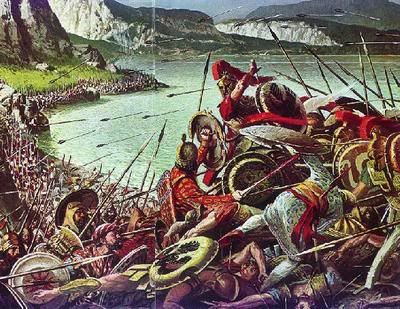

'Battle of Thermopylae'
After Leonidas and the 300 sacrificed their lives down to the last man, which allowed for Sparta the time to gather themselves, the stage was set for the big battle. An army of ten thousand Spartan warriors were lined up to do battle with an army of thirty thousand Persians. The narrator Dilios, for the purpose of the movie speaking in real time, gave a short speech to the army. He finishes with the following: “Give thanks, men, to Leonidas and the brave 300! TO VICTORY!”

When viewing it, I thought he said “Take Leonidas and the brave 300 to victory!" Actually, that line would have worked too! Good movie.

.


Monday, May 6, 2013

Today is the Festival of Artemis

Goddess Artemis

Artemis was one of the most widely venerated of the Ancient Greek deities. Her Roman equivalent is Diana. Some scholars believe that the name, and indeed the goddess herself, was originally pre-Greek. Homer refers to her as Artemis Agrotera, Potnia Theron: "Artemis of the wildland, Mistress of Animals." The Arcadians believed she was the daughter of Demeter.

In the classical period of Greek mythology, Artemis was often described as the daughter of Zeus and Leto, and the twin sister of Apollo. She was the Hellenic goddess of the hunt, wild animals, wilderness, childbirth, virginity and protector of young girls, bringing and relieving disease in women; she often was depicted as a huntress carrying a bow and arrows. The deer and the cypress were sacred to her. In later Hellenistic times, she even assumed the ancient role of Eileithyia in aiding childbirth.


The proto-European Almother

It is confusing as later mythological manifestations mixed regional manifestations of the proto-European Mother Goddess, or whom I prefer to refer to as the "Almother"--or other aspects, beliefs or traditions of those early Moon cults--with what migrated or emerged several thousands years ago. In this case the Classical Greek mythology or Olympian pantheon absorbed the Goddess Hecate, probably the Goddess Artemis, and possibly even the Goddess Phoebe. The three may possibly have been the same goddess at one time in pre-Olympian Greece. The following excerpt, from the Hecate Wikipedia page, reflects this confusion:

Hesiod emphasizes that Hecate was an only child, the daughter of Perses and Asteria, a star-goddess who was the sister of Leto (the mother of Artemis and Apollo). Grandmother of the three cousins was Phoebe the ancient Titaness who personified the moon.


Laphria (festival)

Laphria was an ancient Greek religious festival in honour of the goddess Artemis, held every year in Patras. There was a sanctuary of Artemis Laphria on the acropolis of Patras. The sanctuary had an image of Artemis Laphria, that was brought there from Calydon in Aetolia after it was laid waste by Augustus. Every year, the people held a "festival of the Laphria" in the goddess's honour "which was peculiar to their place". They made a barrier of tall logs round the altar, "still green", so that the stockade would not burn. They piled the driest wood on the altar, for kindling, and then smoothed the approaches to the pyre by laying earth on the altar steps. On the first day, the people walked in procession of the "greatest grandeur" for the goddess. A virgin priestess brought up the rear, riding in a chariot which was drawn by tame yoke deer. The next day, living animals are sacrificed, including edible birds, boars, deer, gazelles, wolves and bears, but also fruit from trees. The altar was set on fire. Animals forced out by the first leap of the flames, or escaping at full tilt were thrown back into the fire, to their death, by those who had brought them. There was no record of anyone being injured by the animals.


Festivals

Artemis was born at the sixth day, the reason why it was sacred for her.

Festival of Artemis in Brauron, where girls, aged between five and ten, dressed in saffron robes and played the bear to appease the goddess after she sent the plague when her bear was killed.

Festival of Amarysia is a celebration to worship Artemis Amarysia in Attica. In 2007, a team of Swiss and Greek archaeologists found the ruin of Artemis Amarysia Temple, at Euboea, Greece.


Festival of Artemis Saronia, a festival to celebrate Artemis in Trozeinos, a town in Argolis. A king named Saron built a sanctuary for the goddess after the goddess saved his life when he went on hunting and swept by the wave and held a festival for her.

At the 16 of Metageitnio (second month on Athenian calendar), people sacrifice to Artemis and Hecate at deme of Erchia.

Kharisteria Festival on 6 of Boidromion (third month) to celebrate the victory of Marathon and also known as the Athenian "Thanksgiving."

Day six of Elaphobolia (ninth month) festival of Artemis the Deer Huntress where she was offered cakes shaped like stags, made from dough, honey and sesame-seeds.
 

Day 6 of 16 of Mounikhion (tenth month) a celebration of her as the goddess of nature and animal. A goat was being sacrificed to her.

Day 6 of Thargelion (eleventh month) the 'birthday' of the goddess, while the seventh was Apollo's. A festival for Artemis Diktynna (of the net) in Hypsous.
 

Laphria, a festival for Artemis in Patrai. The procession started by setting the logs of wood around the altar, each of them sixteen cubits long. On the altar, within the circle, is placed the driest of their wood. Just before the time of the festival, they construct a smooth ascent to the altar, piling earth upon the altar steps. The festival begins with a most splendid procession in honor of Artemis, and the maiden officiating as priestess rides last in the procession upon a chariot yoked to four deer, Artemis' traditional mode of transportation (see below). It is, however, not until the next day that the sacrifice is offered.
 

In Orchomenus, a sanctuary was built for Artemis Hymnia where her festival was celebrated every year.

.