Showing posts with label Camunian heritage. Show all posts

Tuesday, June 16, 2015

The "Eighteen Families" of Loveno Grumello II


I had put up a piece years ago entitled 'The "Eighteen Families" of Loveno-Grumello', and I wanted to put a sampling of Camunian surnames from the comunes that my grandparents came from before migrating to the Ironwood-Hurley area along the Montreal River. "Loveno Grumello" are two villages within the comune of Paisco Loveno, which are both under one administration. There are only 199 inhabitants today in Paisco Loveno, which is made up of the villages of Ardinghelli, Case del Longo, Case di Bornia, Grumello, Loveno, and Perdonico. The comune of Prestine has 390 inhabitants today. Some of the old family names have disappeared into one of the big Italian or European cities, or into the United States, Canada, Argentina, etc.

Surnames today in Paisco Loveno include Armeni, Baldoni, Berardi, Bordoni, Bressanelli, Brianza, Brunelli, Calufetti, Caluffetti, Calvetti, Capelli, Caratti, Catotti, Chiapparini, Cicchitti, Contenti, Curcelli, Degani, Ferrari, Filafusi, Fioroni, Franchini, Ghenzi, Ghirardi, Lucchi, Mansini, Manzini, Marzi, Mascherpa, Mastaglia, Mastiglia, Mattia, Mitterpergher, Moraschetti, Morelli, Moreschetti, Moreschi, Moreschini, Omassoli, Palazzi, Pangrazio, Pantaleoni, Salvetti, Somenzi, Sorosina, Zigliana, and Zucchi.

Surnames today in Prestine include Abarelli, Avanzini, Ballerini, Bellicini, Bettoni, Bomtempi, Bontempi, Bonali, Canossi, Corbelli, Cominini, Corini, Danioli, Domenighini, Ducoli, Fanti, Fumagalli, Ferrara, Giarelli, Giorgi, Grassini, Iannucci, Imperadori, LaFfranchini (LaFranchini?), Laini, Monchieri, Martinelli, Menolfi, Morandini, Mulattieri, Orsatti, Panizzoli, Panteghini, Pedretti, Pessina, Poli, Quaglino, Rebaioli, Romagnolo, Romelli, Ruffini, Sacchet (Saccheti or Sacchetti?), Salvetti, Scarsi, Scolari, Stabile, Santicoli, Trombini, Tottoli, Tagazzini, Tapini, Troletti, Vaoltropini, Vezzoli.

.

Sunday, February 22, 2015

The Cudighi sandwich... Lombard-Yooper culture in Upper Michigan: Part 2


Cudighi (Wikipedia):

A Cudighi is a spicy Italian sausage that can be bought in links or can be served as a sandwich on a long, hard roll, often with mozzarella cheese and tomato sauce. Cudighi came from Italy to the Upper Peninsula of Michigan. It can be served many ways in many Italian dishes. The sandwich was originally served with raw onions and mustard on a roll.[1] The sandwich is known as an Italian sausage sub throughout most of the United States. However, it is known as Cudighi in the Upper Peninsula county of Marquette, where it can be found at almost all the local pizza and pasty shops.


The word "Cudighi" is now unknown in Italy, although it seems to be derived from Cotechino, an old Lombard word for a fresh sausage made from pork, fatback, and pork rind.[2] According to Hormel Foods, Cudighi originated in Northern Italy.[3] The recipe for what is known as "Cudighi" is likely highly specific to the Upper Peninsula of Michigan. The taste of Cudighi depends much on the amount of clove and cinnamon present in the mix.


Cudighi sandwich remains staple in the Yooper diet 

Rebecca Himmelstein - UpperMichiganSource.com - October 31, 2014


ISHPEMING -- The cudighi has become a staple in the Yooper diet. The construction is simple. Homemade Italian sausage is flattened into a patty and grilled. It is commonly served with melted mozzarella cheese and pizza sauce, but every restaurant has their unique version.

“The basic cudighi has marinara sauce and cheese on French bread and then we have the works, which has mushrooms, green peppers, onions, marinara sauce and the cheese” said Robert Caron, co-owner of Vangos restaurant in Marquette. “Then you have to have that with some waffle fries.”

Vangos has been serving cudighi for 50 years.

“We grind the meat fresh daily and make each batch every day, so it is as fresh as can be and we use the best possible ingredients to make the best cudighi sandwich” said Caron.”

Ralph’s Italian Deli in Ishpeming has sold their secret family recipe since the 1960s.

“The more popular ways are with pizza sauce, mozzarella cheese and onions” said Dominic Gervasi, co-owner of Ralph’s Italian Deli. “A lot of people like ketchup, mustard, onions and mozzarella cheese combination. Also we serve fresh, homemade buns. We make the bread every day. The bun is very important, that has always been 50-percent of it.”

Italian immigrants started making them in Ishpeming and the sandwich’s popularity grew from there across the Upper Peninsula.

“It is a tradition” said Caron. “It is something that you grow up with. It is just a great sandwich and just a little taste of home.”

“The biggest evolvement I have seen is just the number of people and businesses that have gotten into making them and selling them, because it is just like pizza, almost any restaurant makes a pizza now anywhere you go” said Gervasi.

Both restaurants agree that what makes their cudighi sandwiches so good is fresh, high quality ingredients and consistency.

“It is always the same” said Caron. “It is always the same, just a great sandwich.”


.

Saturday, February 21, 2015

The Cudighi sandwich... Lombard-Yooper culture in Upper Michigan: Part 1


The Cudighi Sandwich

From the TV6 & FOX UP YouTube channel

http://www.uppermichiganssource.com/


The Lombard "Cudighi sandwich" ("COO-dih-gee") is to Upper Michigan, what I suppose the Sicilian "Muffuletta sandwich" is to southern Louisiana. In the Lombard language, "cudighi" means "cotechino" in Italian. Cudighi is also known as "Yooper sausage," and I like the idea of it as both "Lombard-American" and also just as "Yooper culture" in general. In the Val Camonica, cudighi is usually spelled as either codèghiì or cudighì in the Camuian dialect. The town of Ishpeming, in the video below, is nearby the city of Marquette in Upper Michigan.


Cotechino (Wikipedia):

The cotechino is an Italian charcuterie product, similar to salami, but requiring cooking; usually it is boiled at low heat for about four hours. Its name comes from cotica (rind), but it may take different names in the different production areas. According to tradition, it is served with lentils on New Year's Eve, because lentils—due to their shape—are 'credited' to bring money for the coming year.

It is prepared by filling the natural casing with rind, pork meat (usually of secondary choice), and fat mixed with salt and spices; in industrial production, nitrites and nitrates are added as preservatives.


Varieties of cotechino

The cotechino Modena is an Indicazione Geografica Protetta-IGP product, meaning its recipe and production are preserved under the Italian law.


Four Italian regions have so far declared cotechino a traditional food:

Lombardy: cotechino (Cremona, Bergamo, Mantua, Pavia)

Molise: cotechino

Trentino: pork cotechino

Veneto: recognises seven different products: coeghin nostran of Padua; coessin co la lengua of Vicenza, coessin of Vicenza, coessin of Val Leogra, coessin in onto of Vicenza, coessin co lo sgrugno, cotechino di puledro

Irpinia: cotechino pezzente


Cudighi tradition continues in Ishpeming
 

From the ABC 10 UP YouTube channel
 

While the origins of the cudighi can be traced back to Northern Italy, the sandwich itself has taken on a life of its own in Marquette County.

.

Friday, October 31, 2014

'Emilia Sina, President of Gente Camuna in Zurich'

'Emilia Sina, President of Gente Camuna in Zurich, was awarded the star of Italian solidarity'

The prestigious title of "Knight of the order of the star of Italian solidarity" was awarded by the President of the Republic Giorgio Napolitano to Emilia Sina-Margelisch, President of Zurich's Gente Camuna by Decree on January 13, 2009.

The coveted honor, established on January 27, 1947 for "rewarding those who particularly contributed to the reconstruction of Italy", was awarded to Emilia Sina following the proposal made by the Intercantonal Switzerland ACLI Eastern Center and Zurich's circle of Gente Camuna, "for its great availability, its solidarity towards others, the help that has been able to give, the work carried out over a period of more than twenty years and love towards Italy and Italians abroad.

Its active membership in different associations---which has undoubtedly contributed to a great approximation of two cultures and promoted several initiatives that have made the Swiss and Italian culture---nonetheless has worked politically in defending the rights of our emigrants in Switzerland.


Emilia Sina was born in Valcamonica in the province of Brescia, Her parents emigrated to Switzerland in 1969 while maintaining a strong attachment to Italy and their Lombard origins, while acquiring dual citizenship. She served as President of the Intercantonal ACLI Central Eastern Switzerland for eight years, with 22 clubs and 1,500 members in eight German-speaking cantons; working with the Group of elders of Kilchberg and with several Italian missionaries and pastors in Switzerland, to promote cultural events in favor of integration and valorisation of the Italian identity. Her social commitment led to a prestigious award with her appointment as Honorary President of Filitalia International of Lugano, an Italian-American philanthropic Association of Philadelphia (U.S.A.).

In 2006 Emilia Sina has promoted a twinning with the Association Ma nel Mondo Onlus and the Zurich Gente Camuna (of which she is Chair) to give impetus to the Italian and Lombard presence in Switzerland, and for social and cultural projects in favor of the emigre community, in collaboration with the Lombardy region, and to promote the participation of Lombardi abroad in the drafting of the new law on Lombardi nel Mondo.
The twinning has been extended, with the Virgiliano Association, associations in Sicily and southern Italy, in Lombardy with a roving annual gathering in Caravaggio (BG), in Sicily, and Magnacavallo (MN), on the occasion of the feast of the emigrant Mantovani and Lombardi.

On the occasion of the international meeting in 2008 of Siciliani nel Mondo, Pietraperzia, Emilia Sina was awarded the International Prize "Globe Italy Guglielmo Marconi" which she dedicated to the sacrifices of women migrants.

Emilia Sina was nominated at the last Congress of the Swiss Office of ACLI National President.


It is one of the promoters together with Gente Camuna, the Association of Mantovani nel Mondo Onlus, and Lombard associations in Switzerland of 1 Party and federalist autonomist Statute of the Lombardy region, in cooperation with the Presidency of the Regional Council, expected next April in Zurich.


Delivering to Emilia Sina---the degree of Knight of the order of the star of Italian solidarity---insignia for the honor will be Giovanni Maria Veltroni, Consul General of Italy in Zurich on 18 April, in Zurich, present Mayor of Zone (BS) Pio Marchetti with fifty expatriates emigrated to Switzerland from Valcamonica, the President of Gente Camuna Nino Stivala, Chairman of the AMM Onlus Daniele Rossi, Pietro Paolo Poidimani, Coordinator and President of "Globe Italy," Bella Rose President del Cenacolo di Storia Patria of Enna and the province, together with representatives of the Italian community in Switzerland.

Chiara Antonuccio

Preparation of Lombardi worldwide
www.lombardinelmondo.org

For congratulations:
Emilia Sina Email e.sina@hispeed.ch


.


Wednesday, August 27, 2014

'So Nahit 'N Val Camonega' by Camunian folk band 'I Luf'


I'm not sure what 'I Luf' means exactly, but "lùf" means "wolf" in the Camunian dialect. This song is an obvious cover of 'Sweet Home Alabama" by Lynyrd Skynyrd. I suppose that it conveys that the Alpine valley is "Home." I think this is being sung in the Camunian dialect.

.

Friday, May 30, 2014

Ancient Camunian Rock Art


Rock Drawings in Valcamonica

Valcamonica, situated in the Lombardy plain, has one of the world's greatest collections of prehistoric petroglyphs -- more than 140,000 symbols and figures carved in the rock over a period of 8,000 years and depicting themes connected with agriculture, navigation, war and magic.


.

Friday, March 30, 2012

"Halfway up the mountain"

Two interesting surnames from the Val Camonica are "Mitterpergher" and "Mittempergher." Some months ago I tried using Yahoo Answers to find out what they might mean. They are very likely of Langobard origin, so I correctly assumed that the modern German language would be the closest fit. Two of the replies were interesting.

From Yahoo user "amphitryon":

A very interesting question: the Germanic sounding name is however not often found today in Northern Europe and seems to be centered in the area of Brescia (Italy) and more specific in the Valle Camonica. It dates back to the 6th century and the invasion of the Lombards.
http://www.britannica.com/EBchecked/topic/346673/Lombard

now to the name itself: Mezzomonte would be the Italian version, both meaning ''middle of the mountain'' (pergh = Berg = mountain in German. ''Mitte'' = middle in German. Mittempergher = ''mitten am Berg'' = at the middle of the mountain; the ''m'' after ''mitte'' coming from the German ''am'' - as in ''mitten am Berg''. The ''am'' is a form of ''auf dem'' - again the ending ''m''.

Mitterpergher = the ''r'' after ''mitte'' gives it the meaning ''one living halfway up the mountain''. I assume it means that the original family/clan lived halfway up the mountain.

I would join this club: http://camonica-club.blogspot.com/
and pursue my inquiries through them.

Good luck

Of course, they ended up looking at our own blog for much of that information. The meaning here is "one living in the middle of the mountain." The "er" personalizes it in German, as opposed to merely pointing out the geography of the mid-mountain point. In modern German it would be "Mitterberger." The "pergher," especially with that "gh," sounds very old. Although there is no way to know for certain, I wonder if the surname was from before the Langobards reached the Camunian Valley, of which the Camuni were basically "mitterperghers" by definition, or if that surname was a family name from some earlier period.

From Yahoo user "chrusotoxos":

The name seems indeed old, possibly Cimbrian in origin, and it is typical of some areas of the Eastern Italian Alps.

It means 'half-mountain', probably in the sense that the people with this name lived halfway up a mountain. The Cimbrian word 'pergh' is equivalent to the German 'berg', and they both mean 'mountain'. Most linguists today don't see a link between Langobards and Cimbrian, which is a bavarian language, but the issue is not settled. It is obviously an old name, so well done for researching your family over so many generations!

Another variation of the surname in the area is Laitempergher, meaning 'from the Latiem mountain', modern Scanuppia.

In German speaking countries there are a lot of variations, though, such as Leuenberger, Guggisberg, Von bergen...mountain life has been an important part of European life, and the Alps in particular are in the middle of it all and were very difficult to cross before roads, so I guess it's normal that many surnames remain from the time where mountain people were essential for travelers. :)
 

This is probably closer to the real meaning of the surname. "One living halfway up the mountain." I was not familiar with the Cimbrian language. For example, the word "pergh" for mountain. Scanuppia is in Trento. The Cimbrian language was not from the South Tyrol, which is essentially German. As to whether or not it was a Langobard survival, or from a particular migration from Bavaria to Verona, Trento, and Vicenza eight hundred to a thousand years ago, is in question.

Another question is whether or not the Camunian surname "Mitterpergher" is of Langobard or Cimbrian origin? The Langobards took the Cisalpine region, and occupied the major cities and the surrounding farmland, and it's highly unlikely that a lone Langobard would climb up into the Camunian Valley to settle there. Of course, at a later time, a Mitterpergher may have migrated there.

Although the Cimbrian language didn't exist specifically in the Val Camonica, the same theory could apply. A Mitterpergher may have made their way there at some later point. After all, "pergh" is a Cimbrian word. It may have been a Langobard word as well.

.

Saturday, March 24, 2012

The Euganeian subrace and the "old religion"

Often I mix the perspectives of specifically "our culture" (Cisalpine, Lombardian, and Camunian) with larger concepts of which we are a part. I made that decision based on the types of issues covered here. This entry is no exception. Anyway, this intentionally open and slight double-speak can't always be helped. The Euganei were, I believe, an Alpine people who were akin to a much larger ancient proto-European stock. By ancient, I mean tens of thousands of years ago. So long ago... before the ancestors of what we know to be the Norse, Mediterranean, Celtic. Slavic, and perhaps other stocks--all of which were later to become Indo-Europeans--had even migrated westward into Europe.

Therefore, the ancient Camunni were a tribe of Euganei, who where themselves part of this Alpine-proto-European stock. The ancient Basques are another example of this stock. Modern survivals of what may have been the first Europeans. In the same way as there were various tribes--some Alpine, some Gaulish--in pre-Roman Cisalpine Gaul; there were also, in Gaul itself, the very same dynamic of Gaulish and Alpine tribes. This ancient social dynamic may have existed all over Europe between the proto-Europeans and the newcomers (Gauls, Norse, Mediterraneans, etc.). Little is known about this proto-European Alpine stock...... however...... they left us with one big reminder of their culture...... the "Old Religion."

Just to backtrack for a moment. The English author Margaret Baillie-Saunders had written about a type of Norse spirituality which existed even prior to the Norse clans arriving into Europe. She placed them approximately in the region now known as Iran, probably during the last ice age about 20,000 years ago. I am aware that I may step on a few toes here. A number of prominent Odinists make statements such as "Odinism was the religion of our Northern European ancestors going back 40,000 years." In reality, a number of sub-stocks--who later, collectively, were to become "Indo-Europeans"--lived all around Europe, North Africa, the Middle East, and Eurasia. This, of course, was a totally different world than what we know today. I think that the ancient world is far more exotic and beautiful than we can even imagine. It was also a very harsh world. I am just using this very ancient Norse item as just one example of this.

This "old religion" interacted, either in a positive or negative way, with the polytheistic spiritual traditions and mythologies of the incoming sub-races--mentioned above--in very ancient times. It appears that they were generally blended into these pagan traditions. I may be stepping out on a limb here, but sometimes I almost get the impression that some of these reconstructionists don't quite know what to do with these mildly out-of-place "old religion" spiritual traditions present within these various polytheistic religions. They seem marginally "out of place." I will avoid further controversy, for now, by not mentioning what those somewhat out-of-step traditions are.

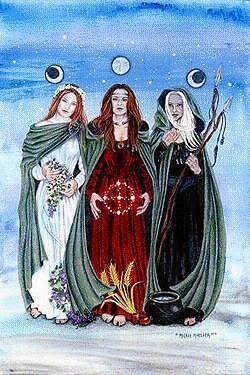
So what is the "old religion?" Although there isn't a genuine folkish name for it that I know of, we can get clues by the spiritual elements which have survived: the Horned God or horned deity, the Triple Goddess or triple deity, the Witches Sabbath, European witchcraft, or witchcraft, the Wheel of the Year, the Mother goddess, or proto-Indo-European religion. Personally, I think that Stregheria from central and southern Italy is probably a good source of clues, as well as in some areas of Wicca, usually Celtic Wicca. I recall watching one woman of Stregheria on a YouTube video, which was actually from an older cable tv program, who was amazed as to the many similarities between Stregheria and Celtic Wicca. Well, these ancient traditions were very widespread. In fact, Stregheria is also known as "La Vecchia Religione"... the old religion. Modern Wicca should have been the reconstructionism of the "old religion," but it simply wasn't. It's a broken thing which cannot be fixed. It's hopelessly mixed with paganism from all over the world, and many have tried to prop it up as some sort of modern political front. If anything, a return to the old religion would be "radical traditionalism," as opposed to some universal aspiration. However, a sizable number of Wiccans could be led into the folkish/traditionalist camp. Who knows, perhaps even a few "Goths" as well.

The most incredible thing about the "old religion" is its historical resilience. It has survived the arrival of all of those polytheist faiths in ancient times; it has survived the literal assault of Christianity and the witch trials in the Early Modern period on both sides of the ocean; and it has survived history itself from our most remote roots. Now, the final hurdle. It must overcome Wiccan-style universalism and modern politics in order to return as a viable, folk-minded, non-political way of life. There is one positive unintended consequence to the promotion of Wicca/eclectic witchcraft by many in high places. They have, despite some unwarranted harm to the old religion's credibility, provided an opportunity by simply smashing the gates. Today, radical folk-traditionalists can also walk through those gates and establish themselves. Look at Hunter Yoder. One man can do a lot, even without help from people in high places. Right now is our chance. All we have to do as native believers is TAKE back our own folk tradition from the pretenders.

They can be overcome, not by antagonism, but simply by outwitting them. The most important step is to not be "anti-Christian." Christian aggression took place a long time ago. In fact, it may perhaps be more pragmatic to take somewhat of a pro-Christian stance. If a jerk does show themselves, use creative arguments. For example, if they make mention of "human sacrifice," which actually took place globally in every locale; then bring up the human sacrifices which were conducted by early Christian sects, and they did take place. However, that is only when confronted with an aggressive person. Personally, I don't even see any reason that a Christian couldn't still believe in a folk tradition from their own remote roots; in the same way that the Greeks or Gaels have done. Everything doesn't have to be a fight. Yes, you can be a Christian and still partake in folk traditions. In fact, you do not have to view this as a "religion" at all.

The most important thing is to establish our own ethics, and not always be influenced by the controversies and contrived drama of others. Something which is a "problem" or "issue" with them, does not have to be an issue at all for us. There are bad people in all religions, including pagan ones. I think I will just end it here, rather than go on about what I believe that we are and aren't. In a nutshell, I think it's pretty safe to say that what we would be aiming for would be something entirely non-political. It might be something which could, in some ways, resemble Asatru. In some ways, Asatru is like standing on top of a mountain under the sun, while the old religion is like standing in a forest clearing under the moonlight. Darker symbolism, but not a dark heart. Asatru is more like masculine spiritual energy; while the old religion is more like feminine spiritual energy. No malevolence. That was propaganda all along, from Christian supremacists and Satanists.


**************************************************

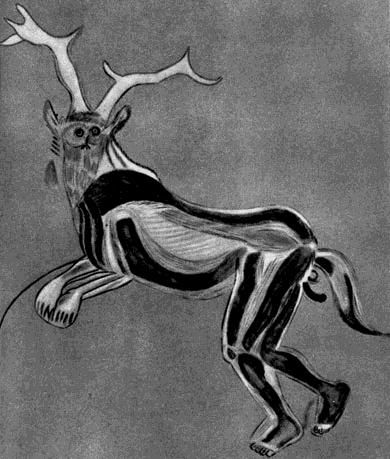
"The Sorcerer" from 13,000 BC
3-31-12 ADDITION: I wanted to add a few more items to this. First, I had put some links to areas which served as clues to this ancient proto-European people and culture. I should have included "the Sorcerer," an antlered-man image found in a cavern called 'The Sanctuary' in France, which may be an early artifact reflecting a Cernic-type god; Cernunnos, which may have been adopted into Gaulish spirituality when the two sub-races came into contact; "Herne the Hunter," an English legend of an antlered-man spirit; and "the Green Man" legend and the "Jack in the green" celebration are a tie-in this this concept, but beyond that it becomes more merged into other spiritual traditions.

What we are looking at is something which goes very deep into the ancient world. Back to Cro-Magon hunter-gatherers who literally defeated another strong species, the Neanderthals, for primacy over Europe. There seems to be a direct link between the horned god legend and the tradition of the Witches Sabbath, over a very long period of time. The "Wiccan concept" should have been something designed to develop over time, rather than allow someone to step in and establish the terms from the get-go.

Although ignored by the American press, there is currently a dig in Bulgaria which hopes to unearth an utterly massive area of what appears to be five pyramids. These structures are so old that they appear as mere mountains at first glance. However, they are being exposed as man-made structures. These are not "mounds" or "carved hills." They could be tens of thousands of years old, and could change everything we know about ancient civilization. This would also tie right into what we are looking at here regarding a proto-European "Alpine race" and their spiritual traditions.

.