Showing posts with label Yooper culture. Show all posts

Sunday, February 22, 2015

The Cudighi sandwich... Lombard-Yooper culture in Upper Michigan: Part 2


Cudighi (Wikipedia):

A Cudighi is a spicy Italian sausage that can be bought in links or can be served as a sandwich on a long, hard roll, often with mozzarella cheese and tomato sauce. Cudighi came from Italy to the Upper Peninsula of Michigan. It can be served many ways in many Italian dishes. The sandwich was originally served with raw onions and mustard on a roll.[1] The sandwich is known as an Italian sausage sub throughout most of the United States. However, it is known as Cudighi in the Upper Peninsula county of Marquette, where it can be found at almost all the local pizza and pasty shops.


The word "Cudighi" is now unknown in Italy, although it seems to be derived from Cotechino, an old Lombard word for a fresh sausage made from pork, fatback, and pork rind.[2] According to Hormel Foods, Cudighi originated in Northern Italy.[3] The recipe for what is known as "Cudighi" is likely highly specific to the Upper Peninsula of Michigan. The taste of Cudighi depends much on the amount of clove and cinnamon present in the mix.


Cudighi sandwich remains staple in the Yooper diet 

Rebecca Himmelstein - UpperMichiganSource.com - October 31, 2014


ISHPEMING -- The cudighi has become a staple in the Yooper diet. The construction is simple. Homemade Italian sausage is flattened into a patty and grilled. It is commonly served with melted mozzarella cheese and pizza sauce, but every restaurant has their unique version.

“The basic cudighi has marinara sauce and cheese on French bread and then we have the works, which has mushrooms, green peppers, onions, marinara sauce and the cheese” said Robert Caron, co-owner of Vangos restaurant in Marquette. “Then you have to have that with some waffle fries.”

Vangos has been serving cudighi for 50 years.

“We grind the meat fresh daily and make each batch every day, so it is as fresh as can be and we use the best possible ingredients to make the best cudighi sandwich” said Caron.”

Ralph’s Italian Deli in Ishpeming has sold their secret family recipe since the 1960s.

“The more popular ways are with pizza sauce, mozzarella cheese and onions” said Dominic Gervasi, co-owner of Ralph’s Italian Deli. “A lot of people like ketchup, mustard, onions and mozzarella cheese combination. Also we serve fresh, homemade buns. We make the bread every day. The bun is very important, that has always been 50-percent of it.”

Italian immigrants started making them in Ishpeming and the sandwich’s popularity grew from there across the Upper Peninsula.

“It is a tradition” said Caron. “It is something that you grow up with. It is just a great sandwich and just a little taste of home.”

“The biggest evolvement I have seen is just the number of people and businesses that have gotten into making them and selling them, because it is just like pizza, almost any restaurant makes a pizza now anywhere you go” said Gervasi.

Both restaurants agree that what makes their cudighi sandwiches so good is fresh, high quality ingredients and consistency.

“It is always the same” said Caron. “It is always the same, just a great sandwich.”


.

Saturday, February 21, 2015

The Cudighi sandwich... Lombard-Yooper culture in Upper Michigan: Part 1


The Cudighi Sandwich

From the TV6 & FOX UP YouTube channel

http://www.uppermichiganssource.com/


The Lombard "Cudighi sandwich" ("COO-dih-gee") is to Upper Michigan, what I suppose the Sicilian "Muffuletta sandwich" is to southern Louisiana. In the Lombard language, "cudighi" means "cotechino" in Italian. Cudighi is also known as "Yooper sausage," and I like the idea of it as both "Lombard-American" and also just as "Yooper culture" in general. In the Val Camonica, cudighi is usually spelled as either codèghiì or cudighì in the Camuian dialect. The town of Ishpeming, in the video below, is nearby the city of Marquette in Upper Michigan.


Cotechino (Wikipedia):

The cotechino is an Italian charcuterie product, similar to salami, but requiring cooking; usually it is boiled at low heat for about four hours. Its name comes from cotica (rind), but it may take different names in the different production areas. According to tradition, it is served with lentils on New Year's Eve, because lentils—due to their shape—are 'credited' to bring money for the coming year.

It is prepared by filling the natural casing with rind, pork meat (usually of secondary choice), and fat mixed with salt and spices; in industrial production, nitrites and nitrates are added as preservatives.


Varieties of cotechino

The cotechino Modena is an Indicazione Geografica Protetta-IGP product, meaning its recipe and production are preserved under the Italian law.


Four Italian regions have so far declared cotechino a traditional food:

Lombardy: cotechino (Cremona, Bergamo, Mantua, Pavia)

Molise: cotechino

Trentino: pork cotechino

Veneto: recognises seven different products: coeghin nostran of Padua; coessin co la lengua of Vicenza, coessin of Vicenza, coessin of Val Leogra, coessin in onto of Vicenza, coessin co lo sgrugno, cotechino di puledro

Irpinia: cotechino pezzente


Cudighi tradition continues in Ishpeming
 

From the ABC 10 UP YouTube channel
 

While the origins of the cudighi can be traced back to Northern Italy, the sandwich itself has taken on a life of its own in Marquette County.

.

Saturday, May 10, 2014

Paul J. Baroni Company of Calumet, Michigan

Calumet, Michigan


Calumet, Michigan is a village in the northwest part of Upper Michigan, which has a very long history of people generally of Lombardo-Venetian descent. The Paul J. Baroni Company has long been a distributor of Italian food products. The old Italian-American Federation of the Upper Peninsula was based in Calumet I believe. We can look into the history of that an another time.


A tradition on the move

Calumet’s Baroni Company to be taken over by Vollwerth’s of Hancock


KURT HAUGLIE - Mining Gazette.com - 8-22-08

CALUMET - Having a business owned by the same family for 73 years is quite a tradition, but some traditions have to come to an end. Although the products of the Paul J. Baroni Company will still be made, the company will no longer be owned by the Baroni family.

Nancy Baroni, who has been running the company, which makes sauces, various pastas and frozen pizzas, for two-and-a-half years, said although family members hadn't been giving serious thought to getting out of the business, when the opportunity came up last November they took it.

"It just kind of came up in conversation," she said.

That conversation was with Jim Schaaf, general manager of Vollwerth & Company of Hancock, Baroni said.

Because she's the only family member involved with production of their products, and because the next generation of Baronis have other career interests, Baroni said it seemed like the proper moment to think about moving on.

"The time was right," she said.

Currently, Baroni said besides herself there are one full-time and one part-time employee making the Baroni products. She does much of the local delivery of the products herself.

Baroni said Vollwerth's distributes its products, as well as Baroni products, to most of the Upper Peninsula and to parts of Northern Wisconsin, which is one of the factors that helped the family make the decision about selling to the sausage manufacturer.

"They're just a competent, long-standing company," she said.

Baroni said after Vollwerth's takes over production at their plant at the beginning of 2009, she'll be around for a time as production manager.

"I'm going to stay on as long as they need me," she said. "We have to keep the Baroni name going."

To assure that, Baroni said company containers and labels will continue to be used after the switch to Vollwerth's, as will the company product recipes.

"Nothing's really going to change," she said. "Your still going to have the same great products."

The full-time employee, Jared Liimatta, will continue making Baroni products when the production is moved to the Vollwerth Hancock plant.

Schaaf said after Baroni suggested Vollwerth & Company take over Baroni's it was decided that was a good idea because of the Baroni tradition.

"They've been a business for a long time," he said.

Vollwerth is a family-owned business, also, Schaaf said, and because Baroni's makes quality products, Vollwerth officials are interested in keeping the line going.

"They have a lot of loyal customers," he said. "We're not going to make any changes."

Production of the Baroni items will continue in Calumet until the kitchen at the Vollwerth Hancock Street plant can be expanded to accommodate the Baroni canning equipment, Schaaf said. A new storage facility will be constructed behind the plant.

On Sept. 1, Vollwerth will take over production at the Baroni plant on Sixth Street in Calumet, Schaaf said.

Schaaf said after the take over of Baroni, Vollwerth's will still make most of their products, including the sauces, ravioli, chili and frozen lasagna and ravioli entrees. The company doesn't have the floor space to continue the Baroni frozen pizzas now, but they may add them in the future.

Schaaf said it was decided not to purchase the Baroni manufacturing plant and continue production there.

"It was most practical to have it in one building," he said.

Baroni said the Baroni building will either be sold or rented out.

It is sad the tradition of Baroni family ownership of the company is coming to an end, but Baroni said it's time.

"It's going to be hard," she said. "I think it's a good move."

Kurt Hauglie can be reached at khauglie@mininggazette.com


.

Monday, May 5, 2014

Dümènica potpourri: Part 2

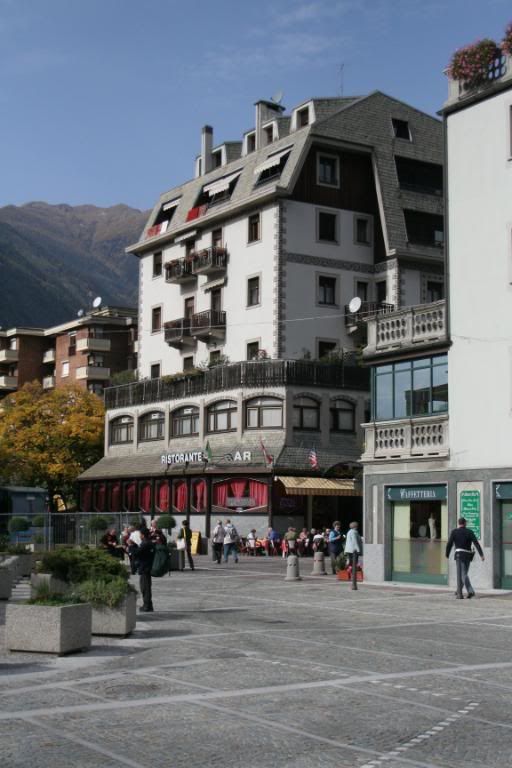
Tirano in Valtellina with distinctive south Alpine architecture
I like to occasionally use Google Maps.. more than Google Earth. Google Earth has too many whistles and bells for me. Awhile back, I was “getting on the ground” with Google Maps at the Brescian Comune of Paisco Loveno in Val Camonica. Actually, it is located in a smaller side valley called the Paisco Valley. Although I had done this numerous times before, I decided to follow the road heading east, passing this group of villages which are up on the hillside to the right. Much to my surprise, I found the road immediately heading into heavy woods, with a river (a tributary to the River Oi to the west) on the lower left side and a mountain on the right side. Above the river on the left was what appeared to be a larger mountain. This “Google drive” reminded me of many areas through the mountains of northern California, and was very rugged and beautiful. After about five or six miles of winding though mountain passes, the narrow valley road opened up and I could see the stunningly beautiful little town of Schilpario in Bergamo. The town was so beautiful, as was the stunning 360 degree view of all the mountains.

I tried the same thing with the small city of Tirano, which is north of Val Camonica on the eastern end of the Valtellina. In some ways it looked like many towns in California, maybe Sonoma County. It was in a wide valley, sunny, open, I could see a girl riding her bike. The mountains were more in the distance. I then tried a road just south of the city, through villages, and it was beautiful, woods and heavy brush, but not as steep as Val Paisco. The houses were wonderful, all with thick exterior wooden shutters. I almost don’t want to use the over-the-top adjective phrase “everything was perfect”… except that everything was perfect! The Alps of eastern Lombardy… Heaven on Earth.

There have been many cable tv programs about legends of “monsters” (‘Monster Quest’, ‘Monsters and Mysteries in America’, etc.). I think anyone who has done any hiking can tell a few stories, myself included, of hearing some strange sounds from the wood and brush. I have heard some strange ominous low growls on occasion. I don’t think they were “monsters,” but it had to be something. The only thing I could compare it to is a wild pig, but not quite as squealy-sounding.

At the base of Mount Fuji in Japan is an infamous area known as Aokigahara, or “Suicide Forest.” This area is the scene of many suicides, year after year. Due to certain factors, there is little wind, it’s unusually quiet, and there seems to be no wildlife there. In Japanese mythology, the forest is associated with demons. There is a lot online about this, including one popular documentary on YouTube called Suicide Forest in Japan. It’s very eery.


I have covered Upper Michigan on this blog, partly because there is a sizable number of people of Lombardian descent there, and because my family is from there. "Yoopers" usually see themselves as a separate state, or identify more with Wisconsin. There is a regional culture, including a distinct dialect, music, and cuisine. It's really not unlike, for example, Cajun culture; except it's Northwoods instead of Swamps. I know, not every Cajun lives in the swamps; and not every Yooper lives in the woods. On a separate note, the Northwoods is filled with folklore, and that's another item that I want to learn more about, as there are numerous books on the subject. It's more than just old stories, as many people claim to have experienced things there. Getting back to Yooper culture, the following is from Wikipedia regarding "Yooper cuisine."

The Upper Peninsula has a distinctive local cuisine. The pasty (pronounced "pass-tee"), a kind of meat turnover originally brought to the region by Cornish miners, is popular among locals and tourists alike. Pasty varieties include chicken, venison, pork, hamburger, and pizza. Many restaurants serve potato sausage and cudighi, a spicy Italian meat. Finnish immigrants contributed nisu, a cardamom-flavored sweet bread; pannukakku, a variant on the pancake with a custard flavor; viili (sometimes spelled "fellia"), a stretchy, fermented Finnish milk; and korppu, hard slices of toasted cinnamon bread, traditionally dipped in coffee. Some Finnish foods such as juustoa (squeaky cheese, essentially a cheese curd, like Leipäjuusto) and sauna makkara (a ring-bologna sausage) have become so ubiquitous in Upper Peninsula cuisine that they are now commonly found in most grocery stores and supermarkets. Maple syrup is a highly prized local delicacy. Fresh Great Lakes fish, such as the lake trout, whitefish, and (in the spring) smelt are widely eaten. There is minimal concern about contamination of fish from Lake Superior waters. Smoked fish is also popular. Thimbleberry jam and chokecherry jelly is a treat.

Lake Michigan
The following is the opening text from an article entitled 'Lake Michigan Triangle: Paranormal activity on the Great Lakes'..... "Besides the Bermuda Triangle, few areas in the world have a reputation for the bizarre like the Lake Michigan Triangle. Although it is relatively unknown on a global scale, especially compared to Bermuda, it has as storied a history of the unexplained as any place on earth." There is a lot online about this, including many video documentaries. One is from the 70's mystery program 'In Search Of', which was a forerunner of so many programs today. In Search of the Great Lakes Triangle - Part 1 (part 2 and 3 will show up on the right). 'In Search of' was great, and it still stands up just as well today.

I haven't been to the Alamo Drafthouse Cinema yet, but it sounds like an interesting idea. I'm actually not a big movie fan, but there are new and old movies shown there, and it sounds like a very comfortable place to visit. They're springing up all over. I first saw the ads on the Independent Film Channel. On one hand I don't like the idea that every movie theater needs to be some large "megaplex," but on the other hand, some of them are quite comfortable. In other words, you may get there a bit early and have some coffee, sit in a comfortable couch-chair, etc.

To go way off topic for a moment, the example of the 'In Search of' program being an inspiration for so much of what we see on cable tv today reminded me of another old program. Probably few remember a late-night variety program called 'Thicke of the Night' from the 80s. That program, as much as a highly-touted flop as it ended up being, actually is very much like so many comedy/variety programs on cable tv today. It was so different. Alan Thicke was the host, and Arsenio Hall the co-host. I'm not even that crazy about those two, but they were really funny on that show in my opinion. Thicke would often ask strange questions to put the guest on the spot, and Hall would often even harass guests from the other side. Most guests seemed to enjoy it, while one (Wally George) stormed off the set. The times that the late Frank Zappa was a guest, in particular, provided for some strange and funny dialog. There were a lot of strange, cheesy skits; and dry sexual innuendos without overdoing it. Some of the old footage is on YouTube... and yes... a few people even have some fond memories of the show. As to whether anyone could say that it was a forerunner of those similar programs today, I don't know. I think it was part of that evolution.

.