Showing posts with label Brescian tri-valley. Show all posts

Sunday, April 11, 2021

Incontri Tra/Montani - 30 Years

Incontri Tra/Montani means "Meetings Between/Mountains," and to the best of my knowledge was formed to provide a political voice to communities in the eastern Alps of Lombardy, Trentino, and also to other Alpine communities who are often overlooked. I think it's comparable to rural Upper Michigan building an "embassy" near the capitol in Lansing to provide a voice for the detached region. ITM turned 30 last year. I believe that province of Sondrio, the Brescian Tri-Valley, and the Bergamo Alps encompasses a strong cultural milieu as well. Naturally we would like to express solidarity with them.


************


http://www.incontritramontani.it/

https://www.facebook.com/Incontritramontani/

https://twitter.com/itm1990

https://incontritramontani.academia.edu/incontritramontani


************


INCONTRI TRAMONTANI - (PIEVE DI BONO-PREZZO)

gianni beordo

Trentesima edizione: Incontri Tramontani


************


Museo Scuola Rango
"Bello!"


************
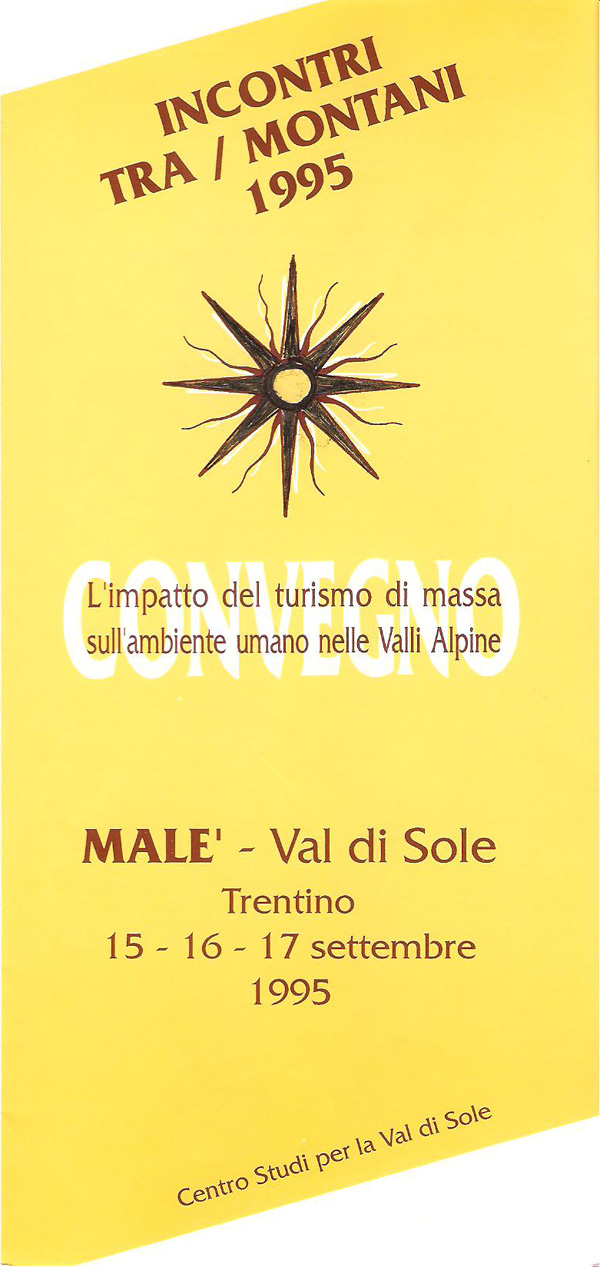
 

A brief history

Incontri Tra/Montani was born in 1990 from a chance meeting between cultural associations of Valle Camonica and Val Trompia. From the observation of a lack of communication between the valleys and from the reading of the great difficulties in which the mountain communities finds itself (exodus, destructive interventions, youth unemployment, etc.), the idea arose of an annual conference that would begin to create a network of non-institutional relations between groups operating in the Italian, Swiss, Austrian, and French Alps with the aim of promoting mutual knowledge, collaboration, exchange of analysis and possible proposals.

In the term Tra/Montani there is a double meaning: 1) The need for dialogue and the consciousness of the sunset of a civilization that was at the center of the pre-industrial economy since all medieval "machines" needed the energy produced by the fall of water.

The study and reflection meetings on issues of common interest in Alpine resorts have been organized regularly since 1990 and touch on topics of various kinds and locations that are always different.

The ITM to which the Valle Camonica, the Giudicarie Valleys, the Val di Sole, Valtellina, Val Seriana, Val Cavallina, Carnia, and Val Verzasca adhere to permanently, has no official seat, nor a statute. It is a self-managed, spontaneous, and free thinking.

Membership of the ITM Group is open to all associations, study centres and cultural groups in the Alps.

'History of the ITM' by Giancarlo Maculotti (pdf file)


The following all collaborated in the realization of the ITM:

• Associazione Comitato Organizzatore Festa di Trate - Gaverina Terme (Bergamo)
• Associazione IVS Inventario delle Vie di Comunicazione Storiche (Milano)
• Centro Studi e Ricerche Archivio Bergamasco (Bergamo)
• Centro Studi Etnografici Val Imagna S. Omobono Imagna (Bergamo)
• Centro Studi Judicaria – Tione (Trento)
• Centro Studi Val di Sole – Malè (Trento)
• Centro Studi Valchiavennaschi Chiavenna (Sondrio)
• Circolo Culturale Baradello Clusone (Bergamo)
• Circolo Culturale Ghislandi Cividate Camuno (Brescia)
• Comune di Montereale Valcellina Montereale Valcellina (Pordenone)
• Cooperativa Arca Gardone Val Trompia (Brescia)
• Cooperativa Il Chiese - Storo (Trento)
• Fondazione Progetto Poschiavo Poschiavo (Svizzera)
• Fondazione Val Verzasca Canton Ticino (Svizzera)
• L’Arcilettore, Circolo di Sondrio (Sondrio)
• Museo Etnografico S. Caterina Valfurva (Sondrio)
• Museo Etnografico Tiranese - Tirano (Sondrio)
• Pro Vita Alpina - Längenfeld (Austria)

.

Saturday, March 7, 2020

The "Trident" story - what does the Beretta logo mean?


'The "Trident" story - what does the Beretta logo mean?'

Matteo Recanatini - Beretta Blog - October 12, 2011

One day, we were sitting around the large desk of one of our conference rooms, discussing over and unders and the staggering heritage that links these guns to the five centuries of Beretta history.

At one point, Angela pointed out that most people recognize the Beretta logo: the iconic three arrows and circles often referred to as "Trident," but that most people don't really know why and how Beretta's logo came to be.

On our Facebook and Twitter accounts, we have mentioned it, in the past, and have answered questions about just this, but I thought it wise to publish a quick post about our most recognizable graphic.

Like all respectable 500-year old companies, Beretta has had its share of logos: the shield with the letters "PB" (for Pietro Beretta, the father of the industrialized Beretta,) the duck with open wings, and the more simple "Fabbrica d'Armi Pietro Beretta" are some of the representations that many of our readers will recognize.

And then, there's the "Trident," which (truth be told) is not a trident at all.

The story of this logo starts not far from Gardone Val Trompia, in the small town of Cargnacco, where poet, writer, director, mariner and journalist Gabriele d'Annunzio ended his days, in the late 1930s.

When you walk into the villa that Gabriele d'Annunzio purchased and where he retired, you will find the very first "Trident." It was he who, ever-the-artist, developed this graphic design to symbolize the will to get things done. The encircled arrows represent the three shots fired by a battleship that engages a potential enemy: the arrow on the left reprents the first warning shot, fired at the ship's stern; the arrow on the right represents the second warning shot, fired at the ship's bow. The central arrow is the last round fired, when the ship doesn't yield: this one is aimed at the ship itself. The logo was dubbed "Dare In Brocca" or "hit the target."

Mr. Beretta was fascinated with this symbol, and asked Gabriele d'Annunzio if he could "borrow it." Gabriele d'Annunzio gave Mr. Beretta the rights to use it as the company's symbol, and from that moment, the "Trident" became the company's logo.

So, now you know it. Next time you're wearing a hat like this one, or carry your Beretta firearm to the range or on the field, make sure you share this story with your fellow shooters!


************


'Beretta’s “Trident” logo explained'


************


BerettaUSA.com
 
.

Thursday, February 12, 2015

Beretta Factory Tour


Beretta Factory Tour - An Insider's Look At How Beretta Firearms Are Made In Italy

The Official GunForSale.com Channel


http://GunsForSale.com presents a video tour of the Beretta factory in Gardone, Val Trompia, Italy.

Beretta has a rich history - the company has been in business for almost 500 years. It's also one of the most technologically advanced firearms manufacturers in the world. This video explains how the company has become what it is today.

Click here to learn more about Beretta: http://gunsforsale.com/manufacturer/beretta-firearms


.

Tuesday, July 29, 2014

Annual "Carnival of Bagolino" in Val Sabbia - Part 2


Il Carnevale di Bagolino 

Translated from the video description:

The Carnival of Bagolino is a rare and precious survival of local folklore. The carnival has existed in this village from 1500 due to the isolated location and the passion of its people who handed it down from generation to generation. It gained growing notoriety, attracting the attention of scholars of ethnology. The Festival is divided into two distinct events, animated by elegant figures of Balarì (dancers and musicians) and the grotesque figures of Maschér (masks). 

This video is a documentary, and it shows more of the beauty of the village location in the Sabbia Valley. There are numerous other videos of the carnival. The festival seems to be a blend of both folk pagan and Christian elements. It seems appears to be disciplined as far as the symbolism it seeks to convey; as opposed to more urban festivals where people go out of their way to be bizarre... and perhaps miss the point. Part of the origin goes back to ancient fertility rites, and with this carnival occurring at the at the end of Winter.

.

Monday, July 28, 2014

Annual "Carnival of Bagolino" in Val Sabbia - Part 1


The dancers and masks of the traditional Carnival of Bagolino

By Claudia Moreschi - http://www.italianstorytellers.com/ - July 2, 2014

Dancers, masks and weird traditions. This is Bagolino Carnival!


Bagolino is a small village in Sabbia Valley, in the province of Brescia, on the border with Trentino Alto Adige. It is in the dairy production area of the local “Bagòss” cheese and is famous for its peculiar Carnival celebrations that date back to the XVI century, as documented by the writings preserved in the municipal archive.

Because of the isolated position of the village, the Carnival of Bagolino (also called ‘Bagosso‘ carnival) has preserved its historic characteristics during the years. Due to its particular folklore it has become increasingly renown drawing also the attention of scholar ethnologists. The Carnival of Bagolino has been ranked among the most important ethnological discoveries of the past 200 years.

The celebrations of the Bagolino Carnival are made up of 2 different performances, led by:


* the ‘Balarì‘, elegant dressed dancers and players

* the grotesque ‘Maschér‘ (masks).

The musical origins of the ‘Bagosso Carnival’ are yet to be discovered. Probably its music reportory roots in Continental Europe: according to scholars, it inherited the practice of instrumental musicians from Austrian Tyrol.

The movements of the dancers mime the ancient court dances, revisited and voiced in their own way by the Bagolino inhabitants.


The Balarì

‘Balarì‘, the dancers, perform only on the Monday and Tuesday of Carnival along the streets and in the squares of Bagolino. Their show is the most spectacular of all the Bagolino Carnival because of their peculiar music and refined dance. A unique event in Italy with only few equivalents in Europe. It provides a striking example of the level of complexity which a folk musical culture can reach.

Violin is the main instrument that gives the leading melody of the various songs that make up the large music repertory that accompanies the dances.

The dancers’ costumes are very characteristic. They wear a felt hat entirely covered by a long red ribbon cleverly folded, adorned with embroidery, jewelry and multicolored ribbons that make up a large bow. On the red band there are family (or borrowed) gold jewels (chains, brooches, earrings, rings etc.). That’s why they don’t peform their dance outdoors in case it rains : there is the risk of losing the gold!

The dancers’ face is hidden by an ivory mask and they wear a dark suit with jacket and pants to the knees, dark tie, white shirt, white gloves, white decorated socks and black shoes. On their shoulders they wear a large shawl with fringes falling down on their back and a wide silk stripe over their left shoulder with flower embroidery or lace inserts.


The Maschér

The tradition of the ‘Maschér‘ – the masks – has a more popular origin referring to the Carnival jokes. Identity is kept unknown.

The masks disordely move among the crowd wearing grotesque or frightening masks and wooden clogs that makes noise on the street pavement. They mock people by touching their genitals, an old habit reminiscent of ancient fertility rituals. Tradition has it that in ancient times the jokes had as polemical target the Counts of Lodrons, often hated by the Bagolino inhabitants.

The masks wear ancient traditional dresses; they usually move in pairs dressed disguised as old woman (‘vecia‘) and old man (‘vecio‘). In addition they move with an awkward posture, stomping and with a falsetto voice.

The maschér ritual is infused with symbolism and many gestures related to a courtship ritual.

The Carnival of Bagolino takes place every year on Sunday, Monday and Mardi Gras. This year will be on March from the 2nd to the 4th 2014.

Participation is free and recommended to anyone who doesn’t want to miss such an extraordinary and unique Carnival!


.