
Showing posts with label masks. Show all posts
Showing posts with label masks. Show all posts
Tuesday, July 29, 2014
Annual "Carnival of Bagolino" in Val Sabbia - Part 2
Il Carnevale di Bagolino
Translated from the video description:
The Carnival of Bagolino is a rare and precious survival of local folklore. The carnival has existed in this village from 1500 due to the isolated location and the passion of its people who handed it down from generation to generation. It gained growing notoriety, attracting the attention of scholars of ethnology. The Festival is divided into two distinct events, animated by elegant figures of Balarì (dancers and musicians) and the grotesque figures of Maschér (masks).
This video is a documentary, and it shows more of the beauty of the village location in the Sabbia Valley. There are numerous other videos of the carnival. The festival seems to be a blend of both folk pagan and Christian elements. It seems appears to be disciplined as far as the symbolism it seeks to convey; as opposed to more urban festivals where people go out of their way to be bizarre... and perhaps miss the point. Part of the origin goes back to ancient fertility rites, and with this carnival occurring at the at the end of Winter.
.


Monday, July 28, 2014
Annual "Carnival of Bagolino" in Val Sabbia - Part 1
The dancers and masks of the traditional Carnival of Bagolino
By Claudia Moreschi - http://www.italianstorytellers.com/ - July 2, 2014
Dancers, masks and weird traditions. This is Bagolino Carnival!
Bagolino is a small village in Sabbia Valley, in the province of Brescia, on the border with Trentino Alto Adige. It is in the dairy production area of the local “Bagòss” cheese and is famous for its peculiar Carnival celebrations that date back to the XVI century, as documented by the writings preserved in the municipal archive.
Because of the isolated position of the village, the Carnival of Bagolino (also called ‘Bagosso‘ carnival) has preserved its historic characteristics during the years. Due to its particular folklore it has become increasingly renown drawing also the attention of scholar ethnologists. The Carnival of Bagolino has been ranked among the most important ethnological discoveries of the past 200 years.
The celebrations of the Bagolino Carnival are made up of 2 different performances, led by:
* the ‘Balarì‘, elegant dressed dancers and players
* the grotesque ‘Maschér‘ (masks).
The musical origins of the ‘Bagosso Carnival’ are yet to be discovered. Probably its music reportory roots in Continental Europe: according to scholars, it inherited the practice of instrumental musicians from Austrian Tyrol.
The movements of the dancers mime the ancient court dances, revisited and voiced in their own way by the Bagolino inhabitants.
 The Balarì
‘Balarì‘, the dancers, perform only on the Monday and Tuesday of Carnival along the streets and in the squares of Bagolino. Their show is the most spectacular of all the Bagolino Carnival because of their peculiar music and refined dance. A unique event in Italy with only few equivalents in Europe. It provides a striking example of the level of complexity which a folk musical culture can reach.
Violin is the main instrument that gives the leading melody of the various songs that make up the large music repertory that accompanies the dances.
The dancers’ costumes are very characteristic. They wear a felt hat entirely covered by a long red ribbon cleverly folded, adorned with embroidery, jewelry and multicolored ribbons that make up a large bow. On the red band there are family (or borrowed) gold jewels (chains, brooches, earrings, rings etc.). That’s why they don’t peform their dance outdoors in case it rains : there is the risk of losing the gold!
The dancers’ face is hidden by an ivory mask and they wear a dark suit with jacket and pants to the knees, dark tie, white shirt, white gloves, white decorated socks and black shoes. On their shoulders they wear a large shawl with fringes falling down on their back and a wide silk stripe over their left shoulder with flower embroidery or lace inserts.
The Maschér
The tradition of the ‘Maschér‘ – the masks – has a more popular origin referring to the Carnival jokes. Identity is kept unknown.
The masks disordely move among the crowd wearing grotesque or frightening masks and wooden clogs that makes noise on the street pavement. They mock people by touching their genitals, an old habit reminiscent of ancient fertility rituals. Tradition has it that in ancient times the jokes had as polemical target the Counts of Lodrons, often hated by the Bagolino inhabitants.
The masks wear ancient traditional dresses; they usually move in pairs dressed disguised as old woman (‘vecia‘) and old man (‘vecio‘). In addition they move with an awkward posture, stomping and with a falsetto voice.
The maschér ritual is infused with symbolism and many gestures related to a courtship ritual.
The Carnival of Bagolino takes place every year on Sunday, Monday and Mardi Gras. This year will be on March from the 2nd to the 4th 2014.
Participation is free and recommended to anyone who doesn’t want to miss such an extraordinary and unique Carnival!
.
Tuesday, July 30, 2013
Random thoughts and spirits

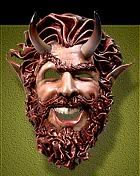
Recently, I went to a Mexican restaurant in San Rafael for lunch. All along the walls were rustic face masks. I didn't get the impression that they were of Mexican origin. They reminded me of old rural European folk art. They were like a rustic type of art. Something that you might see on a fence in the countryside. In other words, a crude type of outdoor country art. Even if they were Mexican, they would have been from a European face mask tradition.
I suspect that the owner purchased them somewhere, feeling that they would liven up the place. They sure did. You can't help but notice them. I recall some were like the image of "Pan," with horns, or maybe like a stereotypical old "country woman" face. I think some were of animals. With Mexican art like that, that I have seen, the faces look "Mexican or Mayan." These seemed much more old rural European. Something that could have been observed in the semi-pagan European countryside--perhaps on a fence or barn--maybe 700 years ago.
There really is something to be said of the crudely beautiful country art. Not trashy, but rustic! Rustic is like an old barn, while trashy is like "junk all over." Rustic is like nature. I think of Brescian history. The southern urban Brescians were fine artisans; while the people of the northern Alpine "Tre Valli Bresciane" (Camunians, Sabines, Trumpilinians) were more in tune with country folk art. Venetian masks are different, as they are more of a fine craft.
**************************************************
Rabbit's feet?
I remember as a young boy, that I had a red rabbit's foot. I may have gotten it in some gift shop in Wyoming. I was one of my prized possessions, as I kept it in that special box with those types of items. Somehow I lost it over the years. A rabbit's foot is an old pagan symbol for good luck. I was thinking recently, are rabbit's feet somehow immoral? A rabbit isn't an animal that humans regard as special, like dogs, horses, or cats. We still hunt and eat them.
I like rabbits, but I don't really see them as ideal pets. They belong in the foothills and brush, so they can kick their hind legs and take off. They're ill suited for a small cage, like small pet rodents. But is there something wrong with a rabbit's foot? People have deer or other horns, which they may well have found while hiking. Unlike a horn, "fur" isn't something that one would really retrieve from an animal at the end of it's life. A rabbit's foot is sort've in-between a horn and fur.
I say it's not immoral. The question of animal furs or reptile skins will go on, but rabbits are not in any way rare. It's just too "sensitive" of us to be so perturbed by a rabbit's foot. It's not like rabbit's feet are some big industry. It's another small part of our past and history that lingers on.
**************************************************
 Daily synchronicity
One evening several weeks ago, I ran across a book in pdf form entitled 'Miners, merchants, and midwives: Michigan's Upper Peninsula Italians' (Magnaghi; 1987). The Upper Michigan Italians were almost all from the north, and have a history even going back to the 1860s. The book is out-of-print, and used copies are very expensive. My family migrated to the Montreal River area with other immigrants from Lombardy. Reading a bit about that history was very fascinating to me. Although solidly Catholic, some women of the community gained a reputation as practitioners of folk medicine, brought with them from rural Alpine villages. A leftover from the "La Vecchia Religione" of the ancients.
The very next morning, I was driving and thinking about a part of the book where it talked about Upper Michigan immigrants who came from around the Valtellina north of Val Camonica, Trento, and the Südtirol. Just as I'm about to park, still engrossed in this particular section of the book that I had read the night before, I look at the bumper of the car directly in front of me.... and I see an old sticker with a red eagle, which read "Tyrol!" That particular coat-of-arms was of the German Tirol, but I would lean towards a synchronistic connection for me there.
**************************************************
An animal message?
Animals are a way for the goddesses and gods to communicate with us, as has been covered here before. A couple of weeks ago I was sitting on a deck overlooking a vast hillside, having a beer. The occasion was the finalization of a long-range plan for a business. As I was sitting there, a small bird landed right on the railing. I can state conclusively that it was within two feet from me! It chirped, and remained there for about ten seconds before flying off.
.
Subscribe to:
Posts (Atom)