Showing posts with label Sondrio. Show all posts

Sunday, April 11, 2021

Incontri Tra/Montani - 30 Years

Incontri Tra/Montani means "Meetings Between/Mountains," and to the best of my knowledge was formed to provide a political voice to communities in the eastern Alps of Lombardy, Trentino, and also to other Alpine communities who are often overlooked. I think it's comparable to rural Upper Michigan building an "embassy" near the capitol in Lansing to provide a voice for the detached region. ITM turned 30 last year. I believe that province of Sondrio, the Brescian Tri-Valley, and the Bergamo Alps encompasses a strong cultural milieu as well. Naturally we would like to express solidarity with them.


************


http://www.incontritramontani.it/

https://www.facebook.com/Incontritramontani/

https://twitter.com/itm1990

https://incontritramontani.academia.edu/incontritramontani


************


INCONTRI TRAMONTANI - (PIEVE DI BONO-PREZZO)

gianni beordo

Trentesima edizione: Incontri Tramontani


************


Museo Scuola Rango
"Bello!"


************
 

A brief history

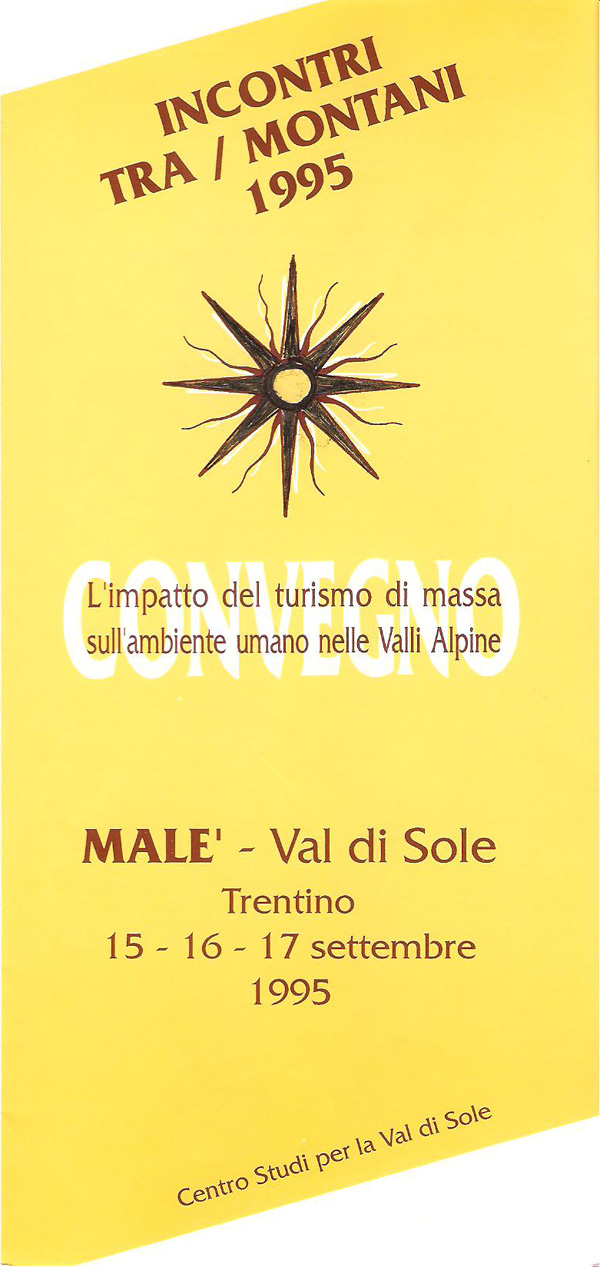
Incontri Tra/Montani was born in 1990 from a chance meeting between cultural associations of Valle Camonica and Val Trompia. From the observation of a lack of communication between the valleys and from the reading of the great difficulties in which the mountain communities finds itself (exodus, destructive interventions, youth unemployment, etc.), the idea arose of an annual conference that would begin to create a network of non-institutional relations between groups operating in the Italian, Swiss, Austrian, and French Alps with the aim of promoting mutual knowledge, collaboration, exchange of analysis and possible proposals.

In the term Tra/Montani there is a double meaning: 1) The need for dialogue and the consciousness of the sunset of a civilization that was at the center of the pre-industrial economy since all medieval "machines" needed the energy produced by the fall of water.

The study and reflection meetings on issues of common interest in Alpine resorts have been organized regularly since 1990 and touch on topics of various kinds and locations that are always different.

The ITM to which the Valle Camonica, the Giudicarie Valleys, the Val di Sole, Valtellina, Val Seriana, Val Cavallina, Carnia, and Val Verzasca adhere to permanently, has no official seat, nor a statute. It is a self-managed, spontaneous, and free thinking.

Membership of the ITM Group is open to all associations, study centres and cultural groups in the Alps.

'History of the ITM' by Giancarlo Maculotti (pdf file)


The following all collaborated in the realization of the ITM:

• Associazione Comitato Organizzatore Festa di Trate - Gaverina Terme (Bergamo)
• Associazione IVS Inventario delle Vie di Comunicazione Storiche (Milano)
• Centro Studi e Ricerche Archivio Bergamasco (Bergamo)
• Centro Studi Etnografici Val Imagna S. Omobono Imagna (Bergamo)
• Centro Studi Judicaria – Tione (Trento)
• Centro Studi Val di Sole – Malè (Trento)
• Centro Studi Valchiavennaschi Chiavenna (Sondrio)
• Circolo Culturale Baradello Clusone (Bergamo)
• Circolo Culturale Ghislandi Cividate Camuno (Brescia)
• Comune di Montereale Valcellina Montereale Valcellina (Pordenone)
• Cooperativa Arca Gardone Val Trompia (Brescia)
• Cooperativa Il Chiese - Storo (Trento)
• Fondazione Progetto Poschiavo Poschiavo (Svizzera)
• Fondazione Val Verzasca Canton Ticino (Svizzera)
• L’Arcilettore, Circolo di Sondrio (Sondrio)
• Museo Etnografico S. Caterina Valfurva (Sondrio)
• Museo Etnografico Tiranese - Tirano (Sondrio)
• Pro Vita Alpina - Längenfeld (Austria)

.

Monday, March 17, 2014

"Camuno-Valtellina" - A new province?


Camonica and Valtellina

Below is an article, which I translated from the 'Bresciaoggi' provincial news source, which details an idea for the possibility of a new Camunian-Valtellinese province. The two cultures are nearly identical. The only difference being the difference in the native dialects. Historically-speaking, Val Camonica has always been politically pulled in the direction of Brescia and the eastern Lombard dialect; while the Valtellina has been pulled in the political direction from Milan and the western Lombard dialect. A topographical view from Google Earth of east Lombardy clearly shows the dramatic difference between the urban sprawl and farmlands of the Po Valley southern flatlands, and the northern mountain valleys. I had to make a few changes and do what I could to make the Italian text make sense in English. It at least gives some idea of the proposal from 2012.

There has long been talk about a "Val Camonica province," but this idea seems interesting as well. The Camunian Valley is about forty miles long north to south; while the Valtelline valley is about twice that distance east to west. The northern Camunian town of Edolo is very close to the Valtelline town of Aprica, with the two connected by a mountain road (SS39) through an elevated mountain valley of small villages, with the official "border" being a mile or less east of Aprica. Val Camonica has always been somewhat used and controlled by the powers that have been over time; while the Italian administrative state wouldn't even give the Valtellina the respect of it's proper name. Instead, it chose one of the main towns of the valley as a political center and carelessly named the entire province after it.


Camunian-Valtellina province, the idea is launched

Lino Febbrari - Bresciaoggi.com - February 14, 2012

THE PROPOSAL. In the two valleys of the initiative, the idea is promoted by cultural associations and political leaders to create an interim authority. Giancarlo Maculotti, Mayor of Cerveno: "For the Mountain territories, a future with only municipalities and regions is unthinkable. If Rome decides to abolish the provinces, the Valcamonica and Valtellina revived, with the proposal to create a new reality that can act as intermediary between the municipalities and the region. The consideration is that Lombardy has a territorial size equal to or greater than other European States. It is therefore not likely that we can change, in one fell swoop, the present institutional bodies."


Now two cultural associations, which held a joint "Tramontani Meeting" in the Oglio Valley, have launched the idea of creating an Alpine province: an intermediate body, which responds to a logic of a new geographically and socially homogeneous area. "What the idea proposes is renewed institutional arrangements, taking into account the mountain areas," states Giancarlo Maculotti--Mayor of Cerveno and key figure of the "Tramontani Meeting." Several parties have stated that the current provinces are outdated, and it is unthinkable that in the future a large and diverse territory of Lombardy, there would only be the region and municipalities without a medium.

Maculotti added that a new political body might actually be a new Alpine province, able to gather and meet the needs of populations living in the mountains. After the launching of the proposal, one may immediately wonder if it is only a dream, or whether the project may actually come into being--focusing on the need for an institutional presence on a particular territory like that. "Of course there are steps to be taken for the idea to produce any results, and then into a very precise Bill that could have legs to walk on" says Maculotti.

It will take time and effort. But if the mountain valleys do not decide to claim institutions which are close to its needs, we will always be lost. To lay the foundations for the desired "Camuno-Valtellina province"--on Saturday, February 18, 2012 in Sondrio (Valtellina) at the Palace of Bim in via Lungo Mallero Diaz--a meeting was held entitled "The mountains speak," with politicians of the two valleys. The theme will then be dealt with again on March 10th in Edolo (Val Camonica). Illustrating the project on this occasion will be the sociologist Aldo Bonomi.

.