It's amazing to me--that whenever the subject of alchemy is brought up--even intelligent, educated, and well-read people resort to the tired old "they tried to turn base metal into gold" line. As if they were "failures" who at least "tried." What a joke! Even someone as well-known as Michio Kaku will cite alchemy as "science's humble beginnings." That's proof that he never bothered to even look into it at all. Career scientists are usually terrified of anything they can't explain or do not understand; which has lead to practices such as hiding away fossils and artifacts from the public into storage because they do not fit their theories of human origins (aka "false theories").
Some excellent quotes from the documentary: "Magic is both an art and a science. Certain things cause certain affects to happen. At the same time they have to be done with a certain intention and perhaps a certain flair in order to work." -- James Wasserman, Author, 'The Mystery Traditions' "Science nowadays really is touching against ideas dealing with where magic and spirituality and religion intersect and they're both ways of trying to find out about how the world works." -- Richard Kaczynski, Ph.D, Author 'Perdurabo: The Life of Aleister Crowley'
"The occult means secret or hidden, and its early masters were regarded as true magicians, but they were also the first scientists. Their discoveries in the occult arts of astrology and alchemy gave birth to modern scientific disciplines. Many still view the occult with suspicion, but modern science is often working on the edge of the supernatural. Trying to solve mysteries that confronted the first magicians. Were the early occult masters keepers of secrets that modern science is only beginning to rediscover?" -- John Cullum, Narrator, 'Secrets of the Occult: The Magicians' "You go back to ancient times, there was no science. So the magicians and the alchemists and the proto-mathematicians; they were doing science, but they were also doing literature and philosophy and cosmology and religion, and there was no sorting out of those things. Since the birth of what we would call modern science, science and the occult have sort of separated paths. Serious physicists are contemplating time travel. Serious physicists are contemplating parallel universes. Serious physicists are trying to understand the eleven dimensions of string theory, and when you get into those realms, you start to look at myth and sort of magical thinking, and almost surreal thinking as a way to even talk about those things. -- Dan Burstein, Author, 'Secrets of the Code'
"That was really an approach to try and understand the way the physical world works, and alchemy as a practice was the forefather of modern chemistry." -- Richard Kaczynski, Ph.D, Author, 'Perdurabo: The Life of Aliester Crowley'
"Alchemy had existed since the early Egyptians, but in the hands of the Renaissance scientists it reached new heights. Alchemists were on the leading edge of science. They discovered phosphorus, zinc, the distillation of alcohol, the germ nature of diseases. They were the first to understand how blood circulates in the body. The church viewed their unorthodox experiments and scientific breakthroughs with growing suspicion." -- John Cullum, Narrator, 'Secrets of the Occult: The Magicians'
"Everything that we know and do today in our modern science was developed by the alchemists. Laboratory techniques were part of the alchemical tradition. The observation of results. The scientific method is a child of alchemy." -- James Wasserman, Author, 'The Mystery Traditions' .
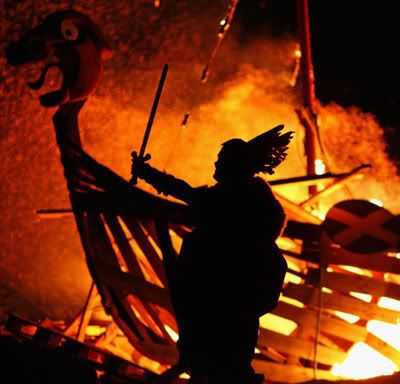
I finally saw the final episode for season three, 'The Dead', which was one of the best ones so far in the popular series. Clearly, each season has received more of a budget as the program has grown in popularity. If you go to the 'Vikings' History channel site, there is an online store with posters, clothing, dvds, music, jewelry, throw pillows, tote bags, etc. This could foster more interest in the Asatru movement, if the interested individual can comprehend that Asatru wasn't only a "Viking religion." The Pagan-Asatru band featured is "Wardruna" from Norway, which apparently produced much of the music from the show. This could also foster interest in the pagan music genre as well. Those who will seek out other bands from this multifaceted genre will be surprised at how much is out there.
The spiritual tradition of "the Seer" character is apparently not an Asatruar, but an adherent of "Norse witchcraft." The general theme of Viking paganism was stronger in season three. Floki, in particular, was guiding by the Odinic spiritual tradition... by "the gods." He felt betrayed by Ragnar for his conversion to Christianity. Also, Lagertha's line "If you’ve gone to heaven, then we will never meet again. And yet, I think Odin will ride like the wind and rescue you, and take you to Valhalla where you belong. And there we shall meet again, and fight, and drink, and love one another."
There are many bloggers and forums which have followed the series, such as "Vikings - Fan Site, News and Recaps for History Channel's Vikings." There are numerous sub-plots ready to unfold for season four. Part of what I'm getting at here is that the Vikings were the last great "Heathen Nation" in Europe. This sets it aside from a series about any other post-Roman/Constantine European or Western nation. I know there will be many who will take that first step and google for more information about that "Viking religion." Then the second step, when they type in a search for "Asatru today" or "Odinism modern." Even if one is from a different folk path, it still bridges that disconnect.
I found the character of the Parisian Princess Gisla to be a strong and moving character. During the Viking attack, she stood along the top of the walls of Paris and urged on the defenders of the city. She displayed class and leadership qualities, only to be forced into a marriage with the enemy as it was. That final scene of her standing in her royal clothing and expressing her disgust was one that would get one's attention. If it was shown in a movie theater, dressed in animal furs and with long hair, Rollo's response of saying "hello" in French and then smiling would have received much laughter. Also, of course, the best scene with Ragnar jumping out've the boat/casket! Perhaps his "conversion" was faked?
It probably should be mentioned that--although France had every right to defend itself against the Viking horde--this was only after centuries of extreme Christian aggression against any traditions or ideas which were native to northern Europe.
The "Hexenwolf" legend
Since this posting is Germanic/Heathen in nature, I wanted to add one related article: 'The Legendary Hexenwolf'. This is a part of German-American folklore.
An interesting name
According to IMDb.com, regarding the surname of actor Bob Odenkirk ('Breaking Bad'; 'Better Call Saul'): His last name means "Church of Odin" in Old Norse. It was spelled
"Oatencirck" many generations back, and originated with a German
immigrant ancestor.
5-11-15 Addition:According to IMDb.com, regarding the given name of the actress Thora Birch ('American Beauty'; 'Ghost World'): Her parents, Jack Birch & Carol Connors, thought that she would be a boy, and planned on naming the child Thor, after the Norse God of Thunder and Lightning. When she was born, however, her parents feminized the name and called her Thora.
A gentle world 'What It Would Be Like to Live on Saturn's Moons Titan and Enceladus' [Joseph Castro - Space.com Contributor - March 10, 2015] This has already been covered here, but this is a confirming article by space.com. It's fascinating to think that Titan has such a gentle atmosphere. All you would need is an oxygen apparatus and warm clothing. It would be like a calm Antarctica, except mostly rock and sand. The sky would be orange instead of blue. Imagine just walking around on a land beyond Mars, and beyond Jupiter. Infographic
Little-known Earth feature I wasn't aware of the apparently little-known fact that there is literally a solid hot metal ball at the core of the Earth that spins on it's own within a zone of liquid metal. It is about 70% of the size or our Moon. 'Earth's Inner Core'
Synchronicity and Enlightenment I've listened to so many interviews, lectures, and presentations online; that it would be impossible to keep track of all the names and subjects, partly because they overlap each other. However, David Wilcock is one of the best. This is one of his Coast to Coast interviews from August 2013, after 'The Synchronicity Key' was published.
Coast To Coast AM - Aug 19 2013 - Synchronicity & Enlightenment - C2CAM, Radio, David Wilcock [Video] The "speech gene" Human have at least one exclusive gene, now accepted as the one which allows for speech: "FOXP2." It is believe by some that this is proof of DNA manipulation of early hominids by some greater intelligence. In any case, just the fact that mainstream archeology cannot account for many artifacts and fossils which positively no not fit into mainstream theories make me believe that there needs to be more of an open debate. Much of mainstream science is funded by special interests.
2 timeless faces I'm no connoisseur of the golden age of Hollywood. However, I have long thought that the two actresses of that time period which stand out as far an having a timeless iconic look were Greta Garbo and Carole Lombard.
Tonight, Sunday morning as I'm writing this, is the full "Flower Moon" of May. Sometimes Sunday evenings can be a good time to get out on a nearby trail, despite the strong feeling of it as a strange weekly transition period. Once you're out there, the environment will create it's own energy with you. A few days ago during twilight, I spoke to a nice family of four whom I ran into on one trail. They were excited because they had just had a close up encounter with a coyote. I saw the animal as well, from a distance. I think there is a need for some simple mystery in our lives. Even if we live in an urban area, there often still is something... such as, perhaps that mountain in the distance. What's going on up there? What creatures roam free up there?
One odd bat story I recall hiking about a year and a half ago along a mountain trail in the northernmost Santa Cruz Mountain range. It had been a hot day, and it was twilight. It was still very warm and still with no wind, and an orange sky in one direction... which graduated into a small light blue part of the sky. I recall seeing one lone bat leaving the top of a particularly tall tree line on one side of a valley ridge, and towards a taller 1,300-plus foot peak on the other side of the valley in the distance. It struck me as so strange that a bat would just take off towards such a high altitude.. at least for them. I just shrugged it off as just a fluke of nature, and perhaps the bat would turn back towards another nearby grove of trees after I had passed though. I remembered it because it was somewhat eery, and almost ethereal, to see it flapping its wings and aiming for such a lofty summit against that orange sky.
Just about two months ago, as bizarre as it may sound, I saw the same thing at roughly the same location. It had been an unusually warm day, with no winds from the Pacific, and it was early twilight. Again I saw a bat coming from one of those tall tree lines, and start to make its way toward the peak. If it did indeed continue on, it would have been well over one thousand feet above the lower valley in short time. Bats don't sour like a bird, and it would have had to just flap its way all the way across... about a mile. I just wonder what would prompt it to do that? It appeared that there would be no better prospects for insects on the other side. Would it know it's way back?
Old original movies... of remakes
I'm going off topic here, but the other evening I saw the 1941 movie 'Here Comes Mr. Jordan', which was the original for its 'Heaven Can Wait' remake in 1978. I wanted to see it because I remember how, as a young boy, I was emotionally drained by 'Heaven Can Wait'... as it didn't have the overt feel-good ending that I had hoped for. Although, that was part of the intrigue of the film. The original was a little like seeing it again with fresh eyes, as it was very similar. Some time back, I finally saw the 1935 version of 'Mutiny on the Bounty' starring Clark Gable. There had actually been two earlier Australian versions, and a 1984 version starring Mel Gibson. I had been fascinated by the more well-known 1962 film, starring Marlon Brando, when I was a child. The adventure of the high seas, mixed with great characters and cinematography.
Long Cool Woman (In A Black Dress)
For so long I wanted to know the name of this song. It's another one of those great 70s hits. I didn't even realize that it was by The Hollies. It reminds me of the open rural road, as I can remember listening to it while traveling as a child. I think, like the vast majority of Americans, there's "Americana" that I like.. and parts that I could do very well without. That song is very much in the "LIKE" category. It's a song that just resinates with the land, and time. 'The Air That I Breathe' is another one, also by the Hollies, that the same thing could be said about. Timeless. This is why, I believe, there is now a sub-trend of young adults who are discovering earlier music.
Luciano's "vampire ring" Although it has not been confirmed, an episode of the reality TV program 'Pawn Stars' featured what one guy claimed had been Lucky Luciano's ring. It looks occultic in style, and possibly in its meaning or purpose as well.
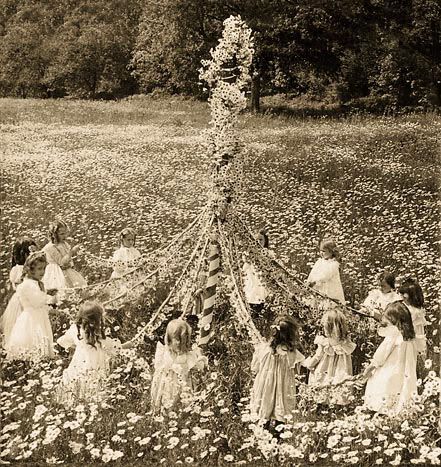
In the movie 'The Wicker Man" (1973), a Maypole is is shown with children celebrating around it. Also, in the remake, an elaborate festival is portrayed... which I think was May Day, as in the original. I loved the visuals of that scene. Often at the top of the poles is a tree-like display, with ribbons extending to the ground, where a each person in the circle walks in one direction with it. The little tree shape may turn with the pulling, or it might be allowed to twist around the pole top to bottom. Often the colors red and white are used to decorate the pole, as well as the colors of the ribbons. I have seen other shaped displays, such as a wheel of the year.
Symbolism
The symbolism of the maypole has been continuously debated by folklorists for centuries, although no set conclusion has ever been arrived at. Some scholars classify maypoles as symbols of the world axis (axis mundi). The fact that they were found primarily in areas of Germanic Europe, where, prior to Christianization, Germanic paganism was followed in various forms, has led to speculation that the maypoles were in some way a continuation of a Germanic pagan tradition. One theory holds that they were a remnant of the Germanic reverence for sacred trees, as there is evidence for various sacred trees and wooden pillars that were venerated by the pagans across much of Germanic Europe, including Thor's Oak and the Irminsul. It is also known that, in Norse paganism, cosmological views held that the universe was a world tree, known as Yggdrasil. There is therefore speculation that the maypole was in some way a continuance of this tradition.
Non-Germanic people have viewed them as having phallic symbolism, an idea which was purported by Thomas Hobbes, who erroneously believed that the poles dated back to the Roman worship of the god Priapus. This notion has been supported by various figures since, including the psychoanalyst Sigmund Freud. Phallic symbolism has been attributed to the maypole in the later Early Modern period, as one sexual reference is in John Cleland's controversial novel Fanny Hill:
"...and now, disengag'd from the shirt, I saw, with wonder and surprise, what? not the play-thing of a boy, not the weapon of a man, but a maypole of so enormous a standard, that had proportions been observ'd, it must have belong'd to a young giant."
The anthropologist Mircea Eliade theorizes that the maypoles were simply a part of the general rejoicing at the return of summer, and the growth of new vegetation. In this way, they bore similarities with the May Day garlands which were also a common festival practice in Britain and Ireland.
Italy
Maypole traditions can be found in some parts of the country, e.g. in Friuli, Umbria and Marche.
"After we've gone to get the pole in thirty or forty people, we placed it like a six month child. We walked in procession with this tree and not even a single leaf had to touch the ground. We had to raise it without making it touch the ground, holding it in our arms like a child. For us it was the saint of the 1st of May."
—Quirino Marchetti (ancient peasant of San Benedetto del Tronto), in L'albero di maggio
"May Day" has been celebrated in the Italian peninsula--largely in the north--since Roman times. Along with singing, dancing, and feasting, the holiday was also marked by the giving of "May baskets," small baskets of sweets or flowers, usually left anonymously on neighbors' doorsteps. Whose to say that we couldn't bring some of those traditions back? A May basket would be a nice gesture to give to family members, friends, or neighbors... depending on your relationship with your neighbors. You could follow it up with a short explanation of the tradition. In Italy it is called Calendimaggio or cantar maggio a seasonal feast held to celebrate the arrival of spring. The event takes its name from the period in which it takes place, that is, the beginning of May, from the latin calenda maia. The Calendimaggio is a tradition still alive today in many regions of Italy as an allegory of the return to life and rebirth: among these Piedmont, Liguria, Lombardy, Emilia-Romagna (for example, is celebrated in the area of the Quattro Province or (Piacenza, Pavia, Alessandria and Genoa), Tuscany and Umbria.
The function of this magical-propitiatory ritual is often performed during an alms during which, in exchange for gifts (traditionally eggs, wine, food or sweets), the Maggi (or maggerini) sing auspicious verses to the inhabitants of the houses they visit and throughout the Italian peninsula this Il Maggio couplets are very diverse, most are loving occasions with an important sexual load, that young people sang to celebrate the arrival of spring. Symbol of spring revival are the trees (alder, golden rain) accompanying maggerini and flowers (violets, roses), mentioned in the verses of the songs, and with which the participants adorn. In particular the plant alder, which grows along the rivers, is considered the symbol of life and that's why it is often present in the ritual.
Calendimaggio can be historically noted in Tuscany as a mythical character who had a predominant role and met many of the attributes of the god Belenus. In Lucania, the Maggi have a clear auspicious character of pagan origin. In Syracuse, Sicily is held during the month of May, the Albero della Cuccagna (cf. "Greasy pole"), a feast celebrated to commemorate the victory over the Athenians led by Nicias. However, Angelo de Gubernatis in his work Mythology of Plants, believes that without doubt the festival was previous to that of said victory. It is a celebration that dates back to ancient peoples very integrated with the rhythms of nature, such as the Celts (celebrating Beltane), Etruscans and Ligures, in which the arrival of summer clothed great importance. .
May 1 marks the ancient northern folk festival of "May Day." Part of the festiveness of this European celebration is centered around the Maypole.
May Day on May 1 is an ancient Northern Hemisphere spring festival and usually a public holiday; it is also a traditional spring holiday in many cultures. Dances, singing, and cake are usually part of the celebrations that the day includes.
A maypole is a tall wooden pole erected as a part of various European folk festivals, around which a maypole dance often takes place. The festivals may occur on May Day or Pentecost (Whitsun), although in some countries it is instead erected at Midsummer. In some cases the maypole is a permanent feature that is only utilized during the festival, although in other cases it is erected specifically for the purpose before being taken down again.
Primarily found within the nations of Germanic Europe and the neighboring areas which they have influenced, its origins remain unknown, although it has been speculated that it originally had some importance in the Germanic paganism of Iron Age and early Medieval cultures, and that the tradition survived Christianization, albeit losing any original meaning that it had. It has been a recorded practice in many parts of Europe throughout the Medieval and Early Modern periods, although became less popular in the 18th and 19th centuries. Today, the tradition is still observed in some parts of Europe and among European communities in North America.
Like so many aspects of ancient European folk traditions, May Day was co-opted by Christian denominations and political extremists. Still, it remains a powerful symbol of how ancient peoples related to the Earth, the Sun, the Moon, the seasons, their harvests, and each other. May Day--although more Germanic in tradition--was also celebrated by the Romans.
The earliest May Day celebrations appeared in pre-Christian times, with the Floralia, festival of Flora, the Roman goddess of flowers, held April 27 during the Roman Republic era, and with the Walpurgis Night celebrations of the Germanic countries. It is also associated with the Gaelic Beltane, most commonly held on April 30. The day was a traditional summer holiday in many pre-Christian European pagan cultures. While February 1 was the first day of Spring, May 1 was the first day of summer; hence, the summer solstice on June 25 (now June 21) was Midsummer.

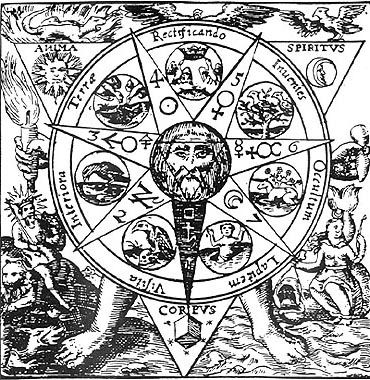 "Science nowadays really is touching against ideas dealing with where magic and spirituality and religion intersect and they're both ways of trying to find out about how the world works." -- Richard Kaczynski, Ph.D, Author 'Perdurabo: The Life of Aleister Crowley'
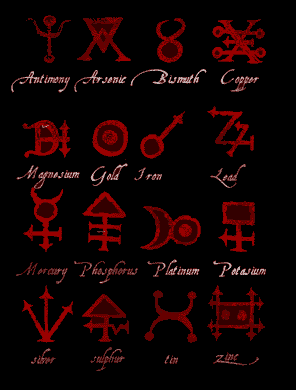 "Alchemy had existed since the early Egyptians, but in the hands of the Renaissance scientists it reached new heights. Alchemists were on the leading edge of science. They discovered phosphorus, zinc, the distillation of alcohol, the germ nature of diseases. They were the first to understand how blood circulates in the body. The church viewed their unorthodox experiments and scientific breakthroughs with growing suspicion." -- John Cullum, Narrator, 'Secrets of the Occult: The Magicians'