Thursday, February 23, 2012

Lombardy

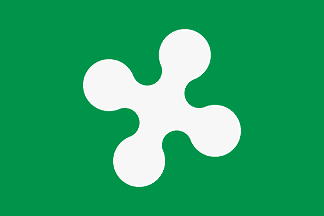
The "Camunian Rose," symbolized on the Lombardian flag
Lumbardia in the Lombard language; Lombardia in Italian & Spanish; Lombardy in English; Lombardei in the bordering German language.

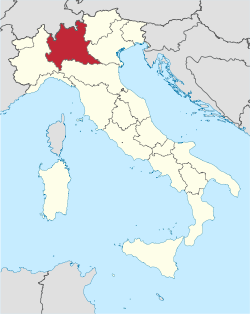
The Val Camonica is located in the province of Brescia, which is located in the region of Lombardy, which is part of the Italian Republic. In a sane world, the Val Camonica would be a province of its own, a part of the region of Lombardia (including the Lombard-speaking sections of Switzerland), and would be part of an entirely sovereign northern nation.

I wanted to put this in two or three parts, but with the table of contents, and wanting to get all the links into this, I wasn't able to. This is basically what we're all about at the end of the day. Our chief goal is to get the ball rolling on forming a "Lombardian-American construct." Even if Lombardy more-or-less disappears, if things don't go as we hope it will in the next couple of decades, we will still be here. We will still have a heritage and a common bond. It must be under the guise of "Lombardian-American," not some name that nobody has any idea of what it means, which will further polarize us from finally getting together (Michigan, California, Washington, Missouri, etc.).


Lombardy (from Wikipedia)

Lombardy is one of the 20 regions of Italy. The capital is Milan. One-sixth of Italy's population lives in Lombardy and about one fifth of Italy's GDP is produced in this region, making it the most populous and richest region in the country and one of the richest in the whole of Europe. Major tourist destinations in the region include the historic, cultural and artistic cities of Milan (which is Italy's second top tourist destination), Brescia, Mantua, Pavia, Como, Cremona, Bergamo, Sondrio, Lecco, Lodi, Varese, Monza, and the lakes of Garda, Como, Maggiore, and Iseo.

The official language, as in the rest of Italy, is Italian. The traditional local languages are the various dialects of Lombard (Western Lombard and Eastern Lombard), as well as some dialects of Emilian, spoken in some parts of the provinces of Mantua, Pavia, and Cremona. According to Istat, almost 27% of Lombards are bilingual with Lombard and Italian languages; 9.1% are monolingual in Lombard and 57.6% are monolingual in Italian.


Country  Italy

Capital  Milan

Government
 • President  Roberto Formigoni (PDL)

Area
 • Total  23,844 km2 (9,206 sq mi)

Population (25 March 2011)
 • Total  9,939,193
 • Density  416.843/km2 (1,079.617/sq mi)

Demonym  Lombard

 • Summer (DST)  CEST (UTC+2)

GDP/ Nominal  € 328.2 billion (2008)
GDP per capita  € 33,500 (2008)


Contents

Geography


Satellite image of Lombardy

Lombardy is bordered by Switzerland (north: Canton Ticino and Canton Graubünden) and by the Italian regions of Emilia-Romagna (south), Trentino-Alto Adige/Südtirol and the Veneto (east), and Piedmont (west). Three distinct natural zones can be fairly easily distinguished in the Lombardy region: mountains, hills and plains – the latter being divided in Alta (high plains) and Bassa (low plains).

The most important mountainous area is an Alpine zone including the Lepontine and Rhaetian Alps, (Piz Bernina – La Spedla, 4,020 m), the Bergamo Alps, the Ortler Alps and the Adamello massif; it is followed by an Alpine foothills zone Prealpi, which include the main peaks are the Grigna Group (2,410 m), Resegone (1,875 m) and Presolana (2,521 m). The great Lombard lakes, all of glacial origin lie in this zone. From west to east these are Lake Maggiore, Lake Lugano (only a small part is Italian), Lake Como, Lake Iseo, Lake Idro, then Lake Garda, the largest in Italy. South of the Alps lie the hills characterized by a succession of low heights of morainic origin, formed during the last Ice Age and small barely fertile plateaux, with typical heaths and conifer woods. A minor mountainous area lies south of the Po, in the Appennines range.

Panorama view: Bergamasque Alps

The plains of Lombardy, formed from alluvial deposits, can be divided into the Alta – an upper, permeable ground zone in the north and a lower zone characterized – the Bassa – by the so-called line of fontanili (the spring waters rising on impermeable ground). Anomalous compared with the three distinctions already made is the small region of the Oltrepò Pavese, formed by the Apennine foothills beyond the Po River. A large number of rivers, all direct or indirect tributaries of the Po, cross the plains of Lombardy. Major rivers, flowing west to east, are the Ticino, the outlet of Lake Maggiore, the Olona, the Lambro, the Adda, outlet of Lake Como, the Mincio, outlet of Lake Garda, and the Oglio, the Lake Iseo outflow. There is a wide network of canals for irrigation purposes. In the plains, intensively cultivated for centuries, little of the original environment remains. The rare elm, alder, sycamore, poplar, willow and hornbeam woods and heaths are covered now by several protected areas. In the area of the great Alpine foothills lakes, however, grow olive trees, cypresses and larches, as well as varieties of subtropical flora such as magnolias, azaleas, acacias, etc. The mountains area is characterized by the typical vegetation of the whole range of the Italian Alps. At a lower levels (up to approximately 1,100 m) oak woods or broadleafed trees grow; on the mountain slopes (up to 2,000–2,200 m) beech trees grow at the lowest limits, with conifer woods higher up. Shrubs such as rhododendron, dwarf pine and juniper are native to the summital zone (beyond 2,200 m).

Panorama view: Lake Maggiore

The climate of this region is continental, though with variations depending on altitude or the presence of inland waters. The continental nature of the climate is more accentuated on the plains, with high annual temperature changes (at Milan an average January temperature is 1.5 °C (35 °F) and 24 °C (75 °F) in July), and thick fog between October and February. The Alpine foothills lakes exercise a mitigating influence, permitting the cultivation of typically Mediterranean produce (olives, citrus fruit). In the Alpine zone, the valley floor is relatively mild in contrast with the colder higher areas (Bormio, 1,225 m, −1.4 °C (29 °F) average in January, 17.3 °C (63 °F) in July). Precipitations are more frequent in the Prealpine zone (up to 1,500–2,000 mm annually) than on the plains and Alpine zones (600 mm to 850 mm annually). The numerous species of endemic flora (the Lombard native species), typical mainly of the Lake Como area, include some kinds of saxifrage, the Lombard garlic, groundsels bellflowers and the cottony bellflowers. Lombardy counts many protected areas: the most important are the Stelvio National Park (the largest Italian natural park), with typically alpine wildlife: red deer, roe-deer, ibex, chamois, foxes, ermine and also golden eagles; and the Ticino Valley Natural Park, instituted in 1974 on the Lombard side of the Ticino River to protect and conserve one of the last major examples of fluvial forest in Northern Italy.

History

Early history


Roman ruins of the Imperial palace of Mediolanum

Ancient Celtic artifacts
retrieved in Lombardy[7]

The area of current Lombardy was settled at least since the 2nd millennium BC, as shown by the archaeological findings of ceramics, arrows, axes and carved stones. In the following centuries it was inhabited by different peoples amongst whom the Etruscans, who founded the city of Mantua and spread the use of writing; later, starting from the 5th century BC, the area was invaded by CelticGallic tribes. These people settled in several cities (including Milan) and extended their rule to the Adriatic Sea. Their development was halted by the Roman expansion in the Po Valley from the 3rd century BC onwards: after centuries of struggle, in 194 BC the entire area of what is now Lombardy became a Roman province with the name of Gallia Cisalpina ("Gaul on the nearer side of the Alps"). The Roman culture and language overwhelmed the former civilization in the following years, and Lombardy became one of the most developed and rich areas of Italy with the construction of a wide array of roads and the development of agriculture and trade. Important figures like Pliny the Elder (in Como) and Virgil (in Mantua) were born here. In late antiquity the strategic role of Lombardy was emphasized by the temporary moving of the capital of the Western Empire to Mediolanum (Milan). Here, in 313 AD, emperor Constantine issued the famous edict that gave freedom of confession to all religions within the Empire.

Middle Ages


King Alboin led the Lombard migration into the Po Valley and made Pavia the capital

During and after the fall of the Western Empire, Lombardy suffered heavily from destruction brought about by a series of invasions by tribal peoples. The last and most effective was that of the Lombards, or Longobardi, who came around 570s and whose long-lasting reign (whose capital was set in Pavia) gave the current name to the region. There was a close relationship between the Frankish, Bavarian and Lombard nobility for many centuries. After the initial struggles, relationships between the Lombard people and the Latin-speaking people improved. In the end, the Lombard language and culture assimilated with the Latin culture, leaving evidence in many names, the legal code and laws among other things. The end of Lombard rule came in 774, when the Frankish king Charlemagne conquered Pavia and annexed the Kingdom of Italy (mostly northern and central Italy) to his empire. The former Lombard dukes and nobles were replaced by other German vassals, prince-bishops or marquises. The 11th century marked a significant boom in the region's economy, due to improved trading and, mostly, agricultural conditions. In a similar way to other areas of Italy, this led to a growing self-acknowledgement of the cities, whose increasing richness made them able to defy the traditional feudal supreme power, represented by the German emperors and their local legates. This process reached its apex in the 12th and 13th centuries, when different Lombard Leagues formed by allied cities of Lombardy, usually led by Milan, managed to defeat the Hohenstaufen Emperor Frederick I, at Legnano, and his grandson Frederick II, at Parma.


The Coronation ceremony of
Gian Galeazzo Visconti in the
Basilica of Sant'Ambrogio

This did not prevent other important Lombard centres, like Cremona (then rivalling Milan for size and wealth) and others, from supporting the imperial power if this could grant them an immediate advantage. Taking advantage of the flourishing agriculture, the area around the Po River, together with Venice and Tuscany, continued to expand its industry and commerce until it became the economic centre of the whole of Europe. The enterprising class of the communes extended its trade and banking activities well into northern Europe: "Lombard" designated the merchant or banker coming from northern Italy (see, for instance, Lombard Street in London). The name "Lombardy" came to designate the whole of Northern Italy until the 15th century and sometimes later. From the 14th century onwards, the instability created by the unceasing internal and external struggles ended in the creation of noble seignories, the most significant of which were those of the Viscontis (later Sforzas) in Milan and of the Gonzagas in Mantua. In the 15th century the Duchy of Milan was a major political, economical and military force at the European level. Milan and Mantua became two centres of the Renaissance whose culture, with men like Leonardo da Vinci and Mantegna, and pieces of art were highly regarded (for example, Leonardo da Vinci's The Last Supper). This richness, however, attracted the now more organized armies of national powers like France and Austria, which waged a lengthy battle for Lombardy in the late 15th-early 16th century.

Modern era


Historical image of Villa Reale di Monza, official summer residence of the Austrian viceroys of Lombardy-Venetia, part of Austrian Empire

After the decisive Battle of Pavia, the Duchy of Milan became a possession of the Habsburgs of Spain: the new rulers did little to improve the economy of Lombardy, instead imposing a growing series of taxes needed to support their unending series of European wars.


The Pirelli Tower under construction in Milan, symbol of the post-war Italian economic miracle of 1950-60s.

The eastern part of modern Lombardy, with cities like Bergamo and Brescia, was under the Republic of Venice, which had begun to extend its influence in the area from the 14th century onwards (see also Italian Wars). Pestilences (like that of 1628/1630,[8] described by Alessandro Manzoni in his I Promessi Sposi) and the generally declining conditions of Italy's economy in the 17th and 18th centuries halted the further development of Lombardy. In 1706 the Austrians came to power and introduced some economical and social measures which granted a certain recovery. Their rule was smashed in the late 18th century by the French armies, however, and with the formation of the Napoleonic Empire, Lombardy became one of the semi-independent province of Napoleonic France. The restoration of Austrian rule in 1815, in the form of the puppet state called Kingdom of Lombardy–Venetia, had however to contend with new social ideals introduced by the Napoleonic era. Lombardy became one of the intellectual centres leading to Italian unification. The popular republic of 1848 was short-lived, its suppression leading to renewed Austrian rule. This came to a decisive end when Lombardy was annexed to the Kingdom of Italy 1859 as a result of the Second Italian Independence War. When annexed to the Kingdom of Italy in 1859 Lombardy achieved its actual territorial shape by adding the Oltrepò Pavese (formerly southern part of Novara's Province) to the province of Pavia. Starting from the late 19th century, and with a boom after World War II, Lombardy sharpened its status of richest and most industrialized region of Italy.

Demographics

Historical populations
Year Pop. ±%
1861 3,160,000
1871 3,529,000 +11.7%
1881 3,730,000 +5.7%
1901 4,314,000 +15.7%
1911 4,889,000 +13.3%
1921 5,186,000 +6.1%
1931 5,596,000 +7.9%
1936 5,836,000 +4.3%
1951 6,566,000 +12.5%
1961 7,406,000 +12.8%
1971 8,543,000 +15.4%
1981 8,892,000 +4.1%
1991 8,856,000 −0.4%
2001 9,033,000 +2.0%
2011 9,939,000 +10.0%
Source: ISTAT 2001
One sixth of the Italian population or about 10 million people live in Lombardy (16.2% of the national population; 2% of the European Union population), making it the second most densely populated region in Italy after Campania with a strong concentration in the Milan metropolitan area and the Alpine foothills areas of the provinces of Varese, Como, Lecco, Monza and Brianza and Bergamo, (1,200 inh./km2), a lower average density (250 inh./km2) in the Po valley and the lower Brescia valleys, and much lower densities (less than 60 inh./km2) in the northern mountain areas and the southern Oltrepò Pavese subregion.

The growth of the regional population was particularly sustained during the 1950s–60s, thanks to a prolonged economic boom, high birth rates, and strong immigration flows (especially from Southern Italy). During the last two decades, Lombardy became the destination of a large number of international immigrants, insomuch that today more than a quarter of all foreign immigrants in Italy lives in this region. As of 2008, the Italian national institute of statistics ISTAT estimated that 815,335 foreign-born immigrants live in Lombardy, equal to 8.4% of the total regional population.

The primary religion is Catholicism; significative religious minorities include Christian Waldenses, Protestants and Orthodox, as well as Jews, Sikh and Muslims.

Economy


View over the business district of Milan: with a metropolitan area of 7.4m people,[9] it is Italy's most important industrial, commercial and financial center.
The gross domestic product in Lombardia (equal to over €328 billion in 2008) accounts for 20% of the total gross domestic product of Italy. When this measure is considered by inhabitant, it results in a value of €31,600 per inhabitant, which is almost 25% higher than the national average of €24,300.[10]
Lombardy's development has been marked by the growth of the services sector since the 1980s, and in particular by the growth of innovative activities in the sector of services to enterprises and in credit and financial services. At the same time, the strong industrial vocation of the region has not suffered from it. Lombardy remains, in fact, the main industrial area of the country. The presence, and development, of a very high number of enterprises belonging to the services sector represents a favourable situation for the improvement of the efficiency of the productive process, as well as for the growth of the regional economy. Lombardy is one of the Four Motors for Europe.

The region can broadly be divided into three areas as regards the productive activity. Milan, where the services sector makes up for 65.3% of the employment; a group of provinces, Varese, Como, Lecco, Bergamo and Brescia, highly industrialised, although in the two latter ones, in the plains, there is also a rich agricultural sector. Finally, in the provinces of Sondrio, Pavia, Cremona, Mantova and Lodi, there is a consistent agricultural activity, and at the same time an above average development of the services sector.


The countryside around Lake Garda.
The productivity of agriculture is enhanced by a well-developed use of fertilizers and the traditional abundance of water, boosted since the Middle Ages by the construction (partly designed by Leonardo da Vinci) of a wide net of irrigation systems. Lower plains are characterized by fodder crops, which are mowed up to eight times a years, cereals (rice, wheat and maize) and sugarbeet. Productions of the higher plains include cereals, vegetables, fruit trees and mulberries. The higher areas, up to the Prealps and Alps sectors of the north, produce fruit and vines. Cattle (with the highest density in Italy), pigs and sheep are raised.
Following a steep decline in GDP during the global recession in 2009 which saw industry heavily hit, Lombardy's economy is predicted to outperform the Italian economy this year with growth of between 1–1.3% expected. Only Emilia Romagna, Lazio and Tuscany are expected to outperform the region in 2010. The revival of the industrial sector is an important factor, but it is the service sector – and especially the financial sector which will drive the Lombard economy to a sustainable recovery.

Government and politics


Palazzo Lombardia in Milan, seat of the regional government.

The politics of Lombardy take place in a framework of a presidential representative democracy, whereby the President of the Region (Presidente della Regione) is the head of government, and of a pluriform multi-party system. Executive power is exercised by the Regional Government (Giunta Regionale). Legislative power is vested in the Regional Council (Consiglio Regionale).

The Christian Democrats maintained a large majority of the popular support and the control of the most important cities and provinces since the birth of the Italian Republic until the late 1980s. The Italian Communist Party was a considerable presence only in the eastern and southern parts of Lombardy from the late 1960s to the mid 1980's. Their base however was increasingly eroded by the Italian Socialist Party until, in the early 1990s, the Mani Pulite corruption scandal which spread from Milan to the whole of Italy wiped away the old political class almost entirely. This, together with the general disaffection towards Rome's government (considered as favouring excessively the less developed regions of southern Italy in economical matters), led to the sudden growth of the secessionist (later Northern League), that is particularly strong in mountain and rural areas. In recent years, Lombardy stayed as a conservative stronghold, that gave about 60 per cent of its votes to Silvio Berlusconi at the last general election. Notwithstanding, the capital city of Milan landslide elected a new progressive mayor at the 2011 municipal elections.


Culture

Although Lombardy as a region is often identified as merely an economic and industrial powerhouse, it has interesting examples [2] even from the standpoint of cultural and artistic. The many examples range from prehistory to the present day, through the Roman period and the Renaissance and can be found both in museums and churches that enrich cities and towns around the region.

Prehistory


Rock engraves, Nadro.

The rock carvings (some 300,000) left by the ancient Camuni in the Valcamonica depicting animals, people and symbols date back to the period from Neolithic to Middle Ages.
The many artifacts (pottery, personal items and weapons) found in the necropolis near the Lake Maggiore, and Ticino demonstrate the presence of civilization Golasecca who lived in Western Lombardy between the ninth and the fourth century BC.

Museums

Lombardy contains numerous museums (over 330) of different types: ethnographic, historical, technical-scientific, artistic and naturalistic which testify to the historical-cultural and artistic development of the region. Among the most famous are the National Museum of Science and Technology "Leonardo da Vinci" (Milan), the The Last Supper of Leonardo da Vinci (Milan), the Accademia Carrara (Bergamo), the Museum of Santa Giulia (Brescia), the Volta Temple (Como), the Stradivari Museum (Cremona), the Palazzo Te (Mantua), the Museum Sacred Art of the Nativity and the basilica of Santa Maria Assunta at Gandino, the Royal Villa of Monza and many others.

Main sights

Cuisine

Rice is popular in the region, often found in soups as well as risotti, such as "risotto alla Milanese", with saffron. In the city of Monza a popular recipe also adds pieces of sausages to the risotto. Regional cheeses include robiola, crescenza, taleggio, gorgonzola and grana padano (the plains of central and southern Lombardy allow intensive cattle-raising). Butter and cream are used. Single pot dishes, which take less work to prepare, are popular. In Bergamo, Brescia, and Valtellina, polenta is common. In Valtellina, Pizzoccheri too. In Mantua festivals feature tortelli di zucca (ravioli with pumpkin filling) accompanied by melted butter and followed by turkey stuffed with chicken or other stewed meats.[11]

Typical dishes


A traditional "Cotoletta alla Milanese (Milanese-style cutlet)" served with potatoes.
  • Polenta (Asino e Polenta, Polenta e Osei, Vunscia Polenta, Polenta e Gorgonzola)
  • Pizzoccheri (short tagliatelle made out of buckwheat flour and wheat, laced with butter, green vegetables, garlic, sage, potatoes and onions, all topped with Casera cheese)
  • Quartirolo lombardo
  • Risotto (alla Milanese)
  • Osso buco
  • Cotoletta (Cutlet) ("alla Milanese")
  • Cassoeula
  • Gorgonzola cheese
  • Bitto cheese
  • Grana Padano cheese
  • Panettone
  • Lo Spiedo Bresciano – a traditional spit roast consisting of different cuts of meat, butter and sage
  • Tortelli di Zucca (Pumpkins filled pasta)
  • Sbrisolona cake

Wines

  • Nebbiolo red
  • Bellavista
  • Santi
  • Nino Negri
  • Bonarda Lombardy
  • Inferno (Valtellina)
  • Grumello (Valtellina)
  • Sassella (Valtellina)

Music


The magnificent auditorium of the Teatro Grande in Brescia.
Besides Milan, the region of Lombardy has 11 other provinces, most of them with equally great musical traditions. Bergamo is famous for being the birthplace of Gaetano Donizetti and home of the Teatro Donizetti; Brescia is hosts the impressive 1709 Teatro Grande; Cremona is regarded as the birthplace of the commonly used violin, and is home to several of the most prestigious luthiers in the world, and Mantua was one of the founding and most important cities in 16th and 17th opera and classical music. Other cities such as Lecco, Lodi, Varese and Pavia also have rich musical traditions, but Milan is the hub and centre of the Lombard musical scene. It was the birthplace of Giuseppe Verdi, one of the most famous and influential opera composers of the 19th century, and boasts a variety of acclaimed theatres, such as the Piccolo Teatro and the Teatro Arcimboldi; however, the most famous is the 1778 Teatro alla Scala, one of the most important and prestigious operahouses in the world.

Language

Apart from standardized Italian, Lombard is the local language of Lombardy. Lombard is a member of the Gallo-Italic group within the Romance languages. It is spoken natively in Northern Italy (most of Lombardy and some areas of neighbouring regions, notably the eastern side of Piedmont) and Southern Switzerland (Ticino and Graubünden).

The two main varieties (Western Lombard language and Eastern Lombard language) show differences and are often, but not always, mutually comprehensible. The union of Western Lombard or Insubric, Eastern Lombard and intermediate varieties under the denomination of "Lombard" is a matter of debate, and it has been argued that the two might potentially form separate languages.[12]


Fashion

Lombardy has always been an important centre for silk and textile production, notably the cities of Pavia, Vigevano and Cremona, but Milan is the region's most important centre for clothing and high fashion. In 2009, Milan was regarded as the world fashion capital, even surpassing New York, Paris, Rome and London.[13] Most of the major Italian fashion brands, such as Valentino, Versace, Prada, Armani and Dolce & Gabbana (to name a few), are currently headquartered in the city.

Administrative divisions

Lombardy is divided into 12 provinces:
Lombardy Provinces.png
Province Area (km²) Population Density (inh./km²)
Province of Bergamo 2,723 1,070,060 392.9
Province of Brescia 4,784 the biggest 1,223,900 255.8
Province of Como 1,288 582,736 452.4
Province of Cremona 1,772 358,628 202.4
Province of Lecco 816 334,059 409.4
Province of Lodi 782 222,223 284.2
Province of Mantova 2,339 407,983 174.4
Province of Milan 1,575 3,121,832 the biggest 1,982
Province of Monza and Brianza 405 the smallest 840,711 2,075
Province of Pavia 2,965 535,948 180.7
Province of Sondrio 3,212 181,841 the smallest 56.6
Province of Varese 1,199 868,777 724.6

UNESCO World Heritage Sites

References

External links

Media related to Lombardy at Wikimedia Commons

.

Wednesday, February 22, 2012

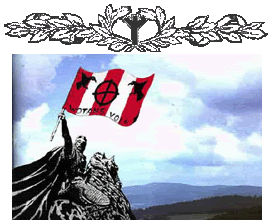
Wotansvolk flag as an Umbrella Symbol of European Neo-Paganism?


In the 1997 book 'Creed of Iron', author Ron McVan presented a new Wotanist flag (shown above). I don't see any particular reason that this flag cannot symbolize all traditional European-descended neo-pagan concerns. According to legend, Genghis Khans mother--Hoelun--handed him an arrow when he was a boy. She asked him to break it in two, which he did. Then she handed him a handful of arrows and asked him to break them in two. When he wasn't able to, she impressed upon him that alone one is not nearly as strong as part of a group; and, of course, Khan went on to conquer much of the world, but only after uniting feuding bands of Mongol tribes.

On page 142 of the book, McVan displays the powerful flag and describes its meaning, which all basically relate to "the Allfather," Wotan. However, the solar cross is the main symbol, and it can be tied to virtually every other Europagan tradition. Lets face it, the Teutonic spiritual tradition had been the most defined and widespread pre-Christian pagan tradition in Europe; and it was spread to virtually every corner of Europe at some point. OF COURSE, there were other pagan traditions! However, remember Hoelun's arrows...

The "horned god tradition," while it was also--in some form--spread throughout Europe in ancient times, lacked the definition of Odinism. Also, almost all of these spiritual traditions overlapped one another; especially as they're connected to the "wheel of the year." I tend to prefer the name "Wotan," rather than Odin, because it reminds me of the larger concept. In other words, "Wotanism" reminds me more of the mountains and forests of ancient central Europe, than it does the more Scandinavian-sounding "Odinism." The Langobards called him "Godan," but I'm thinking of what would be best in relating to the larger spiritual concept. Everything cannot be neatly packaged and presented for each one of us on a silver platter all the time!

A folkish Wiccan, for example, could very much relate to the solar cross and the two ravens. Also, there were "Wiccan-like" pagans (i.e. "Witches") within Norse and Germanic paganism. Still, we live today as if we were those feuding bands of Mongol tribes. Even within Odinism/Asatru, there is a strong factional feeling. Sometimes we need to occasionally think of the bigger picture. Remember, there were Odinists burned alongside Witches in the Middle Ages. They were viewed with the same distain by religious zealots then, or even today. This flag could be more of a "spiritual proposition concept," than an actual "organization." No concern needs to intrinsically "change," but perhaps pragmatically "expand" their spiritual scope.

The flag was designed to be a Wotansvolk ("Odin's People") symbol. Couldn't it also be a symbol of the larger Heathenry ("the people of the hearth") and/or the Pagans? A lot of areas have just a tiny handful of people who self-identify with a particular pagan tradition. Wouldn't it only make sense for them to be part of a voluntary milieu of a larger harmonious localized Europagan social construct? No matter where we live--whether in a remote area or in a large city--we still are all "the people of the hearth." Perhaps it's time to recognize that first, rather than always be factionalized in a largely artificial, negative thought-form.

.

Tuesday, January 31, 2012

'You, Our Father Odin' by Renée Vivien (1907)


'You, Our Father Odin'

Translated by Richard J. Vaako AOR (Brittany, France)


Winter wind rushes bold and strong
As well as Vikings in their noble wrath
Storm had blown on the age-old pine trees
And floods dashed… Come, my Norse’s Gods!

Your eyes had reflection of the boreal blades
For you abysses are easy trails
And you’re tall and slender like silver pines
O masters of the twin colds and of loyal races!

My Norse Gods daring and golden-blond, awake you
From your long asleep in the highest snows
And make resound your calls on all of the plains
Where at evening’s extended the howling of wolves

Come, my Norse Gods with hardened faces
You, our father Odin – You, Freyja
With fairy hair full of scent – You, valorous Thor
You, headstrong Frigga, and all of you my Valkyries!

Listen to me my Gods, such as clear mornings:
I’m the daughter of your venerable Skalds
From those who stood around tables to sing and praise you
Where Heroes drank the mead of the feasts

Come my mighty Gods because our winter is near
We’ll laugh along with the joyous hurricanes
We’ll cut down the oak spared by years
And mountains will rattle up to their heart of stone

We’ll settle our triumphant feet on the large seas
We’ll gladden along with the dance of the waves
For us – undefined shapes, mists will come to life
And for us will bright the streaks of the lightning be

Seagulls will call toward us and toward the thunder
We’ll bring in the palm of our hands…
Now here we’re hearing the powerful fighters
And the screams of the defeated on pale shore

Here my Gods you’re laughing like you did in olden days
And the eagle is wheeling above his eyrie
We had broke out and loose the hounds of thunder
And the cliffs have recognized our voices

Space will listen to our fierce music
And the outraged heavens will bend under our strain…
Come to me, who is waiting for you, my Norse’s Gods!
I am the daughter of your heroic Skalds…

~ Renée Vivien ~


Renée Vivien, born Pauline Mary Tarn on June 11 of 1877 in London, died November 18 of 1909 in Paris. She was a poetess of the early twentieth century Paris trend.


**************************************************

I think Renée Vivien proves that a woman can be a lesbian, a cosmopolitan, as well as a person of great wealth, and still have a spiritually folkish heart. She was a native believer to remember.

.

Monday, December 19, 2011

Caesar Cardini

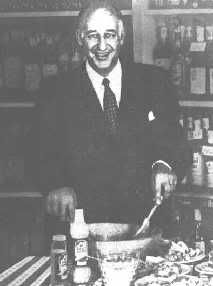
Last week, while grocery shopping, I noticed "Cardini's Salad Dressing." To me the name sounded like it could be of northern or Lombardian origin. Later I looked it up online and found that Caesar Cardini, whom the label was named after, is credited as the creator of the "caesar salad." His place of birth is mentioned simply as the "Lake Maggiore region," prior to emigrating to the United States (Sacramento).


Cesare Cardini (February 24, 1896 – November 3, 1956) was an Italian American restaurateur, chef, and hotel owner, who is credited with creating the Caesar salad.

He was born in the region of Lago Maggiore and had at least four siblings: Alessandro, Carlotta, Caudencio and Maria. While the sisters stayed in Italy, the three brothers emigrated to America; Alessandro and Caudencio eventually were in the restaurant business in Mexico City. Alessandro, who was called Alex in the USA, is reported to have been Caesar's partner in Tijuana, Mexico.

After having worked in European gastronomy, Caesar went to the United States in his early 20s. He ran a restaurant in Sacramento, then he moved to San Diego where he was in the restaurant business. At the same time he engaged in the same business in Tijuana, where he could avoid the restrictions of prohibition. He married Camille, and had a daughter, Rosa Maria Cardini (1928-2003).

Cardini is credited with having created "Caesar's salad" which became fashionable among Hollywood and other celebrities, especially after he had moved his restaurant a few blocks to the hotel built c. 1929 (nowadays called Hotel Caesar's).

The family moved to Los Angeles in 1935 and Cardini focused on the production and marketing of his salad dressing which he trademarked in 1948. He died in Good Samaritan Hospital on November 3, 1956 in Los Angeles following a stroke at his home at 8738 Bonner Drive and was buried in Inglewood Park Cemetery. His daughter took control of Caesar Cardini Foods Inc. Later, the label Cardini's was sold to a third party. It is still popular and offers more than a dozen varieties of the original recipe.


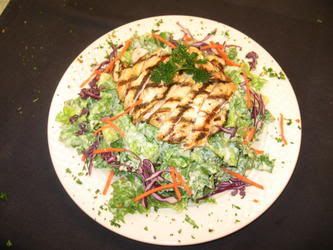
A Caesar salad is a salad of romaine lettuce and croutons dressed with parmesan cheese, lemon juice, olive oil, egg, Worcestershire sauce, garlic, and black pepper. It may be prepared tableside.


History

The salad's creation is generally attributed to restaurateur Caesar Cardini, an Italian immigrant who operated restaurants in Mexico and the United States. Cardini was living in San Diego but also working in Tijuana where he avoided the restrictions of Prohibition. His daughter Rosa (1928–2003) recounted that her father invented the dish when a Fourth of July 1924 rush depleted the kitchen's supplies. Cardini made do with what he had, adding the dramatic flair of the table-side tossing "by the chef."

A number of Mr. Cardini's staff have claimed to have invented the dish.

Julia Child claimed to have eaten a Caesar salad at Cardini's restaurant when she was a child in the 1920s.

Nonetheless, the earliest contemporary documentation of Caesar Salad is from a 1946 Los Angeles restaurant menu, twenty years after the 1924 origin asserted by the Cardinis.


Recipe

The original Caesar salad recipe (unlike Alex's Aviator's salad) did not contain pieces of anchovy; the slight anchovy flavor comes from the Worcestershire sauce. Cardini was opposed to using anchovies in his salad.

In the 1970s, Cardini's daughter said that the original recipe included whole lettuce leaves, which were meant to be lifted by the stem and eaten with the fingers; coddled eggs; and Italian olive oil.

The trademarks "Cardini's", "Caesar Cardini's" and "The Original Caesar Dressing" are all claimed to date to February 1950, though they were only registered decades later, and more than a dozen varieties of bottled Cardini's dressing are available today. Some recipes include mustard, avocado, tomato, bacon bits, garlic cloves or anchovies. Cardini's Brand original Caesar dressing is somewhat different from Rosa's version.

Many restaurants offer a more substantial salad by topping a Caesar salad with grilled chicken, steak, or seafood. Certain Mexican restaurants may improvise on items such as substituting tortilla strips for croutons and Cotija cheese for the Parmesan, or the addition of tomatoes.


Ingredients

Ingredients according to the Hotel Caesar's recipe from about 2006:

*Romaine or cos lettuce
*Olive oil
*Fresh crushed garlic – often in olive oil
*Salt to taste
*Fresh-ground black pepper
*Wine vinegar
*Lemon juice or lime juice - fresh squeezed
*Worcestershire sauce
*Raw or coddled egg yolks
*Freshly grated Parmesan cheese
*Freshly prepared croutons


Variations

There are limitless variations. However, some of the more common are:

*Other varieties of lettuce
*Grilled poultry (most often chicken), meat, shellfish, or fish
*Capers
*Romano cheese
*Anchovies
*Bacon

.

Tuesday, December 6, 2011

Milanese Rite chant from the Middle Ages


Ambrosian chant - Ecce apertum est Templum tabernaculi

Uploaded by Callixtinus

Medieval Ambrosian chant of the church of Mediolanum (Milan).

Title: "Offertorium: Ecce apertum est Templum tabernaculi".

Performers: Ensemble Organum, Director: Marcel Peres

Album: "Chants de l'Église Milanaise"

This is a truncated version (last 2 minutes of the chant missing due to time restrictions).

.

Monday, December 5, 2011

Guido von List: Part 13

I hadn't intended on making this into this type of "series," but as there are connections to the larger Alpine peoples of ancient times, I see fit to keep adding to this. One area, in which I had not anticipated tie-ins to our culture, was the connection of "primal words." However, some of List's concepts, especially regarding the precise fabric of ancient word patterns, are so deep that one would need to buy the book.

List seemed to believe that Wotanism was too large of a concept for the average person's daily life. He believed in what he called "Armanism," which was basically an elite priesthood who could study the finite details of the ancient concepts, and interpret it for the larger society. List believed that spirituality, art, science, architecture, education, etc., were "all one" within the Wotanist culture in ancient times. If ever was there a religion or spiritual tradition which did not conflict with science, it was Wotanism.

To clarify once again, I use the word "Wotanism" in the sense that it seems to tie in more with the expression of Odinism in central Europe, not the mainstream incarnation and related perception of the word. "Odinism" even specifically sounds Scandinavian. Actually, much of what is modern Odinism or Ásatrú, is largely "Norse mythology." If you look at Gaulish or Slavic spirituality and myth, it has close ties to Wotanism. Either through direct migration, or through more subtle spiritual influence, often the ancient spiritual traditions more-or-less referred to the same "All Father" (Wotan). Therefore, when I use "Wotanism," I'm referring to the larger European whole, usually in ancient times.

Guido von List's Armanic ideas were strongly entertained, long after his death, by the National Socialists; and it developed (along with the work of others) into what was called "Ariosophy," which was similar to List's Armanism. I just don't see exactly how that has to do with von List? Consequently, the Armanic concept itself has been demonized. People from the Tre Valli Bresciane ("Three Brescian valleys"), our people, invented the "hand held cannon" five centuries ago. Does this mean that our culture should be vilified as a result of how many people have been shot during the past five centuries?

I was going to place some Wikipedia text regarding Armanism here, but it was just "too anti-von List." It's like Christopher Columbus. He was a hero in his day, and a bad guy today; all because some "social scientist" who never placed his fingers in the Earth's soil or hammered in a single nail, said so. Of course, there's also the factor that our own Camunian ancestors were killed for their pagan faith; so wouldn't von List have been a hero to them, especially during "the burning times"? Perhaps we should consider this before we automatically demonize von List. I'm going to put out some information here soon which will really show what the Catholic officials and the Venetian state thought of us. They believed that we were a bunch of devils.

Because many sun symbols, from western Europe to India, have subtle similarities; this also becomes an area of perceived controversy. In other words, if you compare the circular swastika to the Celtic cross, it's quite obvious that it is the same symbol. The Odinic Rite sells t-shirts and material which features the circular swastika with the slogan "Heritage Not Hate." I can think of some symbols which were used politically, and where many innocents perished in its name, and yet not demonized at all. Aside from that, it should be noted that the "sun of the Alps" is a sun symbol as well. Personally, I can't see how anyone can divorce at least the basic Celtic cross--the circular one, crossed in the middle only--from any type of European neo-paganism.

List apparently wrote extensively about old folk traditions which were incorporated into Christianity; which is far from "the concept of renouncing the imposed foreign creed of Christianity and returning to the pagan religions of the ancient Indo-Europeans" (Wikipedia). It appears that most of the anti-von List ideas simply originate from an opportunity by some Christian concerns to smear paganism in general. So, are pagans "far right" now? Again, a good quote regarding 'Secret of the Runes' and von List by an Amazon.com critic:

This is a classic book on runic magic. A lot of New Age writers [copy] his occult ideas. The Right misunderstands him and the Left smears him. One of the most lied about men in occult history.

This book is well worth the price. Even though many of his ideas have been used by other occult writers, and some of his ideas on magic are standard New Age rite, it is always interesting to visit the source where these rivers sprung. Hopefully, all of Von List's books will be made ready to an English speaking market.

--Wyatt Kaldenberg, Amazon.com review

I wanted to add here that many cultures perceive that they lived in a type of paradise at one time, then something happened to foul it all up for them. I think that these ideas are often greatly exaggerated, but do have some truth to them. About as close as it can get to this, at least in the ancient world, seems to be the Etruscan civilization. They didn't have the philosophy and order of the ancient Greeks or Egyptians--although since the Romans destroyed almost all of their text, we'll never know for certain--they had better land and resources, plenty of technology, and were not "war-like." In fact, it appears that they didn't even have a definite bordered "Nation"; hence the name "Etruscan civilization," as opposed to "Roman Empire." As a "Padanist" (or for that matter, a "Langbardist," "Cisalpinist," or "Etrurianist."), I believe that they would have eventually and peacefully merged with the Umbrians, Cisalpine Gauls, Alpine tribes, etc, and formed a "northern nation"; the specific name of which, not being at all important.

I just didn't want it to sound like I was placing the Etruscans or Umbrians out of my spiritual idealism. Their technology was greater than the Teutons, and their spirituality was on the same level. They seemed to be as close to "living in paradise" as it was possible in the ancient world. The quality of life for the average Roman or Egyptian wasn't very good. There was a tremendous amount of slavery, classism, sexism, and general abuse. I don't just mean that in a modern political usage of terms, but also in a spiritual way. Perhaps the Greeks had something better, but I don't know enough about ancient Greece to say. The ancient Etruscans had great architecture, the institutions of civility, a great farming culture on great land, women had it fairly good, and there just didn't seem to be much strife.

From 'Secret of the Runes' pages 75-76, related to Armanism and society:

All of this is based on the fact that all Aryans or Teutons felt themselves to be one folk. On account of this, every individual, be he free-man or king, had to belong to the provider-class in order to prevent this class, as the main class, from being devalued. Everyone had, therefore, to be a farmer, that is "Ing-fo"--an original maintainer and perpetuator of the ancestors. The second class was the intellectually advanced, the intelligentsia, the rulers, the "teaching-class," to which the skalds, the high nobility, and the kings (princes, counts, etc.) belonged--without ceasing to be farmers. It has already been said on p. 56 above that "ar" means the sun and the law of the sun, and the earn, the eagle [Aar] is its symbol and hieroglyph. Therefore a member of the second class was called an Ar-man or Ir-man, namely a sun-man, Se-man. The Se-mans were the men of knowledge [Wissenden], and from them emerged the skalds--the priests of Wuotan--or better said their core group was the skalds, who, as priests and teachers were also the judges--for in those times "Wihinei" (religion) was simultaneously science and law. one believed what one knew--or at least intuitively recognized, and lived accordingly. Since the Semans, Irminons, Skalds, etc., were one and the same with the scholars, artists, etc., this second class is the "teacher-class"--in spite of the fact that it too belonged to the farmer-class--and is to be recognized as the root area of the activation of the Aryan spiritual work. Therefore, all original lines of the collective arts and sciences are to be derived from it. However, the skalds must remain the central focus in which all the diverse special manifestations of the hieroglyphics can be unified.

.

Sunday, November 27, 2011

Night sky puts on its timeless show


The ancient Camunni were very deep into astronomy. They constructed complex observatories in the mountains. It was a major part of their ancient culture. The Cernic spiritual tradition was based on astronomy. Cernunnos was literally based on the Ophiuchus Constellation ("he who holds the snake"; "the snake bearer"); or known as "Ofiuco" in Italian.

I just wanted to inject here, about five years ago I was in a rural field at about midnight. I don't recall the time of the year, but I believe that it was summer, and I was just in the right place at the right time. A shooting star suddenly came into view. It was traveling at an angle so low that I could see and hear the flames. This fireball was about the size of a basketball. It was pretty startling to witness this. It landed in a tree covered area along a small creek. I tried hard to find it, but I wasn't able to.


Tom Stienstra - Outdoors - San Francisco Chronicle - November 27, 2011

On an early winter night at a camp deep in the Santa Cruz Mountains, Jupiter, almost directly overhead, was like a beacon in a black sky speckled with stars.

About 40 degrees to one side of Jupiter, a bright orange star, Aldebaran, which marks the constellation Taurus, stood out as well.

"Back in the late 1800s, at a camp just like this, these are the same stars that John Muir was looking at on Mount Tamalpais," said Jeff Patty, or "Foonski," my long-since-departed buddy of hundreds of trail camps.

"Or the same stars Joe Walker saw in November of 1833 when he was the first trailblazer to camp in Yosemite."

We had this talk at a camp 30 years ago this week, but you might have the same conversation tonight. The night sky is the link to all places and all times.

Whether you're spending the night at a camp at Point Reyes National Seashore or Yosemite National Park, you're looking at the same stars. Whether it's tonight, 30 years ago or 300 years ago, they are the same stars.

Now can be the best time of year for stargazing. The cold nights of late November and early December can wick moisture out of the air and leave skies sparkling clear. As fall merges into winter, night comes early and campsites in the Bay Area foothills finally have plenty of space.

Spending time looking into the night sky can make your life feel timeless. It can make camps unforgettable. Compared with how so many people push-push-push all the time, when they drive, when they work, even when they play, it sets things aside while you soak in the night treasures.

My favorite winter constellation is the little Pleiades star cluster, the Seven Sisters. It's shaped like a miniature spatula. It is faint to the naked eye and is best seen when not looking at it directly, but just off-center.

At every camp trip, we spend at least one night when we scan the sky for an hour or so. Along with Foonski, Michael Furniss and brother Rambob, my pals across thousands of trail miles and hundreds of camps, we've learned a lot of stars and planets.

"Most people look up at the sky like it's a two-dimensional dome," Furniss said. "Instead, imagine the incredible depth" that seems to extend to infinity "... and our place in it."

We try to add a new star or planet we can share with the group. There's Vega, Deneb, Sirius, Antares, Rigel, Betelgeuse - and as December takes hold, Venus will rise and be brighter than the brightest stars.

When you get in the habit of scanning the sky every night possible, you can see landmark events by accident. This is most true with meteor showers.

This past summer, the Perseids, the most anticipated meteor shower of the year, seemed pretty much like a dud, with a full moon overwhelming the sky. Yet in 1988, while camped at Mount Shasta, I happened to look up by accident and saw 300 to 400 shooting stars in a few hours, often with fireballs that left trails arcing far across the sky.

The next promising meteor shower is the Geminids, which peak Dec. 13 and can provide a good chance to see shooters from Dec. 4 to Dec. 16. If you get lucky, you might see 50 to 100 shooting stars per hour. Though mostly white, they can come in many colors: yellow, as well as orange and red. Look mostly to the east. Like most meteor showers, the show gets better later into the night.

Other significant events are on the way. A lunar eclipse is projected for Dec. 10, from 6:06 a.m. to 6:47 a.m., according to my friends at the Chabot Space and Science Center. That will get a lot of play as it approaches.

As December takes hold, watch Venus, which is easy to pick out because it is so bright. On Dec. 26, just after sunset, you will be able to see Venus adjacent to a thin crescent moon. I've seen this event in past years and it can be one of the coolest night-sky sights of the year.

If you are new to stargazing, start by watching Venus in December. The rest will come with curiosity.

Then imagine Muir looking up at the winter sky when he camped at Mount Tamalpais. Or the sea captains who landed in the Bay Area in the 1700s. Then look up there yourself. The night sky connects all people, from the past to the present.

E-mail Tom Stienstra at tstienstra@sfchronicle.com.

.