Saturday, January 29, 2011

Ultra rare Bugatti could be world’s most expensive car

The founder of the Bugatti automobile, Ettore Bugatti, was Milanese. We can cover more about that history at a future time. See images on the link below.

Ultra rare Bugatti could be world’s most expensive car

A 1936 Bugatti Type 57SC Atlantic — one of just four made — sold recently to a private buyer, and its reported price is, in a word, stunning. Just how much, you ask? Well, auction house and broker Gooding & Company is keeping mum, but reports put the transaction at a stunning $30 million to $40 million.

The car used to be the flagship of the Williamson Bugatti Collection and took Best in Show at the 2003 Pebble Beach Concours d’Elegance. It doesn’t get much better than that.

According to Gooding & Co., the car was derived from Bugatti’s prototype Aerolithe Electron Coupe, and this particular car was the first of four made, whose restoration “has been revered by enthusiasts throughout the world.”

The car’s new owner has not been disclosed, but Gooding & Co. said the buyer is “a devoted connoisseur who will become the guardian of this treasured piece of automotive history.”

“I am extremely pleased to have found the new buyer for the 1936 Bugatti Type 57SC Atlantic, one of the world’s most significant and valuable automobiles that has been in a private collection and rarely seen during the past four decades,” David Gooding, president and founder of Gooding & Company, said in a statement. “It has been a great pleasure to work with the Williamson Family and Trust in this important endeavor.”

As for that astonishing price, reported on Autoblog.com, if it’s accurate the transaction would far eclipse a record set last year: $12 million for a 1957 Ferrari 250 Testa Rossa.

.

Friday, January 28, 2011

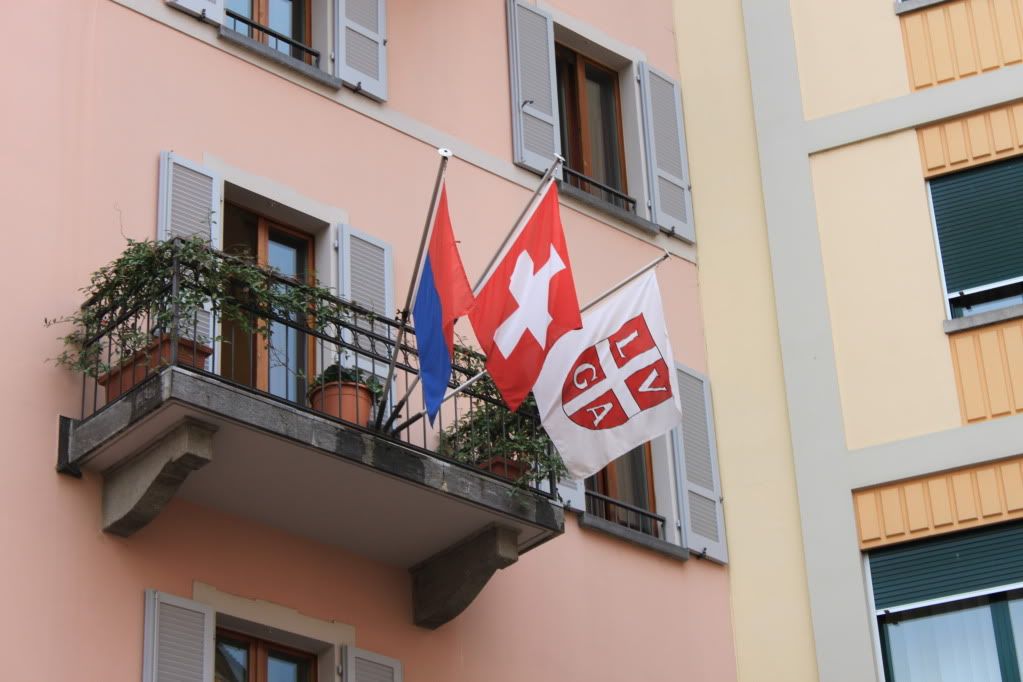
Ticinese Union of London

Unione Ticinese di Londra

A Brief History of the Union Ticinese

The Unione Ticinese is one of the oldest Swiss clubs in the United Kingdom. It was founded in February 1874 by Stefano Gatti, a restaurant-owner and entrepreneur whose family had arrived in London from Marogno in the Val di Blenio a few decades earlier. It was a mutual aid society intended to provide care in sickness and company in health to the increasing number of Ticinesi working as waiters, but also as ice men and other professions, usually as emplOscar Gambazzi, Giuseppe Eusebio, Frank de Maria, revised by Peter Barber, Vita Ticinese a Londra : 125 Years of the Unione Ticinese (London: Unione Ticinese, 1999)oyees of more successful Ticinese immigrants in London. Most members came from the Blenio and Leventina valleys.

Subsidised hospital care and sickness pay were provided and almost from the first members had the right to burial in Society graves in Kensal Green and later in East Finchley. After a rocky start, due in large part to political tensions within the colony and inside Ticino itself, the Society flourished. For the first 70 years it was dominated and financially supported by wealthy Ticinese restaurateurs, and notably by the Gatti and later the Meschini families. It centered its activities on the district between Leicester Square and the Euston Road in London where the largest single concentration of Ticinesi was to be found, though there were smaller colonies in almost every resort along the south coast and in the London suburbs. For many decades members usually met at the Schweizerbund in Charlotte Street, though on special occasions banquets were held at the grander Ticinese-run restaurants, such as the Gattis’ Royal Adelaide Gallery , Monico’s on Piccadilly and Pagani’s, which was owned by the Meschini family.

Since 1945 the Society has altered radically. Its main support now comes from the members themselves. Often these are not native-born Ticinesi but friends of Ticino or descendants who want to learn more about the canton from which their ancestors emigrated. The establishment of the National Health Service and the increasing prosperity of members of the Ticinese colony has led to the gradual abandonment of the Society’s legal role as a benevolent society while the geographical dispersal of the Society’s membership throughout the country has inevitably led to a change in the pattern of its activities. Most notably, the Corale or choir, which was a central feature of the Society as late as the 1950s and early 1960s gradually withered away because of the increasing difficulty of organising rehearsals – and finding sufficient members familiar with the old songs. Dining in restaurants has given way to equally excellent meals prepared by the Society’s catering committee.

Over the same period there has been an increase in the number of lectures and outings. A well-attended barbecue in the Sussex countryside in late June has become an annual event. In its efforts to raise the profile of Ticino, the Society has fostered close links with the Museum of London as well as with the Swiss Embassy in London, other Swiss societies in the United Kingdom and governmental and cultural organisations inside Ticino. Its extensive records, particularly those dating from the 1920s, have been deposited with London Metropolitan Archives and are available over the internet as part of the Archives to Archives (a2a) network (http://www.a2a.org.uk/).

Yet in many ways, the Society would still be familiar to its founding members. Several members of today are descendants of founder or early members. The last days of October sees the annual Castagnata, a celebration in roast chestnuts and wine of what was until recently the staple diet of the Ticinesi. In early February the anniversary of the Society’s foundation is commemorated in appropriate style, often combined with a celebration of Carnevale. The Society’s members continue to have the right to burial in one of the Society’s graves in East Finchley. Elderly members receive a panettone around Christmas time when there is an annual gathering at which small children receive gifts from San Nicolao. The Unione Ticinese remains a family-oriented Society which extends a warm welcome to all who want to join, whether Ticinese-born or not.

If you want to learn more about the Society and the community from which it sprung, these books are available from the Unione Ticinese at £7.50 (including postage and packing within the United Kingdom):

Oscar Gambazzi, Giuseppe Eusebio, Frank de Maria, revised by Peter Barber, Vita Ticinese a Londra : 125 Years of the Unione Ticinese (London: Unione Ticinese, 1999).

Peter Barber and Peter Jacomelli, Continental Taste. Ticinese emigrants and their Café-Restaurants in Britain 1847-1987 [Camden History Society Occasional Paper 2] (London, Camden History Society, 1997).
.

Tuesday, January 11, 2011

A spiritual soul versus and unspiritual soul

Recently, while googling a few key search words, I found an article written by a person of whom I am familiar and have had contact with. This person, I had thought, was a proponent of our people, culture, and history. After scanning this article, I had largely changed my opinion of him.

Of course, you can't really judge a person by something that they might have written or typed at one particular time. Sometimes someone can go in a direction, and it might be misinterpreted. An individual may hold a certain principle that might, depending on the circumstances, be open to interpretation. However, this article made it quite clear, over and over, of what he believed.

He was pleased that our ancestral homeland was accepting massive third-world immigration from 152 different countries, with no end in sight. He was also upset that they weren't being treated well enough. Okay, that was enough of a mouthful, but it wasn't really what bothered me about this article. This person displayed some characteristics of a self-hating person. Every race or ethnic group has some self-hating people. In this case, I am referring to his assessment of what he referred to as the Italian experience in the United States, and he is not American. He believes that there is little difference between any culture within the Italian peninsula, and that Italians were an entirely downtrodden people in the United States, which basically led him to the brilliant conclusion that Italians in Italy have absolutely no right to oppose the new immigrants. He called it a crime against human history, or something of the like.

First of all, he's got everything wrong. I would like to react to him directly, however once I had done this via e-mail, to another person, and I later regretted it. First off, many European immigrant groups did a lot of pushing. They were aggressive people, just like the earlier pioneers, colonists, and settlers had been. Sometimes it was a class struggle, sometimes labor, sometimes xenophobia, sometimes religion, and sometimes it was just a reaction to large scale immigration to already heavily populated urban areas. The Irish immigrants often had it much worse than those who didn't speak English upon arrival. There's a lot to be said about his time period, and I could look further into the dynamics of it, but I don't want to now.

The 1999 HBO movie 'Vendetta' gave, I think, somewhat of a realistic look at probably the more negative aspects of this subject. Personally, I think the labor issue played the predominant role as far as bigotry, rather than religion or ethnicity. Louisiana was already largely Catholic then. Even black laborers opposed what was then large scale immigration. It should be noted that those New Orleans Italians were overwhelmingly Sicilian then, and today their descendants have merged with the French, Irish, Anglo-Saxons, etc. of that time, and are fully part of what might be called the "whites undifferentiated" majority of that state. Also, "national groups" of any background, were frowned upon in the historical South. In other words, the Protestant majority didn't want to see any "German club" or "Irish society." They wanted "American only," which meant "whites undifferentiated" for the most part.

The reason that this issue is being posted here, when it doesn't specifically have to do with our Lombardian heritage, is because this man IS of our heritage and has portrayed himself as a proponent of it. I simply cannot state his name now, in order to avoid damaging an already fragile cross-Atlantic communication with our kindred in Lombardy. 'Vendetta' also portrayed the Sicilian immigrants as being extremely industrious, as well as hard-working. Having grown up partly in what was still a largely "white ethnic San Francisco," with populations of second and third generation people whose grandparents and parents were from many different parts of Europe, I can say that white-on-white bigotry was very small for those assimilated into American society. However, with aggressive people from different backgrounds clashing and competing, even if they were white (back then), some very short-lived tensions could occur, which shouldn't be of any surprise.

There's much more I could look at, but I think I should stop there on that issue. There are legitimate grievances, and there are unreasonable sob stories. Everyone, every person, gets treated like crap at different times in their lives. However, nobody needs to rewrite history because of a bad experience or due to something that they perceive to be true like the person in question who sadly is... one of us. The same people who didn't want anyone in America unless they spoke English and were Protestant, which would not have included our people, are the same people who today adopt Haitian children and support the gay movement. All we should demand is that anyone who associates with us be a real proponent of OUR people. Some of our people might be Protestant, or gay, to use the examples that I just referred to. We're a folk family, period.

One "online friend" of mine is a woman from Wisconsin. I'm not sure if she was born in Sicily or Wisconsin. In any case, she grew up and lives in Wisconsin, the same area that my family came from. She is in her early fifties, a tall slender brunette, classy, a very attractive intelligent woman. She's very Wisconsin, but is proud of her roots, and interestingly is from a family who has maintained very close contact with relatives in Sicily. She has gone back there her entire life. I tend to believe in the "Israel homeland concept," by which a person can live in countries like the United States, Argentina, Australia, etc., while still holding onto their heritage. In other words, they have both their country and their "ancestral homeland" in a spiritual sense.

After I was so turned off by the earlier mentioned person's dark outlook and awful critical thinking ability for a short time, I thought of this woman and it gave me a brighter outlook. Her healthy spirituality, world view, and "can-do" attitude made this man look so small in my eyes. He's basically a bigot who wants to call others by that name. Although I may not be able to react to him like I might like, I feel more at ease that there are bright people like her to offset his bleak outlook.

.

Thursday, December 23, 2010

An Interview with the Slavic Faith Association (by the Odinic Rite)

This was a text interview from either in late 2009 or early 2010, which was not conducted by us, but was published by the Odinic Rite. However, since the OR has removed it from their press service website, and we were able to retrieve it, we wanted to post it here so it would not be lost.

It's so interesting to examine how certain pre-Christian traditions overlapped one another. For example, how the old Gallic paganism (what we call "Cernism") overlapped with Odinism in the north and east or with the British Isles. Also, in this case, how Slavic paganism overlapped with Odinism. There are many common themes and symbols.

One interesting term used by the interviewee was "native believer," or anyone who believes in their specifically ancestral faith. Also interesting is a reference to the Celtic people who lived in Poland in ancient times. Especially around Slenza mountain, as he mentioned. Celtic roots are such a common thread among European peoples, hence the Celtic solar cross found all over from the ancient world.

An Interview with the Slavic Faith Association

OR: What is the name of your organization and what is it’s purpose? What are it’s aims?

SFA: The full and official name of our organization is The West – Slavic Denominational Association “Slavic Faith” (ZZW “Słowiańska Wiara”) but we’re commonly known as “Slavic Faith” or “Slavonic Faith”. Our aim is to deepen our Slavic beliefs, to create a unique philosophy of life and sustain our heritage. Over the past few years we have created an inimitable community of people dedicated to this aims.

OR: When was your organization formed?

SFA: Unofficially the organization was formed nearly 3 years ago. First ideas had been in our minds since about 2004. It took time to find other really devoted neopagans from all around Poland. I became a native-believer about 12 years ego. And I don’t remember such a successful enterprise over the previous decade. This has taught me to be patient.

OR: What are the beliefs of the Slavic Faith?

SFA: Let me quote the first point of the Denomination of Slavic Faith, the most important of our declarations:

“We believe in the Slavic Gods. We believe in the wisdom, goodness and beauty hidden under their countenances. Slavic Gods are the founts of life, power and happiness. Belief in our Gods is the heritage which we continue.”

OR: What are the values of the Slavic Faith?

SFA: The eighth point says:

“We are the defenders of our values, families and community. We defend the right to live on our own territory; we defend the space of our civilization. This duty arises from the most obvious laws of nature.”

The whole 12 paragraphs of Denomination of Slavic Faith is available here:

www.slowianskawiara.pl/wyznanieanglia.html

OR: What are some of the symbols used in Slavic Paganism?

SFA: We have just sent some documents to the polish ministry of internal affairs (MSWiA). these include lists of Slavic pagan symbols. We want to create official documents which specify these symbols and allow us to protect them by law, like the Christian cross, the Star of David or the Crescent. These symbols in most cases have a Solar origin. Some of those aren’t widely known, for e.g. God’s Hands. Picture below:

OR: What is the relevance of the fylfot/swastika to Slavic Paganism? What about the triskelion?

SFA: Of course the swastika was widely known and has been used in Poland for hundreds of years. It has appeared on house ornaments, carvings, costumes. Before World War Two it was even used as an ornament of distinction by some polish corps. But one of the Solar symbols is specially important for us. This symbol is the Swarzyca. A carved Swarzyca symbol appeared in a wall stone on the outside of a collegiate church in Kruszwica (central Poland). We think that this stone block was part of pagan temple from around a thousand years ago.

The Triskelion has also been used in Poland. The Triskelion from the picture below comes from Plock (Central Poland) from the XII century.

OR: What are your holy days and what do you do to celebrate them?

SFA: During the year we celebrate 5 of the biggest ceremonies in Poland. 4 of them are: the autumnal/ vernal equinox and the summer/winter solstice plus Ancestors Day which is around 1st November.

In addition to these five we also celebrate two more international festivals. The most important celebration in Slovakia is Peruns Day at midsummer and the Mokosz celebration in Czech Republic (autumn).

We also have some special events such as the swearing in of a new member of the association as well as Slavic weddings and many more. The Slavonic Faith organizes them all.

OR: What types of rituals do you perform?

SFA: Every celebration contains different types of rituals, prayers, songs and offerings.

Every stanza, every word, every gesture expressed by the priests (we call them Kaplan) has a deep meaning. It’s all based on mythology and our reflections. There is no place for improvisation. When someone is coming to our ceremony unprepared, he might only see… well I would say “poetic performance” and nothing more. But even for people without the necessary knowledge, those festivals always make a big impression.

OR: How important are your ancestors?

SFA: Two of the most important festivals in our calendar are: Slavic Spring (March equinox) and Ancestors Day. Ancestors are very important indeed and I’m not talking only about our community. For all Polish people, the memories of our ancestors is something extraordinarily important. There were so many thousands of martyrs in our history, that the memories of them are still alive. This has really nothing to compare with Western Europe. 1st November is National Ancestor Day. On this day all Polish people go to the graveyards to light candles on the tombs of relatives. If you could see satellite pictures from Poland on that day, it would looks like the whole country is burning.

OR: How important are your folk (tribe/people)?

SFA: I became a native believer because these things were the most important in my life. My community provides me with an environment where I can be a better person. I want to be a better person to help and to support my community.

OR: How are men and women viewed in Slavic Paganism?

SFA: "Slavic Faith is an Oak (symbol of male element in nature) and Linden (symbol of female element) braided together, it’s family it’s union”. Women and Men have different roles to fulfill. I’m glad there are more and more women in our community every year (it was always less women than men). In this way we pursue the full harmony. Of course we are against mixing up the natural roles of both sexes in society. We’re traditionalist.

OR: What do you believe about death and life after death?

SFA: I must refer again to the Denomination of Slavic Faith:

“We assume that the death of a man ends a certain stage. It is the condition of the transformation into a new form of existence. It is the shedding of the old, exhausted form. The noble and persistent ones will be rewarded with entering into continuously higher and higher levels of existence, more conscious, more significant and closer to the Gods.”

It’s a very complex problem (of course it is), but what we try to avoid is giving people simple answers. This is the Holy Book, read it, do what we tell you and you gonna be saved – at least that is how monotheistic religions work. We don’t know exactly what happens after death. The core of pagan philosophy is to keep trying to understand the world around us. We have to improve our knowledge. If you want achieve something you must refer to your strength and will, you won’t get anything valuable for free. That is why our religion is never gonna be very popular. We don’t give simple answers for everyone.

OR: Are there any sites which are particularly holy to Slavic Paganism? Could you tell us about them?

SFA: There is many of these places. But I wish to tell about one specific place. It’s the Slenza mountain, 30 km south of Wrocław. It is only 718 meters above see level, but it’s an absolutely magical place. It’s the pagan heart of Poland. It’s a place where you can find remnants of Celtic tribes, a place where pagan rituals have been performed for hundreds of years after the christening of Poland. And a place with a few thousand years old Solar Altar, even an armed cross carved on a big megalithic block hidden somewhere half-way up the Mountain. At the foot of the Slenza, the Slavic Faith organize ceremonies.

OR: How do you see Slavic Paganism in the modern world? Is it relevant to today?

SFA: It is relevant. Relevant for my community and in a cultural aspect relevant for my country. I would say it’s also relevant for Europe. European culture is slowly dying. Careless about heritage and our roots, Europe is becoming another cosmopolitan place. We are probably one of the last bastions of tradition and culture. And I always emphasize, that we are not pagans from Xth century. We are modern living people. We not trying to live the way people lived thousand years ago. We struggle with today’s problems and the neopagan religion helps us deal with the present.

OR: How does your faith affect your day-to-day life?

SFA: I’m one of the fifteen sworn members who are trustees. We have a lot to do. Sometimes the Slavic Faith is like a second job for me.

OR: What do you see for the future of your faith? What role will it play?

SFA: I think the future is bright for us. As an organization we are growing up quickly. We are going to buy some land which will let us organize celebrations without any permission. We want to publish books about our beliefs in the near future and also to persuade the government to enlarge the content of school books about paganism. We want to officially register the Slavic Faith as a legal entity. We also want to strengthen cooperation between pagans from all Slavic countries and also cooperate with other European native believers. (We were thinking about creating an international association to help people to cooperate all around Europe) And many other ideas.

OR: How does society react to you? You are based in a country that is known for it’s Catholicism. Does that create any problems? Have you ever had to deal with discrimination or persecution? If so how do you deal with it?

SFA: I must say, we never have any problems with Catholics. So far so good. We had one serious incident when the police didn’t allow us to celebrate the Spring Festival in a public park. (I don’t think that this was religious harassment, rather pure stupidity) But we know how to execute law, so this case is now being considered in the public prosecution service.

OR: Do you see any similarities between Slavic Paganism and Odinism? The mythology and/or Gods? The value systems? Etc.

SFA: I must say 90% of values represented by Odinism and Slavic Paganism are the same. Heroism, family, the maternal instinct, friendship, loyalty, bravery, honesty. It can’t be different, after all we descended from the same cultural circle . All differences are based on different cultural foundations. And of course these differences are very important. These differences make us unique. What is good for a Buddhist not necessarily must be good for an American. What is good for an American Indian is almost certainly wrong for a German. Monotheistic religions assume the all human kind is this same (at least ought to be). As children of one God we should learn from one holy book and have the same system of values. Sometimes it looks like some insane idea of mixing up everyone to create some amorphous cultural pulp. We should learn from each other, which doesn’t mean trampling out our own culture.

Similarities between Gods ? Well, there is so many common notions, and many of them are so evident. Thor – God of warriors, who sends thunder strokes from heaven. Slavonic God – Perun – God of warriors, who sends thunder strokes from heaven. I can give hundreds of these examples. Sometimes I’m really surprised by how much we have in common.

OR: Where can one find more information about your faith in general and your organization in particular?

SFA: Unfortunately there is no much English language literature about Slavic mythology. This is obviously the fault of the Slavs themselves. We know a huge number of really good scientific publications which have never been translated into English. As an association we have to take action; in the future we’ll translate the most valuable works into English and other European languages.

The simplest way to meet us is to click on: www.slavicfaith.com Here you can find the English (simplified) version of our website. For more news about our activities you can contact ours representatives via the e-mail addresses available on this webpage. We willingly provide information about our activities.

OR: Do you have anything you would like to add?

SFA: I really wish to see you one day at any of our festivals. As native believers we are a really small bunch of people. We don’t even compare to any of the monotheistic communions. That’s why it is so important to cooperate. And by cooperation I mean all kinds of intellectual, spiritual and moral support.

Slavic Faith Association

Przemysław Mrugacz – Executive Member

.

Wednesday, December 22, 2010

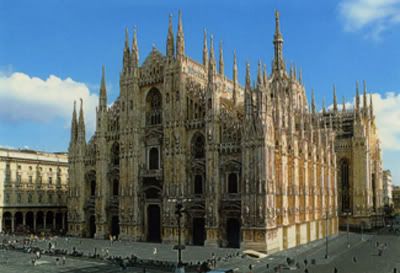
The Milan Cathedral: Iconic image of Milan and Lombardy

The Milan Cathedral has long been the single strongest iconic image of both Milan and Lombardy. Incredibly, it took five hundred years to complete its construction. The history of it's construction is so long, and the architecture so complex, that I will not put the entire Wikipedia page here.

From Wikipedia -- Milan Cathedral (Italian: Duomo di Milano; Milanese: Domm de Milan) is the cathedral church of Milan in Lombardy, northern Italy. Dedicated to Santa Maria Nascente (Saint Mary Nascent), it is the seat of the Archbishop of Milan, currently Cardinal Dionigi Tettamanzi.

The Gothic cathedral took five centuries to complete. It is the largest Gothic cathedral and the second largest Catholic cathedral in the world.

The American writer and journalist Mark Twain visited Milan in the summer of 1867. He dedicated chapter 18 of Innocents Abroad to the Milan Cathedral, including many physical and historical details, and a now uncommon visit to the roof. He describes the Duomo as follows:

"What a wonder it is! So grand, so solemn, so vast! And yet so delicate, so airy, so graceful! A very world of solid weight, and yet it seems ...a delusion of frostwork that might vanish with a breath!... The central one of its five great doors is bordered with a bas-relief of birds and fruits and beasts and insects, which have been so ingeniously carved out of the marble that they seem like living creatures-- and the figures are so numerous and the design so complex, that one might study it a week without exhausting its interest...everywhere that a niche or a perch can be found about the enormous building, from summit to base, there is a marble statue, and every statue is a study in itself...Away above, on the lofty roof, rank on rank of carved and fretted spires spring high in the air, and through their rich tracery one sees the sky beyond. ... (Up on) the roof...springing from its broad marble flagstones, were the long files of spires, looking very tall close at hand, but diminishing in the distance...We could see, now, that the statue on the top of each was the size of a large man, though they all looked like dolls from the street... They say that the Cathedral of Milan is second only to St. Peter's at Rome. I cannot understand how it can be second to anything made by human hands."

.

Tuesday, December 21, 2010

First Ever Pagan Metal Documentary


1 of 12 parts. Keep clicking for the next segment on the upper right >>> Part 2, and so on..


Posted on YouTube channel Valmarith

From the video description:

The first ever Pagan Metal Documentary.

By Bill Zebub

Featured Bands:
Korpiklaani,
Primordial,
Finntroll,
Ensiferum,
Leaves Eyes,
Turisas,
Týr


************************************************

Many times, folkish music can be a great way to reach younger people who many be looking for an identity and direction. It doesn't mean that someone really needs to be a pagan, but it can be a very deep, down-to-earth way of attracting them. The youth will be the future. Finer aspects of culture can come with maturity later, if necessary.

.

Monday, December 20, 2010

Minnesota: "Beltrami Country"

Although we have covered the history of Giacomo Beltrami, the famous explorer from Lombardy, it's worth noting that Minnesota has a number of place names in his honor. Like so many subjects, it always seems like we can't quite do them justice. Beltrami lived an incredible and adventurous life.

First, there is Beltrami County, Minnesota, in the north of the state. Next, there is the city of Beltrami, Minnesota, in the northwest of the state. Lastly, there is a neighborhood named Beltrami in the state's largest city, Minneapolis.

There are likely many other names of streets, parks, etc., which bear his regional iconic name. Beltrami explored the American frontier starting in the 1820s. This country wasn't very old at that time, and Minnesota was largely unexplored by Americans. It's hard to imagine that today, but it had really been less than fifty years since the Revolutionary War.

Now, as we look back today, from a "Lombardian-American" perspective, it's ironic that there was significant later immigration from Lombardy to that Great Lakes region. Places like Duluth, Minnesota and Iron Mountain, Michigan; and other places more eastward, on the American and Canadian sides of the lakes. There's a whole history that we need to dig through. We're really just painting some very broad strokes here. There were a couple of notable Lombard Catholic missionaries in the Wisconsin area, who were sent to teach and convert the local natives. One even wrote a book to help preserve their disappearing language. I don't recall their names offhand, but I can see a definite pattern, over a long period of time, of Lombards in this northern-Midwest area.

[Left: Early Duluth]

I know that I've repeated this theme a number of times, but getting information in this area of study is like pulling teeth. As patterns develop, it's both exciting and frustrating. I can say with reasonable certainty that nobody has written about Lombardian history in North America, except Lombardi nel Mondo in Italian-only publications.

One local exception is a book about "The Hill" in St. Louis, I don't recall the name offhand, which was a Milanese/Lombardian district within nineteenth century St. Louis. I had posted a very interesting article about the history of The Hill in an earlier website, which dealt with specifically Lombard culture there, but I may have lost it unfortunately. However, there is the book, and we can eventually find the information again.

.