Thursday, March 25, 2010

Ancient Camunic language and modern Camunian dialect

The ancient Camunian language, and the more modern Camunian dialect, are two different languages. However, the modern dialect likely developed from the ancient language. The Camonica Valley is one of the most remarkable regions in European history. So small, yet able to maintain an incredible cultural continuity for thousands of years. For example, some Rosa Camuna images, as well as other ancient symbols, have been dated at six or eight thousand years, while others are dated at fifteen hundred to two thousand years. The language seems to follow this similar pattern. Also, big upheavals, such as the invasions and/or influence of Gauls, Etruscans, Langobards, Romans, Napoleon, Venetians, and Austrians, over thousands of years, did not interrupt this process.

Camunic language (from Wikipedia; with images):

"The camunic language is an extinct language, spoken in the I millennium BC in some valleys of the Central Alps (Valcamonica, Valtellina) and not deciphered.

"The epigraphic corpus is carved on the rock, as similar as the rock engravings of Valcamonica, in one variant of the north-Etruscan alphabet, known as camunian alphabet or alphabet of Sondrio.

"It is possible that the language was related to camuna Rhaetian language; its name derives from the people of the Camunni, who lived during the Iron age in Val Camonica and was the author of much of the stone carvings in the area.

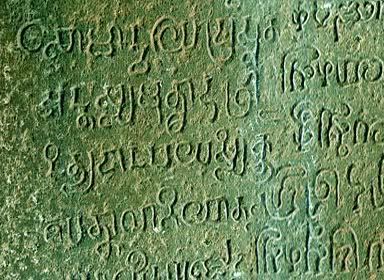
"Today there are known at least 170 inscriptions in camunian alphabet, that are written in lines even from right to left than left to right. The iscriptions are formed mainly by one or two words, and many are those ending in "-au".

"Were found few alphabetaries (a series of letters aligned to forming an alphabet) in Nadro (Zurla and Foppe localities) and in Piancogno, next to the Annunciata. These alphabetaries presents variants of each other, but allow us to date the inscriptions from the 4th to 5th century BC to 100 BC-50 AD)."

Another area which we have covered in the past is the alphabet of the ancient Camunni. In the link is the information sent to us from Naddeo Michelangelo. For further reading on this subject of ancient text, see his website at http://www.michelangelo.cn/. For a look at the characters of the ancient alphabet of the Camunni, see the following link at Wikimedia Commons.

The modern Camunian dialect is a variation of the "Eastern Lombard" dialect, which is eastern Lombardy. As we have pointed out before, and stated on this Wikipedia page: In Italian-speaking contexts, Eastern Lombard is often generically called a "dialect". This is often incorrectly understood as to mean a dialect of Italian, which actually is not the case, it's not a dialect but a language. Eastern Lombard and Italian are different languages and are not mutually intelligible. Eastern Lombard is, in turn, a sub-branch of the Lombard language.

Mauro Fiora has assembled an online Italian-Camunian translator, which has the lists of words by letter, as well as a Babelfish-syle translator. Needless to say, and please look for yourself, "Italian" (Tuscan) and Camunian are as different as English and Polish. What is further remarkable, is that the village of Sonico, and it's immediate surrounding area, speak even a sub-branch of the Camunian dialect!

I wanted to give just a few examples of Camunian words. First, Al Camònega stands for Valle Camonica, with the "Al" meaning "Valley." As with many words, it's different in "Sonican," ..... "Valàr." Also remarkable is that about half the words do not end in a vowel. Many resemble ancient Germanic or Celtic words, but have a unique flavor of their own, very different than the European regional languages that we may be familiar in the English speaking world: English, French, Spanish, German, Italian, etc.

One way to get a real sense of the language is to go to the Italian Wikipedia link: Comunità Montana di Valle Camonica. Then see the list of Camunian villages down on the right side. Click each one, taking you to that respective page, where you can see at the top along with the Italian name.... the Camunian name of that village. In other words, the REAL name. For example, lets take the first one: Angolo Terme. The proper Camunian name is Angól. Monno is Mòn, Gianico is Janec, Borno is Búren, etc.

On the Italian Logos translation website, which seems to be still in the developmental stage, one can search various words in many different languages. Included in these are "Bresciano," "Bergamasco," "Bolognese," "Furlan," as well as other variations of French and others. The translated word, for example, of "family" is family (Engish), famiglia (Italian), familia (Spanish), famille (French), familie (German), familje (Albanian), famija (Brescian), famigghia (Sicilian & Calabrese), famèe (Furlan), and numerous other words in numerous other sub-branches of French, German, etc. "Bresciano" is basically Eastern Lombard, and family in Camunian is famìa. In fact, in Sonican it is Baghècc.

On the television program 'Cake Boss' on the Learning Channel, the show begins with the proprietor of the Hoboken bakery, Buddy Valestro, a Sicilian-American, proclaiming "Mia Famiglia!" Actually, that's TUSCAN. The Sicilian word for "family," as we covered above, is "famigghia." It sort've makes me feel like using the word baghècc just to disagree with the forced paradigm.

I searched the word "market," which earlier had brought me a number of interesting linguistic variations, but it's not working now. In Bresciano, it was "mercàt," (same as in Camunian), as opposed to the Italian "mercato." This is no small potatoes. A language is the birthright of a people! I'm not referring to the United States, as we, or our recent ancestors, accepted the English language.

The Italian book entitled 'Vocabolario Bresciano-Italiano' by Giovanni Battista Melchiori is a more official source for the Bresciano/Camuno dialect of the Lombard language.

[4/12/10 NOTE: Apparently the word "family" is translated as "famija" in all of the Lombard dialects, except Camunian which is "famìa." Also the sub-Camunic variant of "family" is "baghècc" in Sonican, as was covered.

Lastly, I couldn't help but add one other word that really drives home the variations down to Camunian, and Sonican. The word "council" is "consiglio" in standard Italian (Tuscan), "Consèi" in Brescian/Camunian, and "Fabrisiér" in Sonican!

I couldn't easily search out what the word is in Lombard or East Lombard, but we can plainly see that one little community of villages (Sonico) can literally develop it's own language over centuries of continuity. How do we know that this tiny regional dialect wasn't some surviving remnant of ancient Camunian, ancient Langobard, Celto-Alpine, etc?]

.

Sunday, February 7, 2010

Interview with a Gaelic Polytheist

Interview with a Gaelic Polytheist

CC: You previously mentioned that you were a “Gaelic Polytheist.” What is Gaelic Polytheism, and is it the same thing as a “Celtic Reconstructionism?”

GP: Gaelic Polytheism is a branch of Celtic Reconstructionism. We recognize that the various peoples who are today called “Celtic” were, in fact, distinct societies, each with their own language, culture, and pantheon. As Gaelic Polytheists, we practice the Gaelic tradition exclusively; that is, the traditions of Ireland, Scotland, and the Isle of Man.

CC: Does it primarily deal with the pre-Christian pagan traditions? (as opposed to focusing on all aspects of culture and history)

GP: Gaelic Polytheism is based in pre-Christian Gaelic spirituality, though it incorporates a great deal of living tradition from the Gaelic lands. We recognize that the Gaelic peoples have living cultures, and that much of what we find as folk traditions in those lands are survivals of pre-Christian traditions. We do not want to practice the religion as it existed 2,000 years ago; we want to practice it as we believe it would be today if it had never died out.

CC: Are you also a actual practitioner of some aspect of what is referred to as “Celtic Reconstructionist Paganism? If so, what specific tradition?

GP: Yes, Gaelic Polytheism is the Gaelic form of CR.

CC: How would you assess the power of the Druids in Western Europe, prior to Roman influence? Some people believe that they had tremendous influence.

GP: We find clues to the what the role of the ancient Druidh was in the Gaelic lore. I do not speak for the other “Celtic” traditions, but we see that in ancient Ireland and Scotland, the Druid was highly respected, often having a place of honor beside the king, and being his top advisor. He also was known for having powers of magic and divination. Unfortunately, most of this knowledge has been lost to us.

CC: Is the concept of a predominantly male-dominated Druidic system, and the predominantly female-dominated Cernunnos-based Witchcraft tradition, exaggerated, or even true?

GP: Cernunnos was not a deity known to the Gaelic peoples, so I really have no answer to this.

CC: You had previously stated how eclectic and historically inaccurate the Wiccan or neo-pagan movement is. Can you comment on that? Also, do you believe that these modern movements have served any type of modern psuedo-political agenda?

GP: Neopaganism is a new religious movement which is largely based upon post-modern philosophy, medieval ceremonial magic, and some ancient Pagan traditions. However, most of the actual Pagan tradition that has been blended in has been altered from its original form and made to fit into the Wiccan or Neopagan mold. This is nothing short of cultural theft, and while we must respect their right to practice whatever spirituality they wish, I do not condone the co-opting of Gaelic deities or traditions into Neopaganism when they are not accurately portrayed.

CC: What are some of the chief symbols used by Wiccans, which you do not attribute to a Celtic or European origin?

GP: The most common is the Pentacle, which had no place in Gaelic or any other Celtic culture. The Triple Moon symbol is a 20th Century creation and was unknown to any ancient people.

CC: The Wiccan Revival of the twentieth century seemed to have been brought about by Freemasonic men in the UK. Might this initial Freemasonic influence, itself eclectic, Eastern, and universalist, have rubbed off on modern Wicca?

GP: Wicca certainly seems to have been influenced by such movements as Freemasonry and, without doubt, by ceremonial magic.

CC: Historically speaking, both spiritually and in social relations, how would you describe the interaction between the “Gaulic, Gaelic, Druidic” cultures, and the more Teutonic/Odinic peoples?

GP: These two peoples were closely related and there was a frequent exchange of population between them. They share nearly all of the same values, and some common themes appear in their lore. Some scholars believe that the Germanic peoples may have branched off of some paleo-Celtic people group. Whether this is true, the fact is that these two cultural groups have strongly influenced one another.

CC: Can you elaborate further on Gaelic Polytheism. What does it mean to you?

GP: One of the most important things for me is knowing that I am helping to revive and perpetuate the traditions of my ancestors. In fact, reverence for the ancestors is a strong theme in Gaelic tradition, and we definitely seek to reconnect with and honor them.

CC: Can you comment on the ancient seasonal “Wheel of the Year” as far as where it fits into history, and it’s significance?

GP: It seems to be a 20th Century fusion of traditions from various cultures. The ancient Gaels knew four seasonal festivals, which we as Gaelic Polytheists still observe today: Samhain, Imbolg, Beltain, and Lughnasadh. The ancient Gaels knew of the solstices and equinoxes, but there is not evidence that they observed these dates as religious festivals. A few GP’s may follow the 8-festival Wheel of the Year, but that is not the norm.

CC: You had stated that you do not believe that there was a definitive "Celtic culture" in the ancient world. Without necessarily mentioning names, what is your opinion of the current international groups which were organized to facilitate this "Pan-Celtic" concept?

GP: I think to some degree they are helping to perpetuate an interest in the various cultures that have come to be called "Celtic", even though the Pan-Celtic concept itself is a modern fantasy. I used to be Pan-Celtic myself several years ago, and the more I studied the ancient traditions, the more I realized that they were very distinct. I then learned that reputable historians agree with this assessment.

Also, it should be noted where the word "Celtic" itself originated. The ancient Greeks referred to the bararian tribes who lived to the north of them as "Keltoi". It is ironic that so many centuries later, some people decided that the term should be applied to the inhabitants of the British Isles, who are not the descendants of the Keltoi, and are only distantly related to them.

CC: How would you quickly sum up the affect of early Christianity on paganism, especially in what were considered regions of Celtic settlement?

GP: The conversion of the Gaels was not as bloody or brutal as the conversion of the Germanic peoples and some others. The early Celtic Christian Church simply blended traditional Gaelic spirituality with the Christian faith to create a system where followers were free to honor Christ at the same time as Brighde, Daghda, etc. This period of blended faith lasted several centuries, and in fact, it could be said to still exist today, since many Gaelic Christians still honor Brighde as a saint, and may give honor to the spirits of nature as well.

CC: We have a concept that we would like your opinion of. The chief deity, of which the Wicca religion is based on, appears to be the horned god Cernunnos. Correct?. Since one of the alternate names for this deity is “Cern,” couldn’t this tradition be called “Cernism” in a revisionist direction? (in the same way as Odin and Odinism)?

GP: Again, Cernunnos is not a deity known in our tradition, so I’m not really qualified to speak to this.

CC: Where do the hundreds of very ancient megalithic monuments located largely in the British Isles, like Stonehenge, fit into the Gaelic Polytheist belief system?

GP: Stonehenge itself is in an area that has never been the home to any Gaelic tribe, so it is pretty irrelevant. We do see other stone circles, such as Calanais, which are in the Gaelic lands, but these predate the Gaels. Likewise, Newgrange in Ireland, which is aligned to the Winter Solstice, is of pre-Gaelic origin.

I'm sure many Gaelic people appreciate these sites as historical landmarks, and even for their spiritual significance, but they were not constructed by Gaelic people, and I'm sure they had much greater significance to the people who actually did build them.

CC: Are there any other subjects which we have missed, but are of importance? If so, can you elaborate on them?

GP: Thank you for the interview. This is actually my first chance to speak for Gaelic Polytheism to people outside our movement. You will find some variation within GP and some may have even answered these questions differently than I did. But I believe I have represented our movement accurately, as far as what the concensus would be on these subjects

We simply seek to restore the spiritual traditions of our ancestors within a modern context. Though some things have been lost, we would rather fill in the blanks with our own innovations which are rooted in our knowledge of Gaelic lore and tradition, rather than borrow from another culture or from a Neopagan tradition.

Being a Gaelic Polytheist is as much about culture as it is religion. To follow this path, one must be willing to study and immerse oneself in Gaelic lore, folk tradition, values, language, art, culture, music…basically, to carry on not only the religion of the ancient Gaels, but the traditions of the living Gaelic cultures. This is an ethno-cultural tradition.

I may recommend a couple of websites if you wish to have more information.

http://www.gaolnaofa.com

This is a GP organization in which I hold membership. The website has a great deal of information and resources.

http://www.paganachd.com

This is another Gaelic Polytheist website, which has an excellent and very lengthy FAQ about the movement.

Thanks again for the opportunity to speak with you..

Froach MacFhionghain Stiubhart
froach222@yahoo.com


.

Monday, January 4, 2010

"Cernism" and the Camonica Valley

This entry is something of a continuance to the October 25, 2009 Padanian-American League blog entry entitled "Cernism: Finally giving a proper name to an old tradition." The subject of the Celtic pagan deity, known today mainly under the title of Cernunnos, can be a little bit confusing when we try to search for an origin. Although usually attributed as being born from Celtic/Gallic culture, there seems to be at least some overlap with the Germanic world. Also, to add to the confusion, as stated in the Wikipedia Cernunnos webpage: "The earliest known probable depiction of Cernunnos was found at Val Camonica in Italy, dating from the 4th century BC, while the best known depiction is on the Gundestrup cauldron found on Jutland, dating to the 1st century BC." However Wikipedia does clarify part of the issue, as it went on: "The Cauldron was likely to have been stolen by the Germanic Cimbri tribe or another tribe that inhabited Jutland as it originated from south east Europe." One of the best depictions of Cernunnos exists on Gotland Island near Sweden (see Wikipedia link above for a good image of it). Despite that, the tradition clearly is most identified with the Celts.
Although there was some later Celtic influence at times in the Camonica Valley, it does seem odd that the earliest depiction of Cernunnos is found there. That is, the earliest depiction anywhere in Europe. The ancient Camunni were not Celtic, but an Alpine tribe, with roots that go back many thousands of years. The roots of Celtic culture has been strongly linked to what is today the southern reaches of the German-speaking world. Could this spiritual tradition have been passed from the Camunni to the earliest Celtic tribes of the more northern Alpine region? That might seem like a stretch, until we consider that there was a distinct type of culture in the Camunian Valley that has been estimated as being as old as ten thousand years. Scholars seem to at least give a safe estimate at about eight thousand years, but still very old. The Hebrews only go back six thousand years!

The "Cernism" article was mainly to put out the idea that Cernunnos is basically the origin for what passes as modern "Witchcraft" or "Wicca." Wicca is eclectic and universalist, and is only very loosely tied to ancient European Witchcraft. In other words, to add Cernism to the lexicon of neo-paganism once and for all, and present it as an alternative for those who have been disappointed with the direction of Wicca.

The answer to the question of the true origin of the Cernic tradition may never be definitively satisfied. One thing is certain, Cisalpine Gaul, and more specifically the little ever-spiritual Camonica Valley, were a very early part of it. Also, it strongly defines the chief, pre-Roman, spiritual tradition of most of Western Europe.

**************************************************

2-5-13 Addition: I wanted to add a small item from the news in the last week to one of the posts regarding the Cernic tradition... one that I thought was relevant to it. Leading up to Super Bowl XLVII, and also regarding professional athletes from other sports, a small degree of controversy surrounds the use of a performance-enhancing product called by some "deer antler spray." To quote the the UK's 'Daily Telegraph': "Manufacturers claim the product is made from the velvetlike tissue that covers the antlers of male deer..." (see also 'Does Deer Antler Spray Work?' from LiveScience.com). Although perhaps only in a superficial way, this concept ties into the perception of how the antlers of a stag were considered a symbol of male virility, strength, and courage in ancient European cultures. Cernunnos was a "stag god," and was depicted as a man with antlers.

.

Saturday, December 5, 2009

The flags that we use

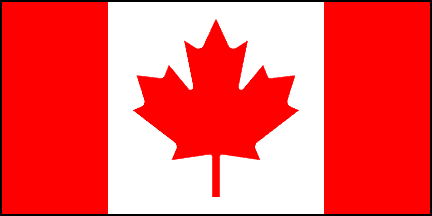
We use the Canadian flag for a number of reasons. First, we see it as a symbol of the entire continent. Because we are so small in number, and are so spread out, localization is not practical as it is with some of the Camunian Folk Association (Associazione Gente Camuna) groups in a few European cities. In this way, people of Camunian descent, whether in Pennsylvania, Florida, California, or Quebec, can feel connected to our unique folk family concept. Other reasons include a symbol of Canada and it's huge land mass, which along with Alaska, make up most of the continent. Also, when looking at a the earth, it symbolizes the great white north in a sense.

We can view ourselves, beyond a regional or ethnic group, as a large family spread out over a vast land mass. We would like someone in Anchorage to feel just as connected to us as someone in Chicago. Let us think of the entire continent, from the Aleutian Islands to the Panama Canal, as possibly where our Euro-Camunian kindred may be living or working

The other flag over on the top left, is a modern colorized flag based on the symbol of the ancient city of "Cividate Camuna" from Roman times. The Romans, after conquering the region, formed administrative cities like this to tie them into the empire. It showed that the Romans clearly saw the Camonica Valley as a distinct region.

Friday, December 4, 2009

Camonica Club of North America

After a long, somewhat embarrassing, series of attempts at organizations and councils to facilitate something in the area of Lombardian/Brescian heritage in this part of the world, we have finally settled on the Camonica Club. Although we have stated this before, time will probably show that this was the one.

Our focus will be on, first Camunian heritage; and second on Brescian, Orobic (East Lombardian), Lombardian/Ticinese, original Austrian (the Langobard province of the Lombardy/Tri-Veneto/Trento region), Padanian, Alpine, and European heritage. This should also include our spiritual heritage: from the ancient Cernic tradition to the Ambrosian Rite.

It should be noted that Lombardi nel Mondo seems to have a regional council in North America, which is devoid of any type of outreach, or even an attempt at creating any interest in Lombardian heritage. There are also a few chapters of Pro Ticino (Ticinesi nel Mondo) in California, and Bergamaschi nel Mondo around the Toronto and Montreal areas, and perhaps a few others.

We would also like to make contact with Camunian cultural organizations and associations in Lombardia. We have have had some contact in the past, but we have probably confused them with our frequent organizational name changes. Hopefully that will clear up in short order.

Tuesday, November 24, 2009

Val Camonica Witch Trials


Val Camonica Witch Trials

The Val Camonica witch trials were two large witch trials which took place in Val Camonica in Italy, in 1505-1510 and 1518-1521. They were among the biggest Italian witch trials, and caused the deaths of about 60 persons, in each trial: 110 in total.

The best source for the trials is considered to be the Venetian Marin Sanudo, who was the chronicler to the Council of Ten from 1496 to 1536. The documentary evidence was destroyed by order of Giacinto Gaggia, the bishop of Brescia, to prevent it from being used by the anticlerical opposition.


Cernunnos

Cernunnos (also Cernenus and Cern) is a pagan Celtic god whose representations were widespread in the ancient Celtic lands of western Europe. As a horned god, Cernunnos is associated with horned male animals, especially stags and the ram-horned snake; this and other attributes associate him with produce and fertility. Cernunnos is also associated mainly as the God of the Underworld.

Everything that we know about this deity comes from two inscriptions from France and one from Germany.


[Music: 'Butterfly' by Tapping the Vein; 'I Walk Alone' by Tarja Turunen; '(Theme From) Midnight Express' by Giorgio Moroder]


Sunday, October 11, 2009

The "Real Austria"

Today, the word "Austria" is used in the English-speaking world to more easily refer to the German-speaking country of Österreich. In fact, this term was first used, in the former nation of Langbard, as the name of the eastern sector of the nation.

From 'History of the Lombards', page 245, footnote 1 in regards to an Austria reference (Edward Peters): "This name was used to designate the eastern part of the Langobard kingdom, and was often mentioned in the laws of king Liutprand (Waitz). Its western boundary was the Adda, and the land west of that stream was called Neustria, which, with the third division, Tuscia, constituted the main kingdom immediately subject to the king, as distinguished from the duchies of Spoleto and Benevento."

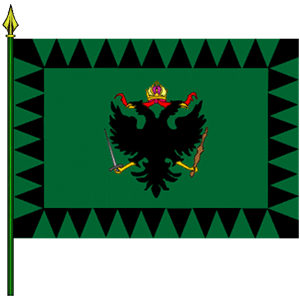
All this is further confused as Österreich had it's heel firmly planted on "Austria" (Lombardy, Trentino, and the Veneto) many centuries later. The above flag is either the flag of the "Langobard Austria" or a flag of the Österreich occupation. It's likely the original, since the official flag for the occupied "Lombardo-Venetia" puppet state was a tan flag with an arms of both Lombardy and the Veneto on it. The double-headed eagle was used by many European cultures over the centuries.


[Above: The three states in Langbard proper. Neustria, Austria, and Tuscia. Yes, Tuscany was part of Langbard.]