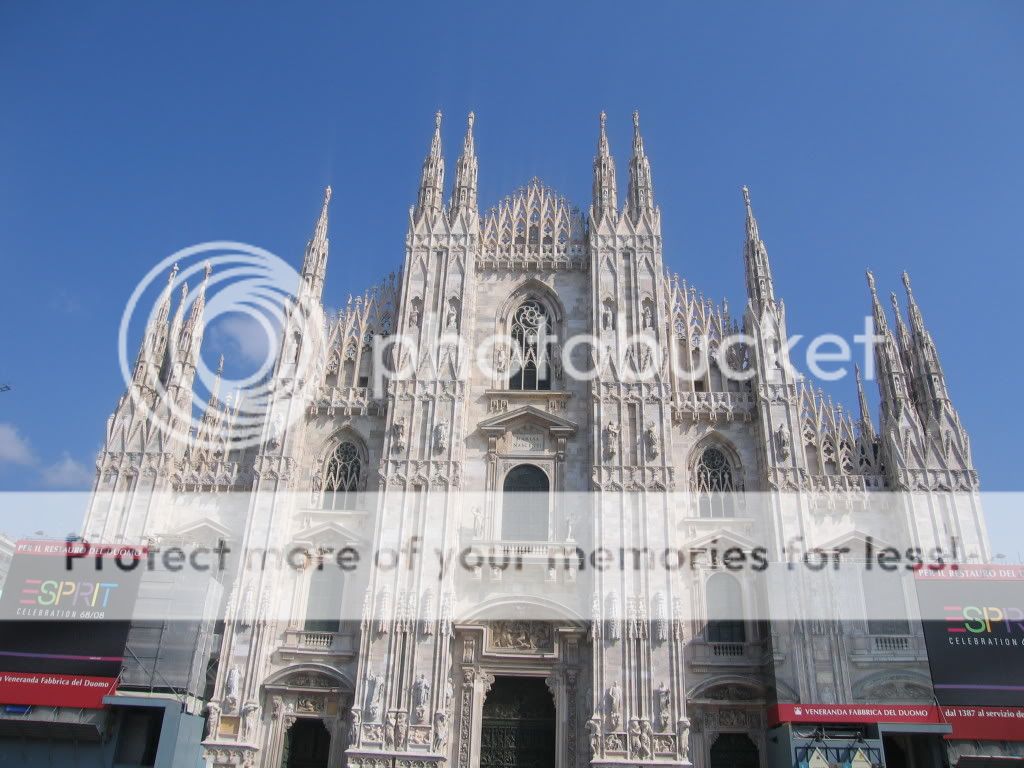
 Bresciani nel Mondo - Northern California now has a new official website. This blog will remain the active arm of the association however. We would like fit into the landscape of the Padanian-American League, Lombardi nel Mondo - Area Nord America, and the Lombardian American Alliance.

Thursday, March 12, 2009
Bresciani nel Mondo - Northern California: Official Website
Bresciani nel Mondo - Northern California now has a new official website. This blog will remain the active arm of the association however. We would like fit into the landscape of the Padanian-American League, Lombardi nel Mondo - Area Nord America, and the Lombardian American Alliance.


Saturday, March 7, 2009
The Radetzky March
From Wikipedia: "Radetzky March
"Radetzky March, Op. 228 is a march composed by Johann Strauss Sr. in 1848. It was dedicated to the Austrian Field Marshal Joseph Radetzky von Radetz, and became quite a popular march among soldiers.
"When it was first played, in front of Austrian officers in attendance, they promptly clapped and stomped their feet when the chorus was played. This tradition is carried over today when the march is played in classical music venues in Vienna, among members of the audience who are familiar with the tradition. It is almost always played as the last piece of music at the Neujahrskonzert, the Vienna New Year Concert.
"Despite its military nature, its tone is rather festive than martial, in accordance with its dedicatee's exuberant personality and popularity in the ballroom as well as the battlefield. It is usually played in under three minutes.
"Radetzky March consists of three main parts:
"* The introduction: The whole orchestra plays here and the brass section plays the melody.
* The first figure: This is played by the string section.
* At figure two, the whole orchestra plays until figure three when it repeats back to the D.S. (first figure.)
* The trio: This is played by the brass section and the trumpet plays three triplets in the last bars of the trio.
* Figure five: The whole orchestra plays here.
* Figure six: The whole orchestra plays here and then repeats back to figure 5.
* The orchestra plays on the last bar.
* They go back to the D.C. (beginning).
* They play until figure three; and the piece finishes with the Fine ("end") bar -- i.e., the direction is Da capo al fine (repeat from beginning up to the word fine).
"Lists of miscellaneous information should be avoided. Please relocate any relevant information into appropriate sections or articles. (March 2009)
"* Danish football club AGF Aarhus play the Radetzky March in their stadium every time a goal is scored by the home team.
* The 1932 book Radetzky March by Joseph Roth, depicting several generations of a military family in the last period of Austria-Hungary was inspired by the Strauss music.
* The march plays an important role in several armies around the world, and its presence demonstrates the influence that Austria made in the countries whose armies play it. Chile's Army's Officers' Academy "General Bernardo O'Higgins" plays the Radetzky March because of the system imposed in it by German officers in the between world wars era. Radetzky is one of the central parts of any of their ceremonies.
* In the film Battle Royale, the teacher Kitano plays the Radetzky March during his first report.
* In the film Werckmeister Harmonies, the march is played in two consective and constrating scenes; first, when Valuska visits Tünde and the drunken police chief, who are dancing to it, and in the following scene, when Valuska attempts to put the police chief's children to bed.
* In the TV series The Prisoner, the march is a notable part of the repertoire of the Village band.
* It was the theme song of the Finnish children's programme Pelle Hermanni, this version was played with a barrel organ.
* The song is played on all El Al flights prior to take-off.
* In Back to School, Mr. Bean, the Radetzky March is played over a horn speaker at the beginning of the episode, with a group of cadets marching.
* On Aristocrat Slot Machines[dubious – discuss], the introduction is played when a jackpot is won."
Further reading:
The Radetzky March (within the context of the Austrio-Hungarian or Happsburg Empire)
Cinque Giornate Revolt (Five Days Revolt in Milan - 1848)
I am not certain as to whether or not this march was composed before or after the Milanese revolt in 1848. It makes little difference, as it was in reference to Radetzky's army marching and conquering Lombardo-Venetia. It is frequently stated that "Italians hate the Radetzky March," which is understandable up to a point. I would think that it would only really be offensive to those of Lombardian, Tri-Venetian, and Trentinese descent. I don't even know if "offensive" is the word, but I do think that we should always be aware of this time period, which is really just one bleep within a historical perspective. We are as close as one or two great-grandparents away from this event. I guess it's possible that someone alive today could have had a grandparent who was alive during this time. That's amazing in of itself! The Brescians also had a big revolt against Radetzky's Happsburg army. The Ten Days Revolt during the same year, and was also victorious (but for only one year). I think that the march has transcended it's original meaning, and is used all over the world. It should be noted that the Venetians had their heel on the Dalmatian coast for a long time, just as the Austrians later had theirs on Lombardo-Venetia. It appears that Venetian colonies down along the eastern Adriatic coast to parts of Greece, were granted a little more political and economic inclusiveness, and less brutality (although the Venetians were brutal at times).
Thursday, March 5, 2009
Loose Ends: Valcamonica, Cernunnos, Wicca, Druids, and the Pentagram
We have covered some of the undeniable history of traditions of witchcraft in the Valle Camonica, and there are more areas to look at. This may not follow any consistent pattern, as we're tying in a number of related loose ends into one entry.
The above video is from the YouTube channel VeraMajestic, and is called 'Wicca vs Satanism.' It covers the issue well I think (3-2-12: this video was changed due to VeraMajestic closing her YouTube account). Wicca probably originated with the Celts, and goes back far before Christianity. A native European tradition. Intrinsically, there is nothing "Satanic" about Wicca/Witchcraft. Starting in the twentieth century, there exists some problems with undue influence in the "Wiccan Revival," with Illuminist type people infiltrating. However, the exact same thing has occurred in some areas of Christianity, and most other religions, as we have painfully seen in recent times. Also, it should be noted that the word "occult" merely means "hidden," and really has no meaning beyond that. It literally goes back to the idea of anything non-Christian being labeled "Occult!" For example, "He got involved in the occult!," has no meaning. Either he got involved in something specific, or not. Also, being called a "heathen" was once a major accusation, when it merely means something "non-Christian." An "infadel" if you will. The most important fact is that virtually all religions and faiths have had undue (mainly Illuminist) influence, and it certainly is a problem; but it's not just pagans. In fact, ironically, Wiccans have done a far better job of weeding out this negative influence than Christians have.
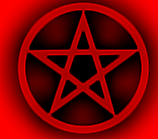 Following the lead of the video, I would like to cover the Pentagram, or also known as the Pentacle. It's basically a "Celtic Star Pentagon" (pentagon = 5 points). Satanists/Illuminists take already existing symbols and contort them to reflect the "evil side." As shown in the video, a Christian Cross, when put upside down, symbolizes Satanism. Nobody believes that the original cross is evil merely based on the fact that it can be turned upside down at any time.
The Pentagram goes back, probably with the Celts, thousands of years. Long before Christianity. It's is not at all Satanic... unless it's turned with one point downward into a "goat's head," at which time it does become a Satanic symbol, but not until. Now the above image probably isn't the best one to use because it's red and gives the wrong impression. A traditional non-Satanic/Celtic Pentagram is usually black I think.
I also wanted to at least mention Cernunnos, Celtic Reconstructionist Paganism, Celtic polytheism, Celtic mythology. Unfortunately, these bring up many false images to most people. Lets separate a little fact from fiction. Some areas, both in the Middle Ages in Europe, and in the early American colonies (Salem witch trials), were exaggerated in their scope. In other areas, it wasn't. The persecution of other forms of Christianity and Protestantism were probably far more brutal. For example, the attacks on the Cathars or the Waldensians. What was not exaggerated was the elimination and demonization of the Wiccan and Druid traditions.
From Wikipedia: "Cernunnos is a pagan Celtic god whose representations were widespread in the ancient Celtic lands of western Europe. As a horned god, Cernunnos is associated with horned male animals, especially stags and the ram-horned snake; this and other attributes associate him with produce and fertility." What has to be understood is that this was from ancient pre-Christian Europe. Fertility, the success of crops, the weather, etc., were of utmost importance. From what I have been able to gather, it was usually deer antlers that men wore.
From Wikipedia: "Archaeological sources such as inscriptions and depictions from Gaul and Northern Italy (Gallia Cisalpina) have been used to define Cernunnos. ...... Several images without inscriptions are thought to represent Cernunnos. The earliest known probable depiction of Cernunnos was found at Val Camonica in Italy, dating from the 4th century BC, while the best known depiction is on the Gundestrup cauldron found on Jutland, dating to the 1st century BC. The Cauldron was likely to have been stolen by the Germanic Cimbri tribe or another tribe that inhabited Jutland as it originated from south east Europe."
I'm only briefly going into Cernunnos, as it's involved and may confuse the issues. What is amazing is that related occult traditions, like Cernunnos, go back thousands of years in the Camunian Valley.
From Wikipedia: "Neopaganism
"In Wicca and derived forms of Neopaganism a Horned God is revered, a divinity which syncretises a number of horned or antlered gods from various cultures, including Cernunnos. The Horned God reflects the seasons of the year in an annual cycle of life, death and rebirth.
"In the tradition of Gardnerian Wicca, the Horned God is sometimes specifically referred to as Cernunnos, or sometimes also as Kernunno.
"Modern Druidry, which derives from Celtic culture, honors Cernunnos in his ancient Celto-European form as the guardian of the forests, the defender of the animal tuatha (tribes), the source of the deep forest wisdom, and the masculine half of creative energy. His restorative work in the cycle of the year is particularly celebrated at Beltaine, and is often paired with one or another of the female deities in her maiden aspect. Druids may call upon him in reference to vital, non-violent masculine divinity."
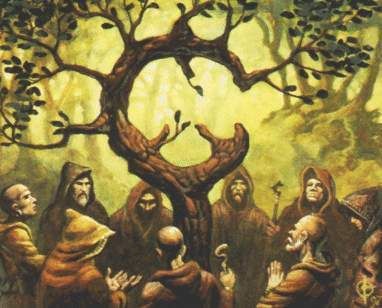 Celtic polytheism, "sometimes known as Celtic paganism, refers to the religious beliefs and practises of the ancient Celtic peoples of western Europe prior to Christianisation" (Wikipedia). Also, Celtic mythology "is the mythology of Celtic polytheism, apparently the religion of the Iron Age Celts. Like other Iron Age Europeans, the early Celts maintained a polytheistic mythology and religious structure" (Wikipedia). Lastly, Celtic Reconstructionist Paganism "is a polytheistic, animistic, religious and cultural movement. It is an effort to reconstruct and revive, in a modern Celtic cultural context, pre-Christian Celtic religions" (Wikipedia).
It should also be noted that the old Greek and Roman deities were exchanged with Northern European traditions, which is too confusing to go into now. Also, don't be afraid to go to YouTube and look some of these things up. It doesn't mean that you're becoming a Druid, a witch, an Odinist, etc. I've said it before, and I will continue to say it, the Greek-Americans have no problem at all adhering to the Orthodox Christian sect while honoring their pagan past. I think that this is the way to go. Who said that there ever had to be any conflict? Why deny what our ancestors were for thousands of years?
I wanted to end this by briefly taking a look at Druidism. From Wikipedia: "A druid was a member of the priestly and learned class in the ancient Celtic societies of Western Europe, Britain and Ireland. They were suppressed by the Roman government and disappeared from the written record by the second century CE. Druids combined the duties of priest, judge, scholar, and teacher. Little contemporary evidence for them exists, and thus little can be said of them with assurance, but they continued to feature prominently in later Irish myth and literature. Most of what is known about them comes from the Roman writers." More subjects relating to the Druids can be found at Wikipedia's Druidry categories.
4-8-09 ADDITION: I think that there are several items that could use clarification here. First, if you are new to the LAA, this had been "Bresciani nel Mondo - Northern California," and focused on issues of Brescian or Camunian origin. One such subject was the deep roots of witchcraft in the Valle Camonica, likely of predominantly Celtic origin. We still want to cover this, and any other part of the history and tradition of any other province of Lombardia (including Ticino and Grigioni). You may send us items to post if you like.
Second, it should be noted that Druidism is not the same as Wicca, although both are mainly identified with Celtic tradition. Also, that's an area where we need a little help on. How did the two interact. I'm not certain, but Druidism seems more Patriarchal, while Wicca seems more Matriarchal, so it would be interesting to find out how the two interacted, especially within a single culture.
Lastly, and this is interesting. The Runes, of Etruscan origin, not only were adopted (and modified) and used by Odinist traditions, but also by Wiccans (not sure about Druids), who used them in their practices. That would be something to look into. As stated before, the Romans destroyed virtually everything Etruscan.
8-1-09 Clarification: The third sentence of the second paragraph begins "Wicca probably originated with the Celts...." Wicca is the modern incarnation of European Witchcraft, therefore was not in existence prior to the twentieth century. It was used here as a convenient term, rather than saying "European Witchcraft." Christians probably would not like a term like "Levantine Priestcraft," and the same for other religions.
3-2-12 Addition: Loose Ends: Valcamonica, Cernunnos, Wicca, Druids, and the Pentagram - Part II
.
Tuesday, March 3, 2009
The Lepontii in Ancient Lombardy
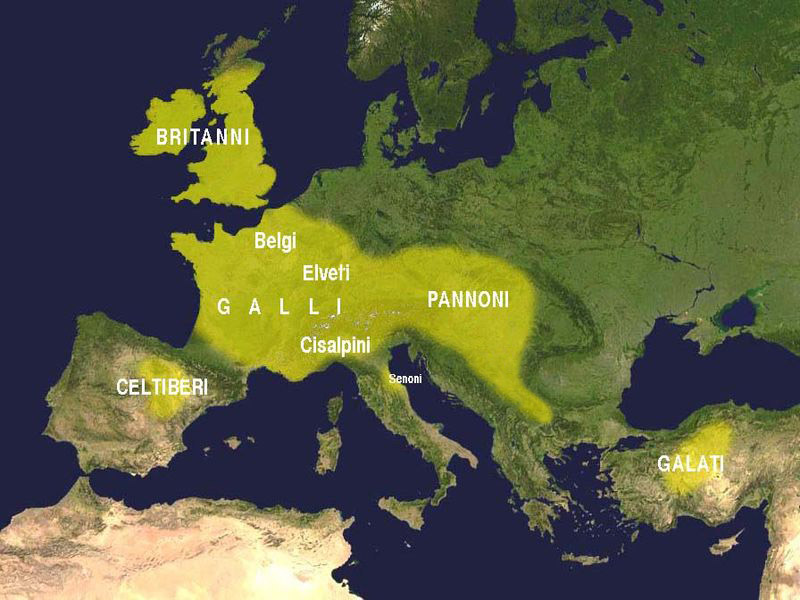
This information was taken from a part of Insubria87's 'Early Celtic Presence in Northern Italy'
Lepontii
The Lepontii were an ancient people occupying portions of Rhaetia (in modern Switzerland and Italy) in the Alps during the time of the Roman conquest of that territory. The Lepontii have been variously described as a Celtic, Ligurian, Raetian, and Germanic tribe. However, most evidence, including recent archeological excavations, and their association with the 'Golasecca culture' of Northern Italy, indicates a Celtic origin although they might actually be an amalgamation of Raetians (who were of Etruscan origin) and Celts.
The chief town of the Lepontii was Oscela, now Domodossola, Italy, and their territory included the southern slopes of the St. Gotthard Pass and Simplon Pass, corresponding roughly to present-day Ossola and Ticino. See also: Lepontic language. This map of Rhaetia [1] shows the location of the Lepontic territory, in the south-western corner of Rhaetia. The area to the South, including what was to become the Insubrian capital Mediolanum (modern Milan), was Etruscan around 600-500 BC, when the Lepontii began writing tombstone inscriptions in their alphabet (one of several Etruscan-derived alphabets in the Rhaetian territory).
http://en.wikipedia.org/wiki/Lepontii
Lepontic was assimilated first by Gaulish, with the settlement of Gaulish tribes north of the River Po, and then by Latin, after the Roman Republic gained control over Gallia Cisalpina during the late second and first century BC.
Lepontic language
Lepontic is an extinct Celtic language that was spoken in parts of Rhaetia and Cisalpine Gaul (today's Northern Italy) between 700 BC and 400 BC. Sometimes called Cisalpine Celtic, it is considered a dialect of the Gaulish language and thus a Continental Celtic language (Eska 1998).
The language is only known from a few inscriptions discovered that were written in the alphabet of Lugano, one of five main varieties of Northern Italic alphabets, derived from the Etruscan alphabet. These inscriptions were found in an area centered on Lugano, including Lago di Como and Lago Maggiore. Similar scripts were used for writing the Rhaetic and Venetic languages, and the Germanic runic alphabets probably derive from a script belonging to this group.

Lepontic was assimilated first by Gaulish, with the settlement of Gaulish tribes north of the River Po, and then by Latin, after the Roman Republic gained control over Gallia Cisalpina during the late second and first century BC.
The grouping of all of these inscriptions into a single Celtic language is disputed, and some (including specifically all of the older ones) are said to be in a non-Celtic language related to Ligurian (Whatmough 1933, Pisani 1964). Under this view, which was the prevailing view until about 1970, Lepontic is the correct name for the non-Celtic language, while the Celtic language is to be called Cisalpine Gaulish. Following Lejeune (1971), the consensus view became that Lepontic should be classified as a Celtic language, albeit possibly as divergent as Celtiberian, and in any case quite distinct from Cisalpine Gaulish. Only in recent years, there has been a tendency to identify Lepontic and Cisalpine Gaulish as one and the same language.
While the language is named after the tribe of the Lepontii, which occupied portions of ancient Rhaetia, specifically an Alpine area straddling modern Switzerland and Italy and bordering Cisalpine Gaul, the term is currently used by many Celticists to apply to all Celtic dialects of ancient Italy. This usage is disputed by those who continue to view the Lepontii as one of several indigenous pre-Roman tribes of the Alps, quite distinct from the Gauls who invaded the plains of Northern Italy in historical times.
The older Lepontic inscriptions date back to before the 5th century BC, the item from Castelletto Ticino being dated at the 6th century BC and that from Sesto Calende possibly being from the 7th century BC (Prosdocimi, 1991). The people who made these inscriptions are nowadays identified with the Golasecca culture, which has been ascribed a Celtic identity (De Marinis, 1991). The extinction date for Lepontic is only inferred by the absence of later inscriptions.
http://en.wikipedia.org/wiki/Lepontic_language
Thursday, February 26, 2009
Lombardian National Council
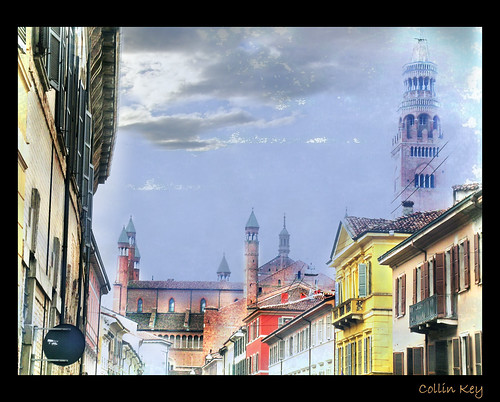 The Lombardian American Alliance would like to announce the blueprint for a formation of a new panel. This panel will be made up of Americans of Lombardian descent, from all around the country, who will be able to directly partake in any process of planning or representation of Lombardian heritage in the United States.
There is new technology on the horizon, which will enable any scattered group, probably anywhere in the world, to be able to hold an audio-visual meeting of sorts. This is just something to keep in mind as we begin the thought process for future organization.
This will be more of a loose association, only "organized" though this panel. Naturally we want to be able to, at some point, count individuals among this group who are from any field; including, but not limited to, professors, scholars, journalists, travelers, writers, researchers, and authors. The chief goal being to promote our heritage through education, and to encourage inter-association.
Although usually called "Lombard" or "Lumbard" in English, we prefer "Lombardian" in order to make a distinction from the ancient Lombards who were all over Northern Italy, and also Southern Italy. "Lombardian" could be considered an ethnic group, in the same way that Venetian (the tri-Veneto region), Tuscan, or Sicilian could form distinct cultural groups. It should be noted that some of historical Lombardia is also located in the nearby cantons of Switzerland (Ticino and Grigioni).
If interested in what will be called the "Lombardian National Council," you may send an e-mail, or visit the Lombardian American Alliance website, which will soon provide a mailing address. Thank you.
Saturday, February 14, 2009
Pre-Roman Tribes of the Lombardia Region
 This entry is based on three articles from the Padanian-American League blog:
The Celti and the Trophy of Augustus
Caesar Augustus' "Conquered Alpine Peoples" - Part 1
Caesar Augustus' "Conquered Alpine Peoples" - Part 2
These articles show the bigger picture of the pre-Roman Alpine region, but we wanted to just focus on the region of Lombardia (which wasn't a distinct region at that time).
Lets start with Brescia. In the Valle Camonica was the Camunni tribe, and just south of it, in the nearby Valle Trompia, was the Trumpilini tribe. Now those two tribes were listed FIRST in the Trophy of Augustus, as the most fierce resistors against the invading Romans (Trumpilini was number one). That alone is a tremendous statement regarding the fighting spirit of these two Italic Alpine tribes. Especially in light of the bigger picture, with the Romans going on to conquer the known world. They had to get past the Alpine peoples first.
From the Wikipedia entry: "Camunni
"The Camunni or ancient Camunians (Greek: Καμοῦνοι for Strabo or Καμούννιοι for Cassius Dio) were an Alpine people who inhabited the valley of the Ollius (modern Oglio), from the central chain of the Rhaetian Alps to the head of the Lacus Sebinus (modern Lago d'Iseo). This valley, which is still called the Val Camonica, is one of the most extensive on the Italian side of the Alps, being over 100 km in length. The actual inhabitants of Val Camonica are called Camunians (Italian: Camuni).
"According to Pliny, the Camunni were a Euganean tribe, while Strabo reckons them among the Rhaetians.
"The name of the Camunni appears among the Alpine tribes who were reduced to subjection by Roman emperor Augustus, after which the inhabitants of all these valleys were attached, as dependents, to the neighbouring towns of Gallia Transpadana ("finitimis attributi municipiis", Plin. iii. 20. s. 24; Strab. iv. p. 206; Dion Cass. liv. 20). At a later period, however, the Camunni, appear to have formed a separate community of their own, and we find mention in inscriptions of the "Res Publica Camunnorum". (Orell. Inscr. 652, 3789.)
"In the later division of the provinces, they came to be included in Regio X Venetia et Histria."
In the above link, make sure to see the amazing map, which shows the tribe territory of Brescia/Lombardia. What is now the Brescia province (and most of the rest of what is now the Orobic language region; East Lombardy), was then in ancient Venetia, and what is now considered Insubria (West Lombardy), was then in ancient Transpadane Gaul. It shows the tribes of the three mountain valleys of northern Brescia: Camunni, Trumilini, and Sabbini (all Italic tribes). To the south in lower Brescia, Cremona, and to the east through what is now the Verona province, was the ancient territory of the Cenomani, who were a Celtic tribe. The Cenomani founded the cities of Brescia (Brixia) and Verona. To the west is the territory of the Insubres, another Celtic tribe, who founded the city of Milano (Mediolanum). In the north central part of Lombardy was the territory of the Orobii, who were also Celtic.

From the Wikipedia entry: "Cenomani (Cisalpine Gaul)
The Cenomani (Greek: Κενομάνοι, Strabo, Ptol.; Γονομάνοι, Polyb.), was an ancient tribe of the Cisalpine Gauls, who occupied the tract north of the Padus (modern Po River), between the Insubres on the west and the Veneti on the east. Their territory appears to have extended from the river Addua (or perhaps the Ollius, the modern Oglio) to the Athesis (modern Adige). Whether these Cenomani are the same people as the Cenomani in Gallia Celtica encountered by Julius Caesar is a subject of debate.
"Both Polybius and Livy expressly mention them among the tribes of Gauls which had crossed the Alps within historical memory, and had expelled the Etruscans from the territory in which they established themselves and subsequently continued to occupy. (Pol. ii. 17; Liv. v. 35.) Livy relates that about 400 BCE, under the leadership of Elitovius (Livy V.35), a large number of the Cenomani crossed into Italy, drove the Etruscans southwards, and occupied their territory. The statement of Cato (in Pliny, Nat. Hist. III.130), that some of them settled near Massilia in the territory of the Volcae, may indicate the route taken by them. It is remarkable that they appear in history almost uniformly as friendly to the Romans, and refusing to take part with their kindred tribes against them. Thus, during the great Gaulish war in 225 BCE, when the Boii and Insubres took up arms against Rome, the Cenomani, as well as their neighbours the Veneti, concluded an alliance with the Roman Republic, and the two nations together furnished a force of 20,000 men, with which they threatened the frontier of the Insubres. (Pol. ii. 23, 24, 32; Strab. v. p. 216.) Even when Hannibal invaded Cisalpine Gaul they continued faithful to the Romans, and furnished a body of auxiliaries, who fought with them at the Battle of the Trebia. (Liv. xxi. 55.) After the close of the Second Punic War, however, they took part in the revolt of the Gauls under Hamilcar (200 BCE), and again a few years later joined their arms with those of the Insubres: but even then the defection seems to have been but partial, and after their defeat by the consul Gaius Cornelius Cethegus (197 BCE), they hastened to submit, and thenceforth continued faithful allies of the Romans. (Liv. xxxi. 10, xxxii. 30, xxxix. 3.) From this time they disappear from history, and became gradually merged in the condition of Roman subjects, until in 49 BCE they acquired, with the rest of the Transpadane Gauls, the full rights of Roman citizens. (Dion Cass. xli. 36.)
"The limits of the territory occupied by them are not very clearly defined. Strabo omits all notice of them in the geographical description of Gallia Cisalpina, and assigns their cities to the Insubres. Livy speaks of Brixia (modern Brescia) and Verona as the chief cities in their territory. Pliny assigns to them Cremona and Brixia: while Ptolemy gives them a much wider extent, comprising not only Bergamum (modern Bergamo) and Mantua, but Tridentum also, which was certainly a Rhaetian city. (Strab. v. p. 213; Liv. v. 35; Plin. iii. 19. s. 23; Ptol. iii. 1. § 31.) It is singular that Polybius, in one passage (ii. 32), appears to describe the river Clusius (modern Chiese), as separating them from the Insubres: but this is probably a mistake. The limits above assigned them, namely, the Addua on the west, the Athesis on the east, and the Padus on the south, may be regarded as approximately correct.
"The Alpine tribes of the Camunni and the Triumpilini, which bordered on them on the north, are expressly described by Pliny as of Euganean race, and were not therefore nationally connected with the Cenomani, though in his time at least united with them for administrative purposes."
From the Wikipedia entry: "Insubres
"The Insubres or Insubri were a population settled in Insubria, in what is now Lombardy. They were the founders of Milan (Mediolanum). Though Celtic at the time of Roman conquest, they were most likely the result of the fusion of pre-existing Ligurian and Italic population strata with Gaulish tribes who had come from what is now southern France.
"Together with the Boii, Lingones, Taurini, Gesati and other Gaulish groups, the Insubres were defeated in 224 or 225 BC by the Roman army led by consul Lucius Aemilius Papus at the Battle of Telamon. Two years later the Romans, backed by their Gaulish allies the Cenomani, reduced the only fortified place of the Insubres at Acerrae, and defeated them again at the Battle of Clastidium. After the defeat of the Gesati, they were compelled to accept the Roman occupation of Milan in 221 and forcible alliance with Rome, while the victors annexed much of their territory.
"During the invasion of Hannibal of 218-217 BC, the Insubres rebelled in support of the Carthaginians. They supported the Carthaginians again in 200 BC, this time under Hamilcar. After several other clashes, they definitively allied with Rome in 194, maintaining some autonomy for their capital. In 89 BC they obtained Latin citizenship and, in 49 BC, Roman citizenship.
"Romanization of the Insubres was probably quick, also due to the reported similarities of the Celtic and Latin languages; in a short span of time after the Roman conquest several literary figures emerged, like that of Caecilius Statius.
"Insubria and Insubric language are named after the Insubres."
The Cenomani betrayal of the Celto-Ligurian federation is perhaps a historical demerit, but the brave actions of the other tribes, in fighting what possibly was the most powerful army the world has ever seen, more than makes up for it.
Thursday, February 12, 2009
San Francisco photographer J.B. Monaco's 1908 pilgrimage to Ticino
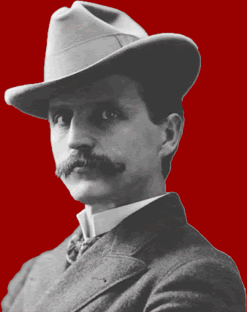 One time someone was speaking to me about old immigrants, when they suddenly said something like "immigrants or pioneers." In some ways, the two words are mutually exclusive. When it comes to Italian Swiss immigrants from Ticino, the word "pioneer" comes firmly into focus. They were true self-determinists who needed no role models or nannies to try to motivate them. They settled in many different types of environments throughout California and Nevada, usually undeveloped areas. One such adventurous type was the well known photographer and Italian Swiss immigrant J.B. Monaco.
From the J.B. Monaco website:
"In 1875, nineteen year old J.B. Monaco arrived in the United States from his native Switzerland and immediately joined his older brother Louis in his Eureka, Nevada City Photo Gallery. For J.B., this would be the start of a distinguished sixty two year photographic career.
"The photographic collection of J.B. Monaco (1856-1938) includes a body of work impressive in scope and content. Not only did Monaco photograph the world around him, he painted, sketched, wrote and preserved a good deal of what he created. Thankfully, many of these images have been passed down and archived to the present.
"His unique Earthquake and Fire compositions convey not only drama but also the sense of a moment captured in time: a single frame of a larger moving picture. His recorded account of the disaster takes on an equally human dimension as it describes the saving of his own home from the approaching fire by means of a back yard well and a neighborhood bucket brigade. Even Monaco's hand-drawn map remains, pointedly displaying where the fire was turned back and his block of Russian Hill saved.
"In his lifetime, Monaco was considered the "Dean of North Beach photographers" and was most appreciated for his studio portraiture work of prominent San Franciscans and families, many of whom were neighbors in the City's Italian center. But his reportorial work stands out equally and impresses even more with the test of time. He used camera, pen and brush to document much of early Nevada and Northern California history.
"What Monaco leaves is a tangible legacy, both comprehensive and personal. Thousands of original prints and negatives are preserved. The Earthquake images have been used in numerous documentaries, photographic collections and historical publications. In all, what he left surpasses the work of one man and the detailing of his life and times. It is the story of a people as they endured and enjoyed experiences that would shape a bit of American history.
"In 1908 J.B. Monaco and his brother in law Domenico Battistessa visited '"The Old Country." They were both born in the Swiss Italian province of Ticino, J.B. in Verscio and Domenico in the small village of Collinosca next to Cerentino. J.B. chronicled the trip with over three hundred photos of Switzerland. Most of their time was spent in Vallemaggia where they still had family and friends. This section includes approximately fifty images from the trip."
J.B. Monaco website
About J.B. Monaco
Photos of San Francisco photographer JB Monaco's 1908 pilgrimage to Ticino
The website has many old photographs of San Francisco, including the 1906 Quake and North Beach.
Subscribe to:
Posts (Atom)