Showing posts with label ancient British Isles. Show all posts

Thursday, August 9, 2018

'Viking: The Berserkers' 2014 film review


Viking: The Berserkers - Official Trailer [HD]

Tornado Films

"The Viking Hunger Games!" When a clan of Viking 'Berserker' warriors terrorise Saxon youths in a ritualistic manhunt, the youths must fight back!


************


In Dark Ages Britain a group of five young Saxons are captured by a clan of fearsome Viking warriors and used as prey in a ritualistic manhunt. High on a potion that turns them berserk the brutal hunters are soon on the scent of the terrified youngsters in a desperate battle for survival. Against long odds, the captors fight back and the hunted become the hunters.

There are so many films about Romans and Vikings, Romans and Vikings, Vikings and Romans…. that I may have to be more selective in which I review. I review the Roman-themed films at the other blog. This film effort was a little different, and would hold up fairly well to ‘Valhalla Rising’, and worth a review. It was at the least, eerie, brutal, and gripping. The film opens with the words Viking Britain 835AD. Most portrayals of the Vikings tend to be negative; however here they are truly shown as brutal murdering sadists. Actually, these were a warrior subgrouping called the Berserkers.

The first scene shows what is described as a rural Saxon family whose mother had been murdered by the invading Vikings, or Berserkers, and the father was merely trying to protect what was left of his family; keeping them away from towns and open trade routes. He is soon murdered by a Berserker ambush. His sons, including a young man named Wade, are captured and taken to a holding pen at their camp.

The entire film is set amid a gloomy foreboding landscape; I assume filmed somewhere in the UK. There’s an obvious British-bias here, but it’s just a movie right? Actually the Angles, Saxons, and Jutes were Teutonic tribes which had invaded the British Isles, and they were originally from what is today northern Germany, Denmark, and Scandinavia. The idea that,--as the DVD jacket stated--"the peaceful times of Saxon Britain have been shattered by the invasion of Viking forces” is at least somewhat deceptive. Those earlier Teutonic invaders were very similar to the Vikings. Also, the Christians are shown to be very peaceful; but actually they had run an aggressive campaign against the Vikings and others who would not submit to the Christian faith. For example, cutting them off from established trading centers.

The Berserkers chose five young individuals from the holding pen, I think three men and two women, and released them into the wilderness to be hunted down. This apparently was a rite to Odin, as the high priestess called The Volva administered this blood ritual. She said to Wade before he was released: “You have fire in your blood. Odin will feast upon your soul.” As the chosen victims were trying  to escape as far as they could get, the Berserkers painted their faces white (later to add blood) as the wicked-looking Volva chanted. They ingested some type of drug substance which put them into a frenzy… growling, foaming at the mouth, and barking at the moon!

Spoiler alert beyond this point!!

.

.

.

.

.

.
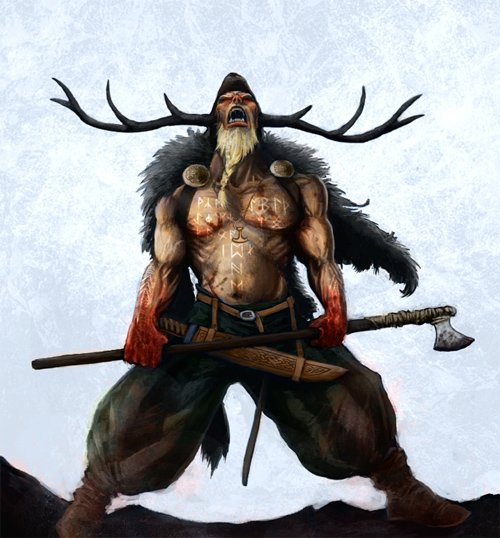


As each victim was brutally killed, their hearts were cut out and taken back to the Volva. It wasn’t always clear as to the intentions of the various characters, but that added to this unpredictable melee. At one point as one the victims was dying, they left some advice to her fellow prey:

“To beat the wolf, you have to become the wolf.”

The Berserkers were presented as like wild animals, roaring and looking into the eyes of their victims as they cut their hearts out; all the while continuing to take more of the drug substance and snarling like wolves. They were like werewolves.

I think this was the type of film that is worth at least one viewing in the same way as a good B horror flick. It’s different and keeps your attention. Of course, it portrays Asatru in a negative light; “the devils of the north” as the protagonist Wade put it. Well, someone's got to play the bad guys. There’s also an interesting theme at the end about life, nature, and evolutionary struggle.


.

Sunday, May 13, 2018

Neopaganism and visual art

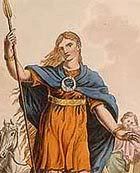
Celtic-Briton and Pagan heroine Boudica

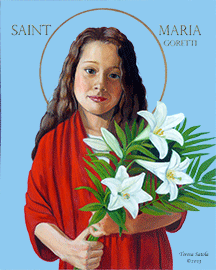
I came across the story of a Catholic virgin-martyr and canonized saint Maria Goretti; an eleven year old girl from early twentieth century Marche who forgave her murderer upon her death. I also noticed the typical church-inspired artwork of her. Some portrayed her as appearing as a child, while others gave her the appearance of a very young woman. These saints and martyrs are never lacking in visual art. It appears to me that Neopagans are lacking in this area.

Musically, Neopagans have been marvelously creative, with numerous different genres and styles. For some reason, visual artwork depicting gods, heroes, events, and concepts have been sorely lacking. I apologize to those who have accomplished the artwork that is out there, past and present. Even if one is not skilled in this area, they may still find an artist to have desired works done for a reasonable fee.


Church-styled and Lombardic-like portrayal of Maria Goretti


Maria Goretti probably more as she actually looked


There are various decisions that one would make prior to taking on an art project. What would you wish as the aesthetics of the person(s)? Typically, the Catholic Church goes the extra mile to completely de-sexualize the subject. Certain Neopagan-inspired artwork tends to oversexualize them. I don't claim to have the answer to this, but a god or hero would not have been walking around scantily clad. I think it would be safe to say that Neopagans would tend to be less modest than the Church; although many Feminist Neopagans seem to have a lot in common with the most strict Catholic Sisters. I think that we should be the ones to find the proper balance, with both extremes being somewhat undesirable.


A Church-style stained glass depiction of Beudica (Moot Hall, Colchester, UK)


Boudica, the Queen of the Iceni of Celtic Briton, strongly comes to mind when thinking of a Pagan heroine. She must have had tremendous strength and courage. A look at her depictions in visual art is interesting. Although the Almother in the form of Hecate or Diana has it's share of visual art, lesser gods and goddesses have much less or practically none at all. Even Aradia, even though the depictions out there are great, is lacking. The Teutonic gods and goddesses are fairly well represented.

Other ideas are regional gods, lesser-known heroes, your favorite direct ancestors, and historical events. Do your homework as some national heroes of the early Middle Ages were not Neopagan; for example, William Wallace was Catholic. Even tragic events are part of our history, such as the Roman slaughter of the last Druid stronghold at Anglesey Island. The Temple of Mona at Anglesey Island was soaked in blood. What other religion has ever suffered a humiliating final defeat such as that? Naturally, moments of glory are important, such as when Queen Gambara of the Langobards called out for her people to "Go Forth!" as they started their migration into central Europe.

Brainstorm ideas; there's a lot to choose from! Once I saw a scene depiction, probably from an Italian film, of a Celto-Gaulish prince marrying an Etruscan princess. That would make for an interesting work of art. Christian theocracy, bloodless science, monopoly Capitalism, soulless Atheism, Masculo-Feminism, and social Marxism have all done their part from cutting us off from the Heroic Ethic. Even within your own family history, you may find events of glory. For example, when my grandfather emigrated to Hurley, Wisconsin. He constructed a great house... pretty much all by himself. There's a photograph of the family in front of it after it's construction.


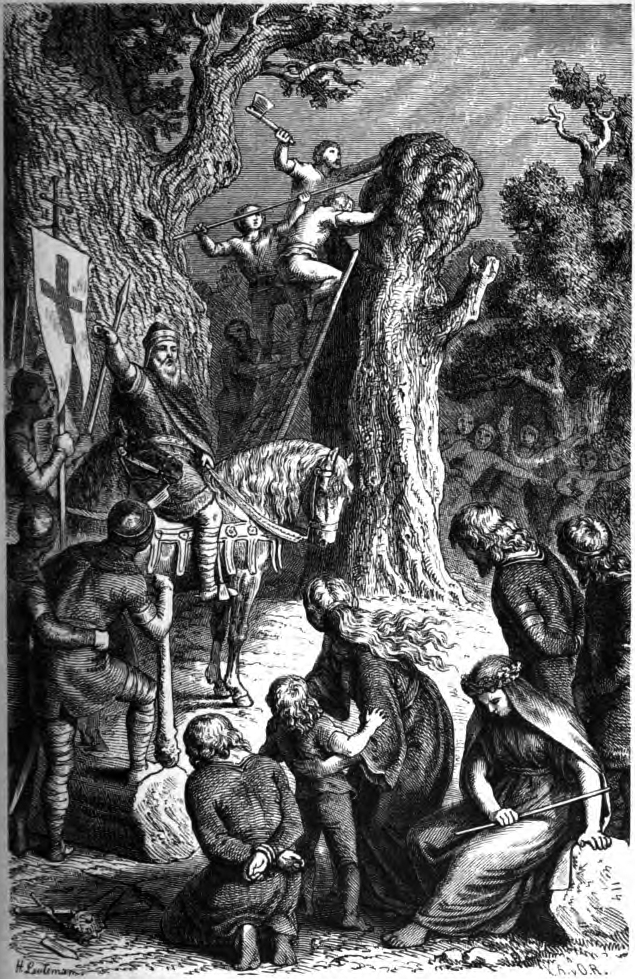
'The destruction of Irminsul by Charlemagne' (1882) by Heinrich Leutemann

.

Wednesday, February 18, 2015

'Rise and Fall of the Druids' (documentary)


From HumbleServant YouTube channel

"Rise and Fall of the Druids" (Full Documentary)

**************************************************

Although this focuses on ancient Briton, the Druidic culture extended into Gaul... and to a lessor degree into what is now the German-speaking regions, Cisalpine Gaul, and parts of Spain.

.

Monday, April 21, 2014

Boudicca’s Burial Discovered at Kings Cross

Boudicca, Celto-Druidic Queen of the Iceni is, in my estimation, a "pagan heroine." She wasn't totally unlike Charles Martel or Joan of Arc, although the particulars are different. If she was a Christian, she would be more famous than they.


Boudicca’s Burial Discovered at Kings Cross

HeritageDaily.org - April 1, 2014


The archaeological world was reeling today from the news that a team of researchers has made the discovery of the century at the site of the Kings Cross rail development in London.

Professor M. Maus, leading an archaeological team from the London Institute of Studies, was able to reveal to the press the burial site of the famous flame haired Queen of the Iceni; Boudicca.

Boudicca famously defied Roman rule, leading a revolt against the occupying force round AD 60. During a successful campaign Boudicca’s forces fought their way west from the homeland of the Iceni tribe in modern day East Anglia. Destroying Colchester, Boudicca headed for London, leading a force of 100,000 to burn and destroy the majority of the city.

The discovery at Kings Cross has been kept under wraps until today for fear of a media frenzy, but Prof. Maus insists that its time the world knows the truth. On an exclusive tour of the site,  HeritageDaily was shown an extraordinary burial chamber containing a wheeled chariot and the body of a woman, remarkably well preserved. Prof. Maus went on to describe the find;

‘If you look closely, there are traces of red hair on the skull and you can clearly see the socket for spikes on each of the wheels – we know Boudicca used these to cut down Roman legionaries in battle. There had always been rumors that Boudicca was buried in Kings Cross, its such a revelation to bring truth to the fables.

Plans are now underway for a major exhibition covering the discoveries, to be funded by the Institute of Studies and the charitable body Funding Organisation Of London.


.

Saturday, December 1, 2012

The Mystic Druids


The Mystic Druids Part 1

From YouTube channel RealmOfDestiny

**************************************************

 One question is whether or not there was a Druidic culture in Cisalpine Gaul, as there was in Gaul and the British Isles. I still don't have the answer to this. From the incongruent information which I have looked at, my guess would be that there was some, more in the area of ancient Piedmont. For the most part, the more native spiritual traditions predominated.

My theory is that Druidism--and generally the Celts themselves--came about, over a long period of time, as a result of more paternally-oriented Teutonic-Odinic people merging with more maternally-oriented native Alpine and some Alpinized-Mediterranean people and their magical traditions. The sun people and the moon people.

**************************************************

The Mystic Druids Part 2


.