Author: Anja Heij
RealMagick.com
The story begins in the northern regions of Europe where the supreme god Odin, also known as Wodan among the German tribes, reigned. (He still lives among us in Wednesday, which is Wodan’s day).
Odin/Wodan was the god of wisdom, magick and occult knowledge, runes, poetry and war. His name means “the inspired one”. Like a shaman he could travel in other worlds to gather more insight while his two black ravens Huginn (Thought) and Muninn (Memory) kept him informed about the news in the world. Odin was depicted as a tall, old man with a white beard and wearing a cloak. He rode the skies and the seas on his fast white horse Sleipnir with his 8 (the number of transformation) legs, while carrying his never missing spear Gungnir (clear and focused intent) in his hand.
He had one eye, for he had offered the other eye in exchange for gathering wisdom at the well of the head Mimir (Norse representation of the Source) and with that he became a shapeshifter, able of seeing in the outward world with his normal eye and understanding the inward worlds with his black, removed, eye.
He was very beloved among his friends and followers who felt happy and energized in his surroundings (an enlightened being?). His enemies however he could paralyze or kill with his sight (insight, the truth).
Odin trained many men and women as warriors for the final battle against the forces of destruction in the underworld at Ragnarok (the Norse judgement day). His fearless warriors often painted their bodies black and fought in the middle of the night.
The story of Odin/Wodan is the battle between good and evil which will stop when we finally realize that black and white are two sides of the same coin.
Odin is a mythical representation of goodness with his wisdom, white beard and white horse (in New Age terms we would depict him as ‘white divine light’). And he is wise enough to understand that ‘black’ is not similar to ‘dark’ in the sense of ‘evil and taboo’ for his helpers are black ravens and black (spiritual) warriors.
The evil he fights is the underworld dragon of false beliefs, untruth and selfishness (in New Age terms we would call this ‘ego’).
(So now we have a wise, good man performing magick/miracles with a white horse riding the skies, a white beard, a cloak, a spear and black advisors/informers/helpers and he is also god of poetry).
Next we go to the Roman empire where between December 17 and 24 the pagan Saturnalia were celebrated, big feasts with a lot of merrymaking, dancing, gambling, sensuality and the exchange of gifts. This festival was meant to celebrate the return of the sun on the shortest days of the year and to counteract the depression due to lack of sunlight.
(Here we find December celebrations with gifts.)
Time goes by. Christianity develops itself.
In the 4th century in Myra, Turkey, a Christian bishop named Nicholas lived with a great reputation for goodness, benevolence and performing miracles for the poor and unhappy. He miraculously supplied gold to three (number of manifestation) girls as marriage dowries so they did not have to become prostitutes and he brought three children back to life who had been chopped by a butcher. It is not difficult to understand that during the poverty of the Middle Ages (also called Dark Ages) this bishop became extremely popular as Saint Nicholas in all parts of Europe. His feastday, it was said to be his birthday, was December 5 or 6, nobody knows. There is no historical evidence however for the true existence of this saint.
(So now we see a benevolent, miracle performing bishop with a white dress and a red cloak.)
After the Reformation Saint Nicholas became forgotten in all the protestant countries of Europe except Holland.
There he became Sinterklaas; a kind and wise old man with a white beard, white dress, red cloak, a crosier and riding the skies and roofs of the houses on his white horse, accompanied by his Black Jacks.
Sinterklaas will visit you on his birthday December 5 or 6 and donate gifts. His Black Jacks have miraculously gathered information about your behavior during the last year; if it were good you will now be rewarded with presents, if it were bad you will be punished by the Black Jacks who will beat you with their rods or even worse: put you in a big bag and take you with to Spain, said to be the residence of Sinterklaas. The last thing seems to be a Christian influence: punishment by a severe father if you don’t behave morally just. On the other hand: if you do behave nice you will be rewarded with sweets and gifts accompanied by humoristic poems that give insight in your weaknesses.
(Here the mix becomes clear between Odin the good magician god and the miracles of the benevolent Sinterklaas. They both ride a white horse in the skies, wear a white beard, a cloak and a spear/cosier. They both have black helpers. They try to support goodness and dispel evil through knowledge. And remember the poetry part?
And the blend with Roman influences shows itself in a December feast with gaiety and presents.)
In the 17th century Dutchmen emigrated to Northern America and brought their tradition of Sinterklaas with. In the new English speaking world the name changed into Santa Claus.
In 1930 a designer for the Coca-Cola Company was asked to draw attractive advertisements for this drink that did not sell well in wintertime. He had to use the company colors red and white and create some cosy type. He remembered the Dutch Santa Claus with his white dress, red cloak, long white beard, kindness and benevolence. The eight-legged horse was replaced for eight flying reindeer. A punishing Black Jack was inappropriate in this concept, so he disappeared.
This new Santa Claus became a big hit. He became so popular that right now in Europe he is serious competition for Sinterklaas. That’s understandable: no more fear for punishing Black Jacks, and you no longer have to sweat on suitable poetry for your gifts.
And the search for human perfection of Odin?
Well, can’t we just have that as a Christmas present from Santa Claus?
[See article link for further related reading]
****************************************************************
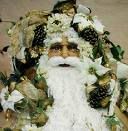 The Origins of Santa Claus
By Patti Wigington
About.com
Early Christian Influence:
Although Santa Claus is originally based upon St. Nicholas, a 4th-century Christian bishop from Lycia (now in Turkey), the figure is also strongly influenced by early Norse religion. Saint Nicholas was known for giving gifts to the poor. In one notable story, he met a pious but impoverished man who had three daughters. He presented them with dowries to save them from a life of prostitution. In most European countries, St. Nicholas is still portrayed as a bearded bishop, wearing clerical robes. He became a patron saint of many groups, particularly children, the poor, and prostitutes.
Odin and His Mighty Horse:
Among early Germanic tribes, one of the major deities was Odin, the ruler of Asgard. A number of similarities exist between some of Odin's escapades and those of the figure who would become Santa Claus. Odin was often depicted as leading a hunting party through the skies, during which he rode his eight-legged horse, Sleipnir. In the 13th-century Poetic Edda, Sleipnir is described as being able to leap great distances, which some scholars have compared to the legends of Santa's reindeer. Odin was typically portrayed as an old man with a long, white beard -- much like St. Nicholas himself.
Treats for the Tots:
During the winter, children placed their boots near the chimney, filling them with carrots or straw as a gift for Sleipnir. When Odin flew by, he rewarded the little ones by leaving gifts in their boots. In several Germanic countries, this practice survived despite the adoption of Christianity. As a result, the gift-giving became associated with St. Nicholas -- only nowadays, we hang stockings rather than leaving boots by the chimney!
Santa Comes to the New World:
When Dutch settlers arrived in New Amsterdam, they brought with them their practice of leaving shoes out for St. Nicholas to fill with gifts. They also brought the name Sinterklaas, which later morphed into Santa Claus. Although the Dutch version of St. Nicholas was written about by author Washington Irving around 1809, it was about 15 years later that the figure of Santa as we know it today was introduced. This came in the form of a narrative poem by a man named Clement C. Moore.
The Night Before Christmas:
Moore's poem, originally titled 'A Visit from St. Nicholas' is commonly known today as 'Twas the Night Before Christmas'. Moore went as far as to elaborate on the names of Santa's reindeer, and provide a rather Americanized, secular description of the "jolly old elf."
[See article link for further related reading]
.