Antonio Stradivari Antonio Stradivari (1644 – 18 December 1737) was an Italian luthier and a crafter of stringed instruments such as violins, cellos, guitars, violas and harps. Stradivari is generally considered the most significant and greatest artisan in this field. The Latinized form of his surname, Stradivarius, as well as the colloquial "Strad" are terms often used to refer to his instruments. The Hills Violin Shop estimate that Antonio produced 1,116 instruments, of which 960 were violins. It is also estimated that around 650 of these instruments survive, including 450 to 512 violins.
Stradivari and the Cremonese violin making school
San Matteo, the Stradivari parish, as well as San Faustino, the Amati parish, made up the center of cremonese violin making.They exerted influence not only on one another, in terms of the shape, varnish and sound of instruments, but also on many of their contemporaries; they defined violin making standards for the next 300 years.
Even at the beginning of the 18th century, Stradivari’s influence could be seen not only in the work of Cremonese makers, but also international ones, such as Barak Norman’s, one of the first important British makers. In the 1720s Daniel Parker, a very important British luthier, produced fine violins after Stradivari’s work selling anywhere from £30,000 - £60,000 in recent auctions. Parker based his best instruments on Stradivari's` `long pattern`, having the opportunity to study one or more of the instruments. Well into the 19th century, Jean Baptiste Vuillaume, the leading French luthier of his time, also made many important copies of Strads and Guarneris.
In the 18th century, Cremonese luthiers were the suppliers and local players on the demand side. After Stradivari’s death, this drastically changed. Although the Cremonese luthiers remained the suppliers, the demand side consisted of collectors, researchers, imitators, profiteers and speculators. Many local players could no longer afford the sought out instruments and most of the purchased instruments would be hidden in private collections, put in museums, or would be simply put back in their cases, hoping that they would gain value over time. It is then that the so-called ‘fever’ for Stradivaris took off.
Cozio, Tarisio and Vuillaume were the fathers of this frenzy that would extend well into the 21st century. Also, soon after Stradivari’s death, most of the other major Cremonese luthiers would die, putting an end to the golden period of Cremona’s violin making, which lasted more than 150 years, starting with the Amatis and ending with the Cerutis.
Stradivarius instruments
Stradivari's instruments are regarded as amongst the finest bowed stringed instruments ever created, are highly prized, and are still played by professionals today. Only one other maker, Giuseppe Guarneri del Gesù, commands a similar respect among violinists. However, neither blind listening tests nor acoustic analysis have ever demonstrated that Stradivarius instruments are better than other high-quality instruments or even reliably distinguishable from them.
Fashions in music, as in other things, have changed over the centuries, and the supremacy of Stradivari's and Guarneri's instruments is accepted only today. In the past, instruments by Nicolò Amati and Jacob Stainer were preferred for their subtle sweetness of tone.
Beginning in the 16th century, Cremona became renowned as a centre of musical instrument manufacture, with the violins of the Amati family, and later the products of the Guarneri and Stradivari shops. To the present day, their work is widely considered to be the summit of achievement in string instrument making. Cremona is still renowned for producing high-quality instruments.
The most famous violin makers (luthiers) between the 16th century and the 18th century include:
The school of Cremona, beginning in the half of the 16th century with violas and violone and in the field of violin in the second half of the 16th century
The Guarneri family, active 1626–1744 in Cremona and Venice
The Stradivari family, active 1644–1737 in Cremona
************
The violin immediately became very popular, both among street musicians and the nobility, illustrated by the fact that the French king Charles IX ordered Andrea Amati to construct 24 violins for him in 1560. One of these instruments, now called the Charles IX, is the oldest surviving violin.
************
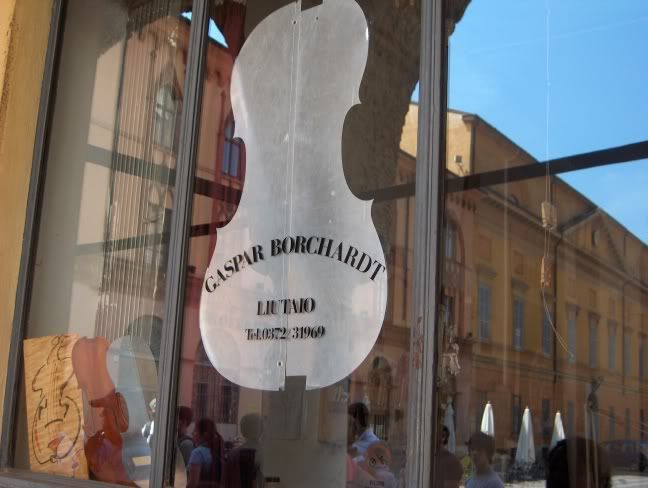
Violin shop in Cremona
To this day, instruments from the so-called Golden Age of violin making, especially those made by Stradivari, Guarneri del Gesù and Montagnana are the most sought-after instruments by both collectors and performers. The current record amount paid for a Stradivari violin is £9.8 million (US$15.9 million), when the instrument known as the Lady Blunt was sold by Tarisio Auctions in an online auction on June 20, 2011.
[Violin] Since their invention, instruments in the violin family have seen a number of changes. The overall pattern for the instrument was set in the 17th century by luthiers like the prolific Amati family, Jakob Stainer of the Tyrol, and Antonio Stradivari, with many makers at the time and since following their templates. ************
The earliest evidence for their existence is in paintings by Gaudenzio Ferrari from the 1530s, though Ferrari's instruments had only three strings. ************
It is not clear exactly who made these first violins, but there is good evidence that they originate from northern Italy, in the vicinity (and at the time the political orbit) of Milan. Not only are Ferrari's paintings in this area, but at the time towns like Brescia and Cremona had a great reputation for the craftsmanship of stringed instruments. The earliest documentary evidence for a violin is in the records of the treasury of Savoy, which paid for "trompettes et vyollons de Verceil", that is to say, "trumpets and violins from Vercelli", the town where Ferrari painted his Madonna of the Orange Tree. The first remaining written use of the Italian term violino occurs in 1538, who brought "violini Milanese" (Milanese violinists) to Nice when negotiating the conclusion of a war.
The oldest confirmed surviving violin, dated inside, is the "Charles IX" by Andrea Amati, made in Cremona in 1564, but the label is very doubtful. The Metropolitan Museum of Art has an Amati violin that may be even older, possibly dating to 1558 but just like the Charles IX the date is unconfirmed. One of the most famous and certainly the most pristine is the Messiah Stradivarius (also known as the 'Salabue') made by Antonio Stradivari in 1716 and very little played, perhaps almost never and in an as new state. It is now located in the Ashmolean Museum of Oxford. Early makers
Instruments of approximately 300 years of age, especially those made by Stradivari and Guarneri del Gesù, are the most sought after instruments (for both collectors and performers). In addition to the skill and reputation of the maker, an instrument's age can also influence both price and quality.
The most famous violin makers, between the early 16th century and the 18th century included:
Amati family of Italian violin makers, Andrea Amati (1500–1577), Antonio Amati (1540–1607), Hieronymous Amati I (1561–1630), Nicolo Amati (1596–1684), Hieronymous Amati II (1649–1740)
Roman Festival Of Veneralia For The Goddess Venus On April 1, 2010 MichaelTheResearcher Thursday, April 1, 2010 - the day of the Roman Festival of Veneralia dedicated to The Goddess Venus. I endeavored some ancient reenacting today, and did as the Romans did. I tried to be as historically-accurate as possible. I erected a nice Shrine and Altar. Therein you will see a soaking-wet and dripping Venus Statue. On this day in antiquity, the Romans washed all of the Venus Statues and adorned Them with flowers. In that spirit, I made sure She has been ritually cleaned and prepared with the proper offerings. She was originally associated with vegetation so I added plenty of vegetables in addition to fruit and some peanut snacks (German import purchased at Aldi). The Venus De Milo to the right is a clay statue I made earlier this year. The image to the left is an albumen print photo dating to the late 1800s. It features the specific Capitoline Venus (based on the Aphrodite Of Cnidus or Aphrodite Of Menophantos). Happy Veneralia!! Photos of the Shrine/Altar can be seen at these links: http://michaeltheresearcher.blogspot.com/2010/04/roman-festival-of-veneralia-dedicated.html
Veneralia Observed by: Ancient Romans Type: Classical Roman religion Observances: Adornment of statues of Venus with flowers Date: April 1 The Veneralia was an ancient Roman festival celebrated April 1 (the Kalends of Aprilis) in honor of Venus Verticordia ("Venus the changer of hearts") and Fortuna Virilis ("Manly" or "Virile Fortune"). The cult of Venus Verticordia was established in 220 BC, just before the beginning of the Second Punic War, in response to advice from a Sibylline oracle, when a series of prodigies
was taken to signify divine displeasure at sexual offenses among Romans
of every category and class, including several men and three Vestal Virgins. Her statue was dedicated by a young woman, chosen as the most pudica
(sexually pure) in Rome by a committee of Roman matrons. At first, the
statue was probably housed within the temple to Fortuna Virilis. This
cult, much older than any cult to Venus
but possibly perceived as weak or gone to seed, may have benefited from
the moral and religious support of Venus as a relatively new but senior
deity; for Ovid,
Venus's acceptance of the epithet and its responsibilities represented
the goddess' own change of heart. In 114 BC Venus Verticordia was given
her own temple.
She was meant to persuade Romans of both sexes and every class, whether
married or unmarried, to cherish the traditional sexual proprieties and
morality
known to please the gods and benefit the State. During the Veneralia,
her cult image was taken from her temple to the men's baths, where it
was undressed and washed in warm water by her female attendants, then
garlanded with myrtle. At the Veneralia, women and men asked Venus Verticordia for her help in affairs of the heart, sex, betrothal and marriage. Fortuna Virilis was given cult on the same day. ************
To our pagan ancestors, April 1st was "New Years Day," therefore the Roman festival of Veneralia was something of a carryover from earlier traditions. I'm not really a believer that Stregheria is from the Etruscan or Roman religions; but that the Old Religion melded with new nation states as they came into existence. Of course, there is much crossover there, and throughout pagan Europe. Apparently, and maybe someone can verify this, the Vernal Equinox ("Ostara"; March 19-22) was separate from the "Pagan New Years Day." I've read items to this effect, but I'm not certain. I think this concept should be given another serious look.
A challenging quote "I'm tired of being told who to admire in this country. Aren't you sick of being told of who your heroes ought to be? You know? Being told who you ought to be looking up to. I'll choose my own heroes, thank you very much." -- George Carlin
Leap year My mother has always recited a variation of this old leap year poem. Thirty days hath September Thirty days hath September, April, June, and November. Thirty-one hath all the rest, Except for February clear which has 28 and 29 in a leap year. Thirty days hath September, April, June, and November All the rest have 31, Except for February. Thirty days hath September, April, June and November All the rest have thirty-one But February's but how much ~ Mother Goose ~
How Dangerous Is The Deep Web? Alltime Conspiracies The deep web makes up about 99% of the internet. To most of us it remains an unfamiliar entity. The media often portrays it as a dark and secretive place. Is this true? Alltime Conspiracies investigates.
Deep web (search) The deep web, deep net, invisible web, or hidden web are parts of the World Wide Web whose contents are not indexed by standard search engines for any reason. The deep web is opposite to the surface web. Computer scientist Mike Bergman is credited with coining the term in 2000. The term "deep web" is often conflated with its subset dark web, which refers to the content that is purposefully obscured from the public internet by requiring specific software, configurations or authorization to be accessed. DEEP WEB
Bobbie Gentry - Son Of A Preacher Man
jackhogan1 Country version of Dusty Springfield song
************ I personally like this version best. .
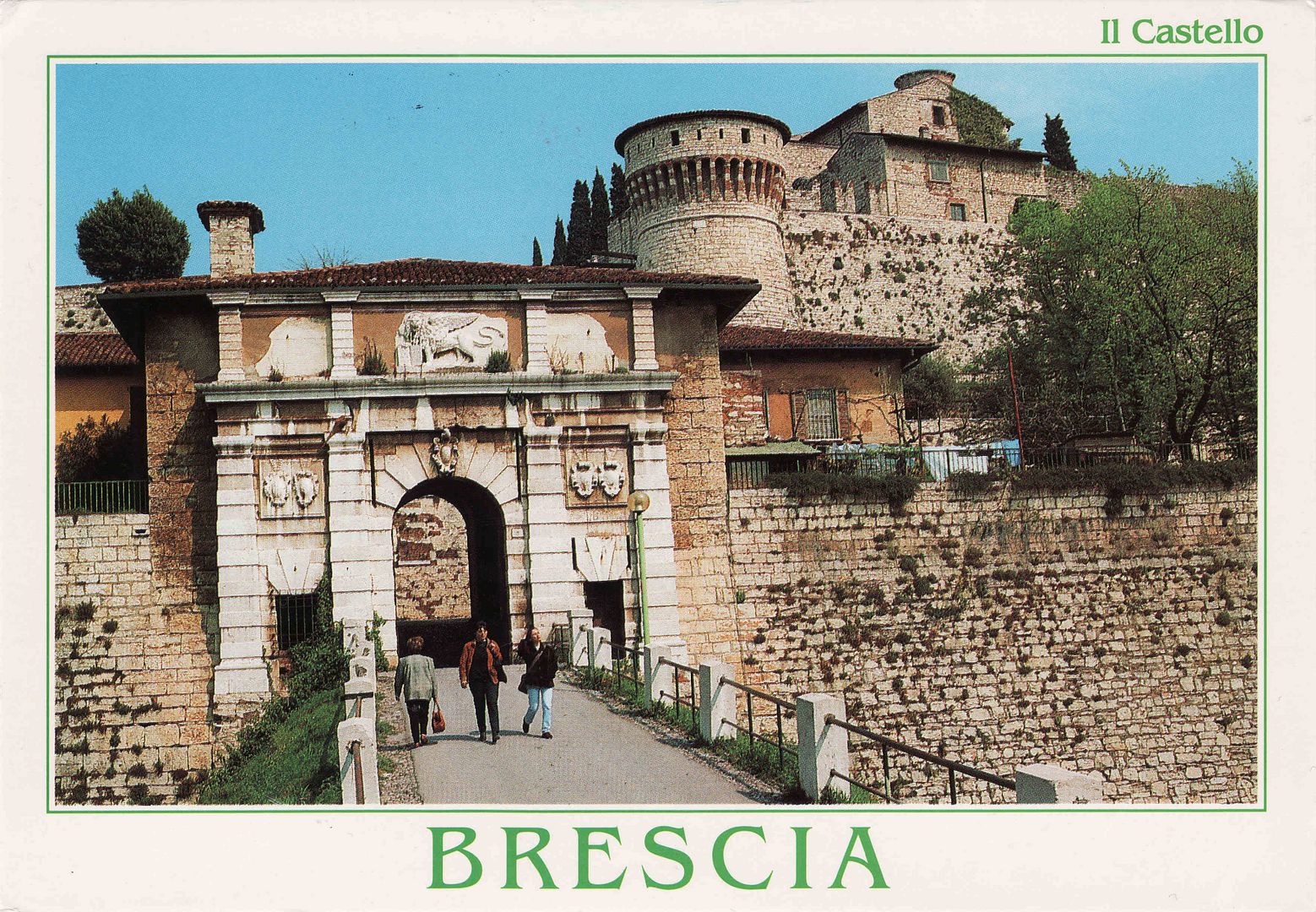
Brescia has had a major role in the history of the violin. Many archive documents very clearly testify that from 1490 to 1640 Brescia was the cradle of a magnificent school of string players and makers, all styled "maestro", of all the different kinds of stringed instruments of the Renaissance: viola da gamba (viols), violone, lyra, lyrone, violetta and viola da brazzo. So you can find from 1495 "maestro delle viole" or "maestro delle lire" and later, at least from 1558, "maestro di far violini" that is master of violin making. From 1530 the word violin appeared in Brescian documents and spread in later decades throughout north of Italy, reaching Venezia and Cremona. [Brescia]
The most famous violin makers, between the early 16th century and the 18th century included:
Micheli family of Italian violin makers, Zanetto Micheli 1490 - 1560, Pellegrino Micheli 1520 - 1607, Giovanni Micheli 1562 - 1616, Francesco Micheli 1579 - 1615, and the brother in law Battista Doneda 1529 - 1610
Bertolotti da Salò (Gasparo da Salò) family of Italian violin and double bass players and makers: Francesco 1513 - 1563 and Agostino 1510 - 1584 Bertolotti, Gasparo Bertolotti 1540 - 1609 called Gasparo da Salò [History of the violin]
Violinists and collectors particularly prize the instruments made by the Stradivari, Guarneri and Amati families from the 16th to the 18th century in Brescia and Cremona and by Jacob Stainer in Austria. According to their reputation, the quality of their sound has defied attempts to explain or equal it, though this belief is disputed.
************
The finest Renaissance carved and decorated violin in the world is the Gasparo da Salò (1574 c.)...
************
The most famous violin makers (luthiers) between the 16th century and the 18th century include:
The school of Brescia, beginning in the late 14th with liras, violettas, violas and active in the field of the violin in the first half of 16th century
The Dalla Corna family, active 1510–1560 in Brescia and Venice
Eugenio Beltrami Born: 16 November 1835 Cremona, Lombardy, Austrian Empire Died: 18 February 1900 (aged 64) Rome, Kingdom of Italy Residence: Italy Nationality: Italian Fields: Mathematician Institutions: University of Bologna University of Pisa University of Rome Alma mater: University of Pavia Doctoral advisor: Francesco Brioschi Doctoral students: Giovanni Frattini Known for: Laplace–Beltrami operator
Eugenio Beltrami (November 16, 1835 in Cremona – 18 February 1900 in Rome) was an Italian mathematician notable for his work concerning differential geometry and mathematical physics. His work was noted especially for clarity of exposition. He was the first to prove consistency of non-Euclidean geometry by modeling it on a surface of constant curvature, the pseudosphere, and in the interior of an n-dimensional unit sphere, the so-called Beltrami–Klein model. He also developed singular value decomposition for matrices, which has been subsequently rediscovered several times. Beltrami's use of differential calculus for problems of mathematical physics indirectly influenced development of tensor calculus by Gregorio Ricci-Curbastro and Tullio Levi-Civita.
Short biography
Beltrami was born in Cremona in Lombardy, then a part of the Austrian Empire, and now part of Italy. He began studying mathematics at University of Pavia in 1853, but was expelled from Ghislieri College in 1856 due to his political opinions. During this time he was taught and influenced by Francesco Brioschi. He had to discontinue his studies because of financial hardship and spent the next several years as a secretary working for the Lombardy–Venice railroad company. He was appointed to the University of Bologna as a professor in 1862, the year he published his first research paper. Throughout his life, Beltrami had various professorial jobs at universities in Pisa, Rome and Pavia. From 1891 until the end of his life Beltrami lived in Rome. He became the president of the Accademia dei Lincei in 1898 and a senator of the Kingdom of Italy in 1899.
Contributions to non-Euclidean geometry
In 1868 Beltrami published two memoirs (written in Italian; French translations by J. Hoüel appeared in1869) dealing with consistency and interpretations of non-Euclidean geometry of Bolyai and Lobachevsky. In his "Essay on an interpretation of non-Euclidean geometry", Beltrami proposed that this geometry could be realized on a surface of constant negative curvature, a pseudosphere. For Beltrami's concept, lines of the geometry are represented by geodesics on the pseudosphere and theorems of non-Euclidean geometry can be proved within ordinary three-dimensional Euclidean space, and not derived in an axiomatic fashion, as Lobachevsky and Bolyai had done previously. In 1840, Minding already considered geodesic triangles on the pseudosphere and remarked that the corresponding "trigonometric formulas" are obtained from the corresponding formulas of spherical trigonometry by replacing the usual trigonometric functions with hyperbolic functions; this was further developed by Codazzi in 1857, but apparently neither of them noticed the association with Lobachevsky's work.
In this way, Beltrami attempted to demonstrate that two-dimensional non-Euclidean geometry is as valid as the Euclidean geometry of the space, and in particular, that Euclid's parallel postulate could not be derived from the other axioms of Euclidean geometry. It is often stated that this proof was incomplete due to the singularities of the pseudosphere, which means that geodesics could not be extended indefinitely. However, John Stillwell remarks that Beltrami must have been well aware of this difficulty, which is also manifested by the fact that the pseudosphere is topologically a cylinder, and not a plane, and he spent a part of his memoir designing a way around it. By a suitable choice of coordinates, Beltrami showed how the metric on the pseudosphere can be transferred to the unit disk and that the singularity of the pseudosphere corresponds to a horocycle on the non-Euclidean plane. On the other hand, in the introduction to his memoir, Beltrami states that it would be impossible to justify "the rest of Lobachevsky's theory", i.e. the non-Euclidean geometry of space, by this method.
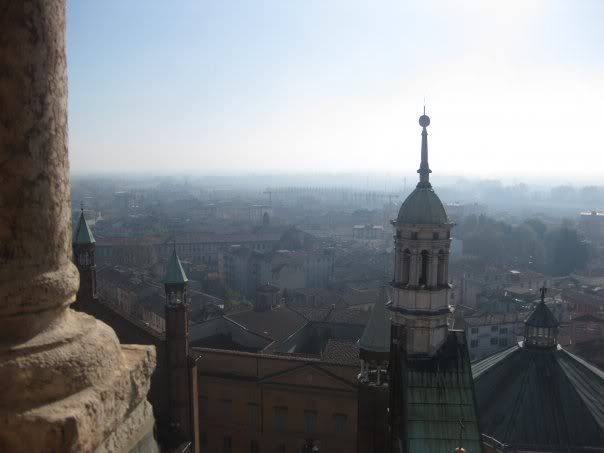
Cremona, Lombardy
In the second memoir published during the same year (1868), "Fundamental theory of spaces of constant curvature", Beltrami continued this logic and gave an abstract proof of equiconsistency of hyperbolic and Euclidean geometry for any dimension. He accomplished this by introducing several models of non-Euclidean geometry that are now known as the Beltrami–Klein model, the Poincaré disk model, and the Poincaré half-plane model, together with transformations that relate them. For the half-plane model, Beltrami cited a note by Liouville in the treatise of Monge on differential geometry. Beltrami also showed that n-dimensional Euclidean geometry is realized on a horosphere of the (n + 1)-dimensional hyperbolic space, so the logical relation between consistency of the Euclidean and the non-Euclidean geometries is symmetric. Beltrami acknowledged the influence of Riemann's groundbreaking Habilitation lecture "On the hypotheses on which geometry is based" (1854; published posthumously in 1868).
Although today Beltrami's "Essay" is recognized as very important for the development of non-Euclidean geometry, the reception at the time was less enthusiastic. Cremona objected to perceived circular reasoning, which even forced Beltrami to delay the publication of the "Essay" by one year. Subsequently, Felix Klein failed to acknowledge Beltrami's priority in construction of the projective disk model of the non-Euclidean geometry. This reaction can be attributed in part to the novelty of Beltrami's reasoning, which was similar to the ideas of Riemann concerning abstract manifolds. J. Hoüel published Beltrami's proof in his French translation of works of Lobachevsky and Bolyai.
Works
Beltrami, Eugenio (1868). "Saggio di interpretazione della geometria non-euclidea". Giornale di Mathematiche VI: 285–315.
Beltrami, Eugenio (1868). "Teoria fondamentale degli spazii di curvatura costante". Annali. di Mat., ser II 2: 232–255. doi:10.1007/BF02419615.
Opere matematiche di Eugenio Beltrami pubblicate per cura della Facoltà di scienze della r. Università di Roma (volumes 1–2) (U. Hoepli, Milano, 1902–1920)[1]
Same edition, vols. 1–4
References
Study, E. (1909). "Review: Opere matematiche di Eugenio Beltrami". Bull. Amer. Math. Soc. 16 (3): 147–149. doi:10.1090/s0002-9904-1909-01882-8.
Stillwell, John (1996). Sources of hyperbolic geometry. History of Mathematics 10. Providence, R.I.: American Mathematical Society. ISBN 978-0-8218-0529-9. MR 1402697
Jeremy Gray, Poincaré and Klein — Groups and Geometries. In 1830–1930: a Century of Geometry (ed L.Boi, D.Flament and J.-M.Salanskis), Springer, 1992, 35–44 External links
"Universe May Have Had No Beginning" 'Big Bang, Deflated? Universe May Have Had No Beginning' by Tia Ghose, Senior Writer - LiveScience.com - February 26, 2015 If a new theory turns out to be true, the universe may not have started with a bang. In the new formulation, the universe was never a singularity, or an infinitely small and infinitely dense point of matter. In fact, the universe may have no beginning at all. "Our theory suggests that the age of the universe could be infinite," said study co-author Saurya Das, a theoretical physicist at the University of Lethbridge in Alberta, Canada. The new concept could also explain what dark matter — the mysterious, invisible substance that makes up most of the matter in the universe — is actually made of, Das added. cont'd
The legend of the Ice Age Eurasian lion
When I was a child, I recall tossing a garter snake or a salamander into water a few times. Even though they had never swam before, as there was no nearby body of water, they took to it as of though they had done it all of their lives. I get the same curious thought when I see a lion in the snow. Just like the drawings of whoolly mammoths and whoolly rhinoceros' roaming the frozen Eurasian tundra of the last glacial movement, it's clear that the modern lion also is partly "whoolly" and could adapt to northern winters as they had once done. In other words, they were once entirely "whoolly"... as one can easily imagine by looking at the above photograph. That lion is not uncomfortable in the snow. Sometimes when I see a documentary featuring African lions, they almost seem to be merely "tolerating" the tropical weather. It may seem like a strange thing to say, but I really wonder if they aren't just as comfortable living in a northern climate. If, just for the sake of discussion, say two hundred of them were released in the remote Pacific Northwest.... I think they would do just fine. Hypothetically, they would just merely be returning to an environment that they once knew. It's like the factory farm pigs who have escaped and mated with wild boars; they became hairy, wild, and adaptive in no time.
History of lions in Europe Lions inhabited parts of Europe during and after the Holocene and even historic times and formed a subspecies called Panthera leo europaea. They lived in ancient Greece, central Germany, Turkey, Georgia, Azerbaijan, Armenia, Iran, southern Russia, coastal Saudi Arabia, western Asia, and India. It is also suggested by historical evidence, although not certain, that they lived in parts of Europe, including modern-day Portugal, Spain, southern France, up to Germany, Italy, and the Balkans beyond Greece. Their diet included cattle, deer and other herbivores.
Fossil record In the earliest Holocene the lion was still present in northern Spain. Until around 5500 to 3000 BCE the lion is confirmed via fossils from Hungary and from the Pontic Region of Ukraine.
Lions in ancient Greece According to reports by Ancient Greek writers such as Herodotus and Aristotle, lions were common in Greece around 480 BCE, became endangered in 300 BCE, until their extinction in 100 BCE. Lions feature heavily in Ancient Greek mythology and writings, including the myth of the Nemean lion, which was believed to be a supernatural lion that occupied the sacred town of Nemea in the Peloponnese. Aristotle and Herodotus wrote that lions were found in the Balkans in the middle of the first millennium BCE. When Xerxes advanced through Macedon in 480 BCE, he encountered several lions. But while lions presumably still existed in the area between the rivers Aliakmon and Nestus in Macedonia in Herodotus' time, in the 1st century CE Dio Chrysostom wrote that they were already extinct in Europe.
Lions in the Caucasus Lions were present in Transcaucasia until the 10th century.
Lion in the snow at The Wild Animal Sanctuary Brandon Crain
[3-28-16 ADDITION: It probably should be noted that the White lion color variation--as well as that of the White tiger--may be a link to perhaps even the true Ice Age of 25,000 years ago. The two appear very similar to the snow leopard of the Himalayas, which would seem to add to the evidence that their white fur could be linked to an ancient cold weather past. Then of course, there are the other white furred arctic or winter-coated animals.]
Strange skulls discovered in Russia, tied to secret Nazi occult group
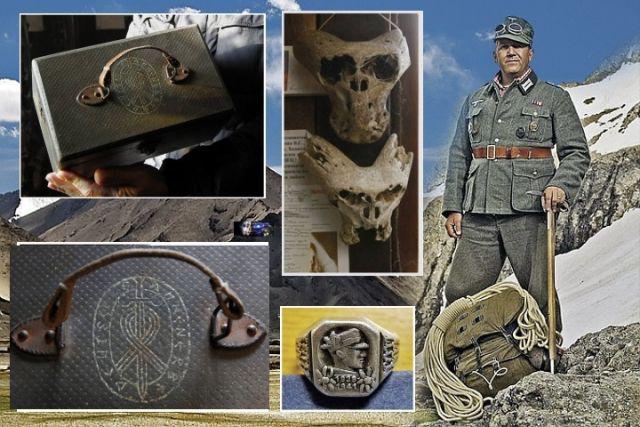
'Strange skulls discovered in Russia, tied to secret Nazi occult group institution and the search for the origin of Mankind' In what sounds as a scene from an Indiana Jones movie, reports from Russian newspapers “Komsomolskaya Pravda” and “Rossiyskaya Gazeta” indicate that a briefcase and two Alien-like skulls were discovered in the mountains of the Caucasus region of Adygeya. Among the briefcase, its finders found two skulls belonging to an unknown creature. Ahnenerbe was probably the most secret society within the SS dedicated to the study of the occult and the supernatural forces on Earth. According to researchers, it is likely that members of the SS were interested in the mysteries of the ancient dolmens and the high amounts of radioactivity present in the region known as the Kishinski canyon. cont'd Ahnenerbe (Wikipedia) Ahnenerbe (German occult)
Alien Or Demon Skulls Found In Russia? LaGranjaHumanaMX Discovered in the mountains of Russia a strange mysterious briefcase and two skulls. According to the journalists of the newspaper “Komsomolskaya Pravda” and “Rossiyskaya Gazeta” briefcase it has written a strange logo “Ahnenerbe” This case was recently found in the mountains of Adygea. In the mountains of the Caucasus region of Adygeya they were found two skulls belonging to an unknown creature for science with the emblem of the Ahnenerbe, probably the most secret society within the SS, dedicated to the study of the occult and the supernatural forces. According to researchers, it is likely that members of the SS were interested in the mysteries of the ancient dolmens and the causes of high natural radioactivity in the region of Kishinski canyon. It is also possible that they should seek the golden Kuban Rada, lost somewhere in the region during the Russian Civil War (1917-1923). Researchers have also found a German map of the territory of Adygeya, held in 1941, and have been amazed by the accuracy and completeness it is. These found objects have aroused great interest among specialists. Historians know many details of the operation of the Wehrmacht Edelweiss, which planted Nazi banners at the peak of Elbrus, the highest mountain in Europe, located in the republic of Kabardino-Balkaria in the Russian Caucasus. However, what it was the purpose of this secret organization in the mountains of Adygea?
Phoenicia.org Phoenicia and Phoenician culture has influenced the world, right up to the present day, in ways that the vast majority of people will never know. Of course, Greece and Rome have the more overt influence; but Phoenicia has given us the more covert-occultic realm. The darker side, although I don't believe that it had to be that way. Certain people made it that way. Carthage was a very powerful Phoenician colony, and when they lost the Punic Wars to Rome, they basically fizzled out of history as a distinct people and culture. In many ways, and certainly in terms of spiritual tradition, Phoenicia embodied much of what came from the civilizations which came before it. In particular, the Saturnian priesthood. They wore purple hooded robes because the rays from the star Saturn emitted a purplish light out of the northern sky before it became a dwarf star. Others present wore black robes, and many of the subtle symbols in a court of law come from their rites... including the black robe of the judge and his "bench." When students graduate, they wear square "Saturnian" caps just as initiates did in Phoenicia. The Phoenician god "EL" is the root word for virtually everything suggesting wisdom, knowledge, or rising in status; from "Elder" to "Elevator." The Quest For The Phoenicians Engineering an Empire: CARTHAGE Saturn the Occult and The Phoenicians ~TØS ~
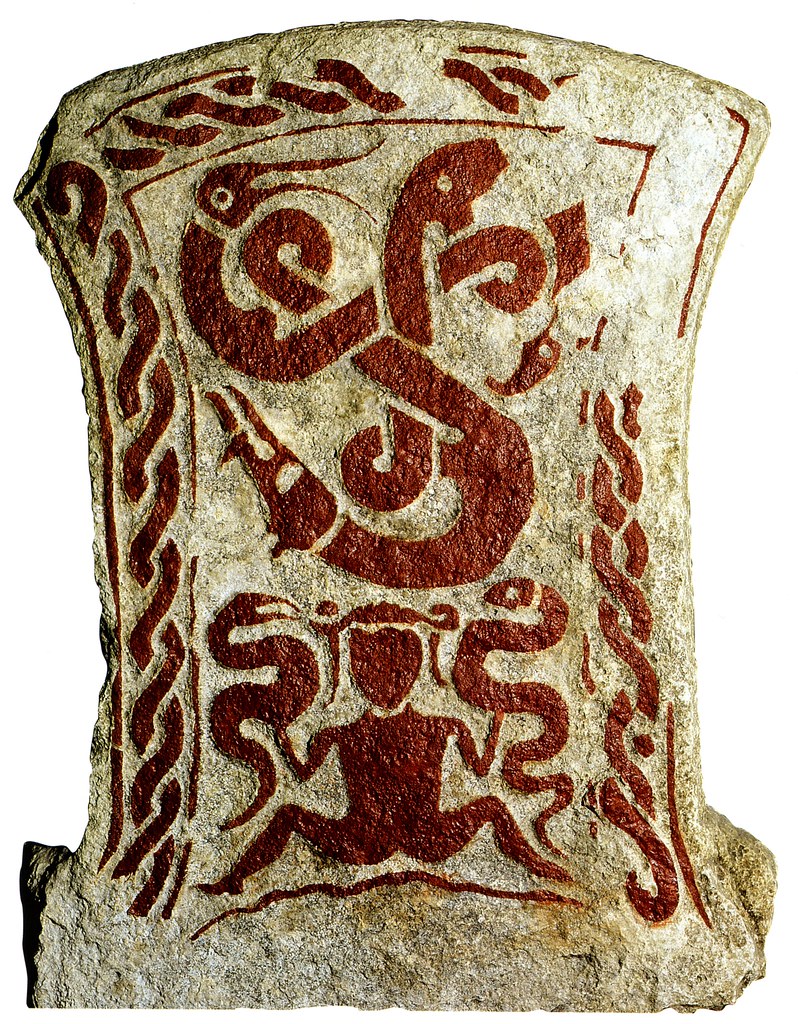
Snake-witch stone The Snake-witch (Ormhäxan), Snake-charmer (Ormtjuserskan) or Smiss stone (Smisstenen) is a picture stone found at Smiss, När parish, Gotland, Sweden. Discovered in a cemetery, it measures 82 cm (32 in) in height and depicts a figure holding a snake in each hand. Above the figure there are three interlaced creatures (forming a triskelion pattern) that have been identified as a boar, an eagle, and a wolf. The stone has been dated to 400–600 AD.
Although many scholars call it the Snake-witch, what the stone depicts—an accurate interpretation of the figures—and whether it derives from Celtic art or Norse art remain debated.
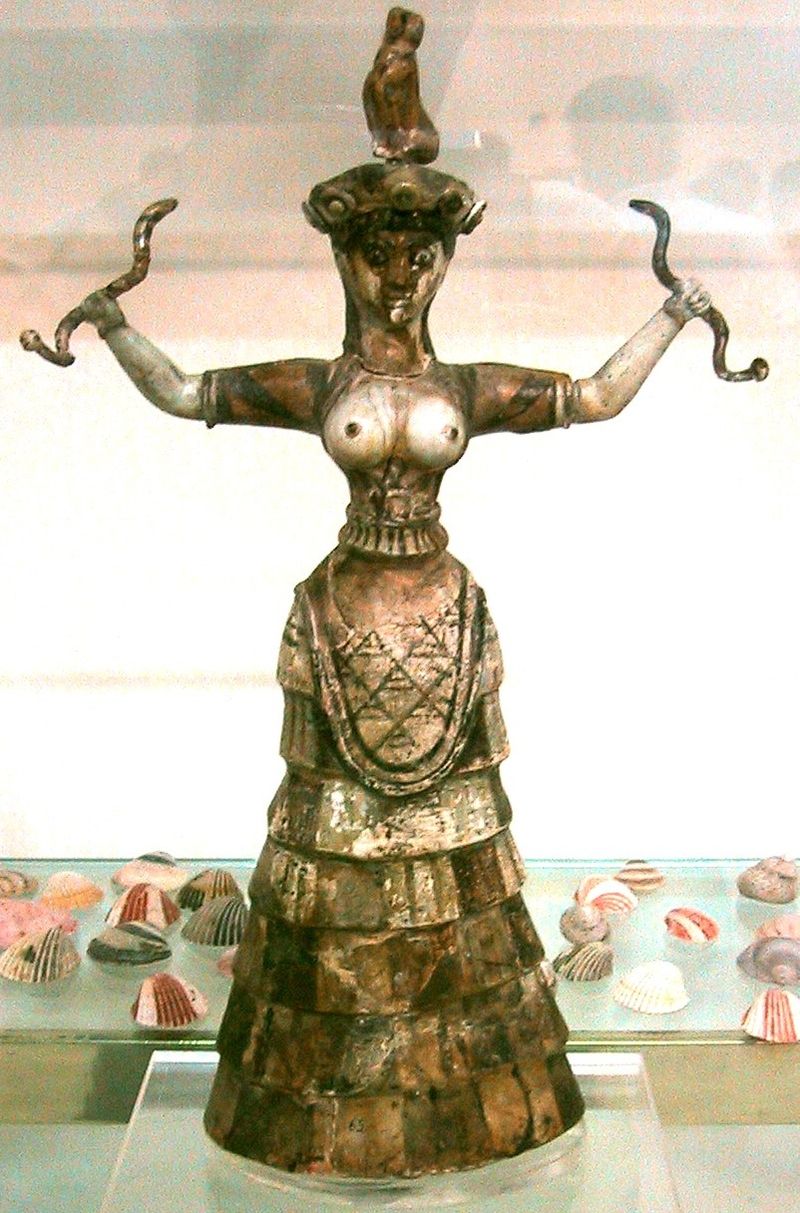
It seems to me that various neopagan concerns have never been certain as what to do with the symbolism on this standing stone/grave marker. First of all, is it Odinic, Druidic, Gaulish polytheistic, proto-European witchcraft, or some combination? This style of standing stone, the serpentine symbolism, and its location would seem to suggest an Odinic origin. However, there was snake symbolism in Gaulish culture, and the Gaulish god Cernunnos was found depicted on the Gundestrup cauldron from some centuries earlier in Denmark. Also, the "snake-witch"--like Cernunnos--is depicted holding a snake; although this artifact may have been obtained in trade between Teutons and Gauls. The snake-witch herself seems to suggest an element of proto-European spiritual influence, such as the pre-Olympian "Snake goddess" of Crete.
Also, just as interesting as the "snake-witch," is the powerful design symbol. To fully appreciate it, you must look at it and fill in the two sections which were somehow chipped off on the animal figure on the upper right. After you do that, then it's clear that this is what I would call a "double-triskellion." The boar, eagle, and wolf are formed as serpentine, with both heads and tails interwoven for this effect. The triskellion or "triple spiral" is found in many ancient European cultures. My guess is that the snake-witch stone is Odinic, with proto-European symbolism. The old Gotlanders, somewhat isolated on an island, probably held onto some aspects of pre-Odinic spirituality. As to whether or not this ties into what is known as "Norse witchcraft," I really don't know at this time. I suppose that there is the possibility or concurrent idea that this was tied to something unique to old Gothic culture and spirituality.
Parallels, interpretations, and speculation
The figure on the stone was first described by Sune Lindquist in 1955. He tried unsuccessfully to find connections with accounts in Old Icelandic sources, and he also compared the stone with the Snake Goddess from Crete. Lindquist found connections with the late Celtic Gundestrup cauldron, although he appears to have overlooked that the cauldron also shows a figure holding a snake. Arrhenius and Holmquist (1960) also found a connection with late Celtic art suggesting that the stone depicted Daniel in the lions' den and compared it with a depiction on a purse lid from Sutton Hoo, although the stone in question does not show creatures with legs. Arwidsson (1963) also attributed the stone to late Celtic art and compared it with the figure holding a snake on the Gundestrup cauldron. In a later publication Arrhenius (1994) considered the figure not to be a witch but a male magician and she dated it to the Vendel era. Hauk (1983), who is a specialist on bracteates, suggested that the stone depicts Odin in the fetch of a woman, while Görman (1983) has proposed that the stone depicts the Celtic god Cernunnos.
It also has been connected to a nearby stone relief on a doorjamb at Väte Church on Gotland which shows a woman who suckles two dragons, but this was made five centuries later than the picture stone.
Snake symbolism
Snakes were popular as a motif on later picture stones which show snake pits, used as a painful means of execution; this form of punishment also is known through Norse sagas. Snakes are considered to have had an important symbolism during the passage from paganism to Germanic Christianity. They were frequently combined with images of deer, crustaceans, or supernatural beasts. The purpose may have been to protect the stones and to deter people who might destroy them.
See also
Hyrrokkin, a female jötunn in Norse mythology who uses snakes as reins
************
3-2-16 ADDITION: I just wanted to add an interesting logo, featuring the Snake-Witch, from a concern called "Heathens and Pagans Against Censorship." Also noteworthy is that this logo---just as with the snake witch/triskellion standing stone---has both proto-European and Teutonic symbolism. However, as covered here before, the proto-Europeans used a different 5-pointed Vehmic rune.