VIEW OUR GUESTBOOK
Friday, July 27, 2007
Saturday, July 14, 2007
The Regions of Brescia Province
There's so much to explore regarding Brescian history, culture, geography, etc., that I thought one good place to focus on right now are the regions of the province of Brescia. The Valle Camonica is often regarded as something of a sub-province. There has even been talk of it becoming a province of it's own, with a capitol at Breno. In any case, Brescia could first be subdivided into the northern mountainous Valle Camonica and the lowland of Brescia.
Administratively, in Italy, the pecking order goes right from sizable provinces to mostly tiny comunes, a big jump. In order to understand Brescia, it would be much easier to view it region by region. These are unofficial regions of the province, almost like boroughs of a big city. The corresponding map lumps a couple of them together, which shouldn’t be, in order to follow regional descriptions. However, it gives a good idea of how the province is perceived.
Think of these regions as 1) Northern Mountains (pre-Alps); 2) Central Highlands; 3) Southern Lowlands. As it corresponds to the map, the mountainous area is the Valle Camonica (not including Sebino), the highland area is everything between the Camonica and Basso Bresciana, and the lowland area is Basso Bresciana. The Valle Camonica is known for it’s very ancient “rock art.” In fact, part of it is protected as a United Nations world heritage park. It was also the home of the ancient Italic tribe, the Camunni, hence the name Camonica. The Franciacorta region is world famous for it’s wines. That’s no exaggeration either. The Valle Trompia is famous as the home of the Beretta company, established in 1526. The company is in the hands of the same family which founded it. Brescia is often credited as the home of the invention of the “hand held cannon,” or the gun. Beretta firearms are considered by most to be the finest firearms in the world. All five branches of the U.S. military use Berettas.
To the right, you will see Lake Garda, the largest lake in Italy. As you can see, it’s divided in two. Brescia to the left, and Verona province to the right. The Garda land region is home of the “Brescian Riviera,” a breathtakingly beautiful coastline. At the center of the province is the Brescian hinterland, where the city and capitol of Brescia is located. This is not to be confused with Basso Bresciana, an agricultural region to the south. For a more comprehensive description of these regions, visit the Onion Communication’s webpages about Brescia (in English).
If you look at that map, and use your imagination, you can imagine the topography of the province. Imagine mountains in the north, green hilly terraces in the center, the blue of Lake Garda to the east, and the green plains of Basso Bresciana to the south. It was considered a prized possession of any nation to which it has belonged, with many quotes to this regard from traveling statesmen over the centuries. The manufacturing, the mining, the fine craftsmen, the gun making, the wineries, the agriculture, etc. It’s almost like a mini central California, with the Sierra Nevada Mountains sort’ve to the north, and the Central Valley southward. From snowcapped Alpine mountains, down to palm trees along the sunny Brescian Riviera along Lake Garda. Amazing.
Sunday, June 17, 2007
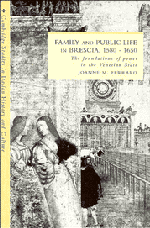
Family and Public Life in Brescia, 1580 - 1650
From the former "Famiglia Bresciana di Nord America" (3/24/07):
I just began reading this book, and it should be very interesting, at least as these types of scholarly books go. I thumbed through 'Town and Country under Fascism: The Transformation of Brescia, 1915-192' (1986) a few times and found it to be very mundane overall. Not the subject matter, but just the way it was written. This should be much more illuminating, as it is about something that is truly "Brescian," good or bad. In addition, it's a good way to learn about "Venetian Bresica." The Brescians actually engineered the Venetians to take over from the Visconti family and the Milanese state.
From the cover:
This book focuses on the behavior of the ruling families of Brescia, a rich and strategically vital city under Venetian rule, during the late sixteenth and early seventeenth centuries. The first part of the book conceptualizes the civic leadership of Brescia, with a profile of its origins and a brief history of the process of aristocratization. Further, it examines the relationship between family structure and the local socio-political structures. Size, wealth, education, and marriage ties were all pivotal factors
which helped determine the family's position in public life. Its strength rested ultimately on its continuity over time. Women and women's property are given careful attention. The second part places the Brescian elite within the Venetian state. Besides controlling urban political institutions, the Brescians held strong economic links with the surrounding countryside, the basis of their power, and they enjoyed ample authority in the rural communities subject to the city. This section of the book examines the different ways in which these families sought to preserve their control over local resources. It also analyzes the Brescian civic leadership's weight in public life, in relation to that of Venetian authorities, illuminating some of the important ways in which the Venetian state was knit together.
From review at Amazon.com:
This book focuses on the behavior of the ruling families of Brescia, a rich and strategically vital city under Venetian rule, during the late sixteenth and early seventeenth century. The first part of the book conceptualizes the civic leadership of Brescia, with a profile of its origins and a brief history of the process of aristocratization. Further, it examines the relationship between family structure and the local socio-political structures. Size, wealth, education, and marriage ties were all pivotal factors which helped determine the family’s position in public life. Its strength rested ultimately on its continuity over time. Women and women’s property are given careful attention. The second part places the Brescian elite within the Venetian state. Besides controlling urban political institutions, the Brescians held strong economic links with the surrounding countryside, the basis of their power, and they enjoyed ample authority in the rural communities subject to the city.
From review by "Renaissance Quarterly':
With the annexation of Brescia in 1426 and Bergamo in 1428, Venetian dominion over the terraferma stretched from the Friuli well into the heart of Lombardy. Venice's subjugation of the city of Brescia and the surrounding countryside (Bresciano) provided access to a rich supply of minerals, cereals, and mulberries, a new source of indirect taxes (dazi) on foodstuffs and manufactured items, and domination over strategically located roads that were crucial in any confrontation with nearby Milan.
Update:
Halfway through the book now, I can see that the book is very scholarly and extremely repetitious regarding the economics in the early part of the book. Many gems of information and insight are mixed in, but it's written in an overtly scholastic style in which facts are established only after long periods of facts and proof. In other words, in most books the author can state opinion (w/references) like "the evidence clearly shows ...x, y & z." Here you must endure pages and pages of facts and figures to show what can be stated in a sentence or two.
I'm about to enter the chapters regarding the customs and family structure of the ruling aristocracy, which should be of greater interest. Of course, this cannot be the only expression of Brescian culture, but only of this ruling oligarchy. Although allowed to rule the province without many restrictions from the government in Venice, taxation was heavy, and they only operated within the provincial territory. Once positive was the unity, as the elites did have much contact with the countryside. In fact, some were actually from the surrounding countryside.
At times, I try to read between the lines of this period, and see the human side for the average citizen. For example, an adventurous young man from the Camunian mountain community could join the Venetian navy. There is little doubt that some Brescians fought in the "Battle of Lepanto," one of the greatest battles in history. Some could have become Venetian merchants and worked for the expansion of Venetian concerns in more of a direct way. This is especially true when we consider that the Brescian oligarchy was a very closed system. For example, you might be excluded if one of your great-grandparents were born out of wedlock!
A hungry merchant or craftsman could have gone out on his own and worked out of the Venetian or Dalmatian coasts, or in one of the outposts in Greece. They could have partaken in adventures like Marco Polo did. Although Venetian territory wasn't very large, they wielded tremendous power and more-or-less controlled the eastern trade routes for centuries.
Sunday, June 10, 2007
San Francisco Cable Cars from Milan
It's nice to know that there is something truly Lombardian in San Francisco. Well, there is the famous Lombard Street, named after the Lombard Street in London, where bankers from North Italian regions once had a foothold. There's a curious little item that I would like to share. Once I saw a listing in the business white pages for a business on Lombard Street named "Lombardia." There was no reference as to what type of business this was. Once, while I was in the area, I looked up the address just to take a look at what it was. It was at night, and I came upon what looked like an ordinary apartment building. On it was a gold colored plaque of some type, and engraved on it was the word "Lombardia." It's possible that this was merely the name of the building, but why was it listed in the business section of the phone book?
I once briefly met an old lady who was born in Lombardia, and lived in a house in what is now a very high crime area of San Francisco. She was over one hundred years old! I feel bad that there wasn't anything I could do for her. She passed away some years ago. I wish I could have organized an effort to move her to another area, perhaps in San Mateo or somewhere like that. She was a widow with no family. Very sad. Perhaps she had even outlived her children. We've failed if we can't address these types of community issues. There is a public service that has been around a long time called Italian-American Community Services that helps elderly people of Italian descent. That could be one area that we can look into in the future. Actually someone I knew was looking after her, so it wasn't all bad.
While on the subject of all things Lombardian in Northern California. It bears mention that the traditional "Swiss" of California are culturally Lombardian. While there have been few Lombardians in our local history, there have been many Italian Swiss or "Ticino Swiss." This is a subject to be explored in greater detail in another entry. Ticino is a very small Swiss Canton, and the only one south of the Alps. The inhabitants are of Northern Italian descent, but they ended up on the Swiss side of the border long ago. Ticino isn't really very far from Milan, although it's basically a mountainous area.
Saturday, June 9, 2007
The "Eighteen Families" of Loveno Grumello
One of the Brescia province's "communes" is Paisco Loveno, which is located in the northern mountains (Valle Camonica). It seems to be made up of three villages. One is "Paisco." The other two are side by side, so they are under the same little town administration. They are "Loveno" and "Grumello," or simply Loveno Grumello.
There are officially 257 inhabitants in Paisco Loveno. Perhaps about half of that in Loveno Grumello. This little tri-village is truly located in some deep woods in the mountains, similar to the Smokey Mountains maybe. If you look at it from a satelite image, it's like a "Black Forest" from an old movie. You can't even see the villages!
Loveno Grumello is more than a village, but has quite a history. Eighteen families live there that go back centuries. They are: Armeni, Baldoni, Calvetti, Calufetti, Degani, Filafusi, Fornoni, Franchini, Lucchi, Mansini, Mattia, Mitterpergher, Norini, Omassoli, Palazzi, Pedretti, Rondoni, and Stupendi.
Some of these names, like Calufetti, are only found in the Camunian Valley. Therefore, quite likely, every "Calufetti" (or Calufetti descendant) in the world is related to one another. "Rondoni" is a name which seems to be tracable right back to ancient Rome (Rondon?), branching out to the Perugia/Umbria area, and north to the Veneto, and finally, perhaps, to "Venetian Brescia" many centuries ago.
The name "Armeni" is interesting in that it literally means "Armenians" in Italian. It could be linked to either an Armenian family who lived in old Venice maybe, or to someone who merely (more likely) traded with the Armenians via the Venetian eastern trade routes. This type of name is somewhat common in Italy, where long ago governors or merchants were sometimes called by the name of the region they were linked with (Albanese, Greco, Francese, Germano, Turco, etc.) Also, this occurred via cities or regions within the Italian peninsula. For example, a Sicilian named "DiNapoli" (of Naples) or a Neapolitan named "Genovese" (a Genoan) or "Lucchesi" (person who is from Lucca). Once again, it's either originated from an ancestor who was a migrant, a trade merchant, or a governmental figure of some type.
Also interesting is the non-Italian sounding name "Mitterpergher." This, almost undoubtedly, is a name tracable right back to the invasion of the Lombards in the sixth century. Ninty-nine times out've a hundred, this type of foreign name is "Italianized" eventually. What is also very curious is that this German-sounding name is not found, with this very old spelling, in northern Europe that I know of. Perhaps it can be found in Germany with a shortened version, like "Miterperger." Needless to say, every name has a long history.
Immigrants from Brescia and the Camonica migrated all over the world. It's difficult to pinpoint exact numbers and percentages. The numbers were not especially large. Certainly Argentina is one of the main ones, and Australia. If we take the name "Calufetti" again, which is only native to the Camunian Valley, and if we were to search out anyone born a Calufetti in Buenos Aires, Montreal, Johannesburg, Melbourne, or Paris, they are literally "family" going back only a few generations.
It probably should be pointed out that Northern Italy has relatively few emigrants compared to Southern Italy and the German speaking lands. Even then, the vast majority were from big coastal cities like Genoa. Also, the vast majority migrated to the southern part of South America. This unusual emigration paradigm often makes it difficult to put many things into context, but it at least offers an explanation of why there are so few Lombardian descended people in America. I always say, if the Venetian Empire was located in Ireland or Sicily, we would have many movies, books, documentaries, etc., about it in English! Also, if the "Cinque Giornate Revolt" happened in Dublin, for example, we would have seen a major Hollywood motion picture about this very dramatic event! As they say, the squeaky wheel gets the oil. We can dig and sift through evidence of Lombardian communities around the world at a later time.
"Voce Camuna" online magazine featured an article about specifically these "eighteen familes," which is written in Italian. "Voce Camuna" means "Camunian Voice" and is probably a newspaper in the Valle Camonica. The very ancient history of the "Camunni tribe" is a whole subject in of itself. Don't be afraid to dig right into some of these regions, provinces, communes, and cities in the Italian wikipedia.
[Correction: "Voce Camuna" is a radio station, not a newspaper, although there are articles on the website.]
[Correction: The surname mentioned, "Germano," probably is from the first name of "Herman" in English. So that would be a surname of Herman. The Italian surname "Tedesco" means "German." "Tedeschi" means "Germans," and other combinations.]
[Note: The apparent North Italian surname "Parigi," which means "Paris," could possibly be based on an individual (perhaps from many centuries earlier) who was either a merchant or statesman who had key business or dealings with Paris or that general region.]
[8-14-09 ADDITION: It's interesting to note that one surname, very similar to Mitterpergher, and much more common in the north, is "Mittempergher." It's most likely of Langobard origin.]
Tuesday, May 29, 2007
Lombard or Lombardian?
The Lombards were a Germanic tribe which conquered Northern Italy in the 6th century. I have heard that they were only about 30,000 strong, but I haven't been able to confirm this. They ruled for about 200 years. It was called the "Kingdom of the Lombards" or "Langbard." Their capitol was based in modern Pavia or what they called "Ticinium," and their base of operation was basically in modern "Lombardy."
I will go into the Lombards at some future time, but I wanted to just spend a little time discussing the confusion of all the names relating to the Lombards. Since they conquered almost all of Northern Italy, every Northern Italian is sort've a "Lombard" in a sense. Then there is Lombardy proper, and this is where the confusion mainly lies.
First of all, lets look at the ancient roving nation of the Lombards. They were called, depending what language you speak: the Lombards, the Longobardi, the Langobards, the Langobardi, the Langbärten, Longobards, the Langbards, and many others. They finally founded their kingdom called Langbard, the Kingdom of the Lombards, Langbardorum, and other similar names.
Second, this is all separate from the Italian region and former nation (1859) of Lombardia, or Lombardy in English. The plural name for modern Lombards is, depending on your language: Lombards, Lumbards, Lombardi, and others. To avoid all this confusion, for English speakers at least, we should refer to the ancients as "Lombards." We should refer to the nation they established as the "Kingdom of the Lombards." We should refer to the modern Italian region as "Lombardia," and to the people as "Lombardians."
"Lombard" should really refer to the ancient tribe only. I have no idea as to why Lombardia had to be modified to Lombardy. The German-speaking nation of Österreich was modified to "Austria" for English-speakers, Bayern was modified to "Bavaria" as well, so why is "Lombardia" so difficult to pronounce? Also, "Lombardians" is a good modern English name for the inhabitants.
The actual pronunciation for Lombardia is "Lom-bar-DEE-ah," but can be simply read straight though in English. It's sort've a forgivable mispronunciation. Even Brescia, pronounced "Breh-shee-ah," can be read in English as "Bressia," without insult, as there are many names that you and I can't pronounce properly, but a fair attempt is acceptable. There's a big difference between that, and a butchering of a word! lol
[Update 9-27-08: I wanted to add what our Lombardian friend Alessio Mezzenzana wrote to us: "In one of your blogs you write that the number of langobarden was 30,000. This is not correct.according to karin priester: the minimum nuber is 150.000 - 200.000. And wilfried menghin writes of 120.000 Langobards. You must have mistaken it with the horde number."]
[Update 12-5-08: "Estimates of the number range between about fifty thousand and two hundred thousand adult males, so we may be talking about a population of four or five hundred thousand people altogether." –Professor Thomas Noble, Chairperson, Department of History, University of Notre Dame, on the Lombard invasion population numbers in 568 A.D. during verbal interview for the History Channel's 'Barbarians II: The Lombards']
Saturday, May 26, 2007
About "Bresciani nel Mondo - Northern California"
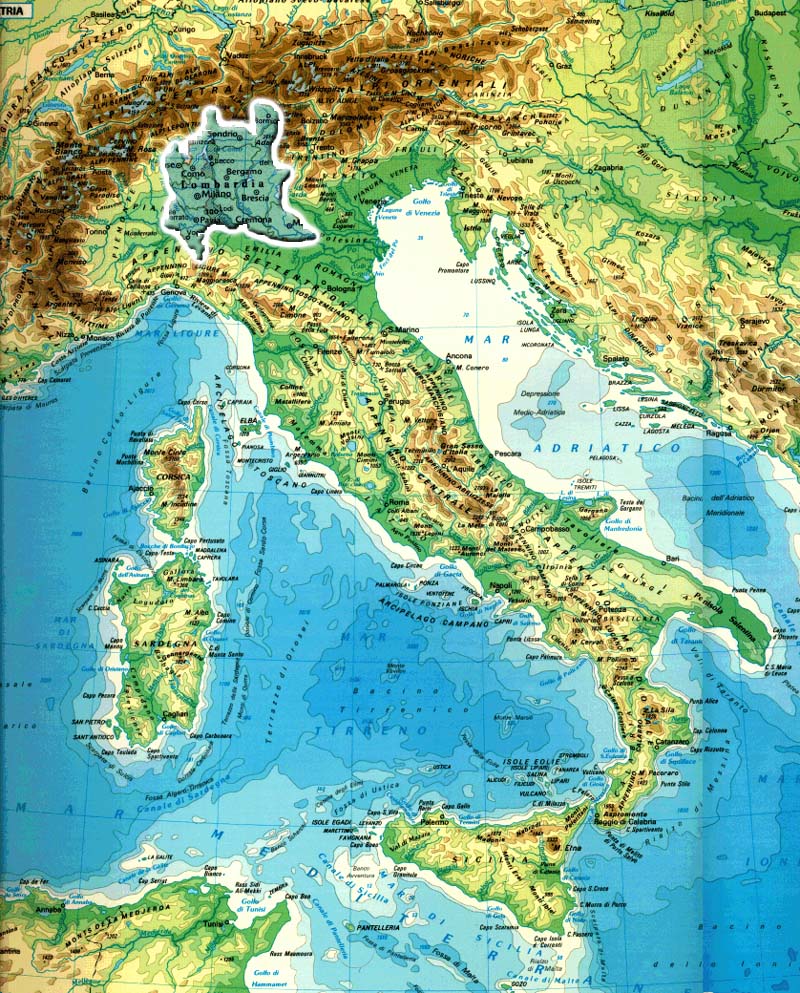
Brescia is an ancient province in Northern Italy. As the geographical map to the right doesn't really show, it lays to the left of the huge beautiful Lake Garda, to the bottom of the pre-Alpine mountains, to the top of the Po Valley, and to the right of the rest of Lombardy.
Although part of historical Lombardy, it's also historically tied to the Veneto. It's made up of two distinct regions in of itself: Brescia proper to the south, and the mountainous Valle Camonica to the north. The Camonica could just as easily be a province itself, with a history that goes back at least 8,000 years.
The gun was invented in Brescia, and the Beretta family has been producing them since 1526. All four branches of the U.S. military use Berettas, long considered by most to be the finest firearms manufacturer in the world. The province is also long well-known for it's manufacture of the violin. Brescia was crucial to the success of the 1,000 year Venetian Empire, especially it's arms manufacturing.
There's so much to say that I will just cut it short for now. I mainly wanted to just say hello and welcome you to this organization. It will be more of a loose association, and hopefully will encourage other similar groups around the world. Certainly Northern California was settled by many Northern Italian immigrants, but mostly from the western part of Northern Italy. Our original plan was to create a large web presence for Bresciani nel Mondo, to spread it around the world, but that plan has been scrapped. We still would like Americans, Canadians, Australians, Angentinians, South Africans, etc. to create similar groups, and perhaps we can all get together at some later point. Needless to say, Brescian heritage is certainly something to be very proud of!