The Northern raccoon Procyon lotor is a species native to North and Central America, but alien populations have established in Europe, several Caribbean islands, and Japan, being introduced for fur farming, hunting, or as pets/attraction in animal parks. In the introduced range, raccoons may impact on breeding birds and amphibians, exert crop damages and transmit pathologies to wild species and humans. The species has been introduced also in Italy, where the only known reproductive population is observed since 2004 in Lombardy, along the Adda river.
Slowly but surely, the North American raccoon is literally spreading across the planet. First introduced into Germany, Japan, and Cacucus during the last century, they are quick to adapt and reproduce. Their habitat is typically northern moderate, but they're native to tropical Mexico and Central America as well. Alaska and northern Canada are too harsh. However, their potential to inhabit territories far and wide exists. In Japan, they have done much damage to ancient temples by sheltering up within the the area around the rafters (urinating for example). The love affair with the raccoon in Japan seems to have ended, as the government is trying to eradicate them. In Europe, they started out in Germany, and have spread heavily into Denmark and Switzerland, and also into France and central Europe, and now into Lombardy.
In Europe, raccoons don't seem to be any more of a nuisance than in North America. Since they have working hands, including opposable thumbs, they can open garbage cans to get at leftover food. There is insufficient data on the Alpine region of Lombardy (Sondrio for example), so it would seem likely that they are there as well. It is known that there are breeding populations in south-central Lombardy. The following link actually has some expanded information, including two good maps; one of Italy and Switzerand, and one of Lombardy: https://www.researchgate.net/figure/Current-distribution-of-Northern-raccoon-in-Lombardy-red-triangles-with-respect-to_fig2_278962437 The Italian/Swiss map clearly shows the considerable extent to which raccoons have inhabited that country, and in turn the potential for the same thing to happen in Italy. An entirely separate breeding population of Raccoons has even taken root in Belarus.
I'm not suggesting that this is something good. Invasive species can cause lots of problems. We have seen the damage done by giant rodents from South America--called nutria--have done in states like Louisiana. Another example are the farm factory pigs which sometimes escape into the wild and breed with with wild boars (an invasive species) of which they descended from before genetic modification. The offspring quickly regain their old DNA and become hairy with tusks again, while becoming even bigger. Some can be up to seven or eight hundred pounds! One "monster pig" was shot in Alabama in 2007; 9 feet 4 inches, and 1,051 pounds. Then of course there are the killer bees from the African bees who escaped in the 1950s and cross-breeding with local Brazilian honey bees, and they migrated to the United States years ago.
So what does invasion of raccoons mean to Lombardy? It would seem highly likely that they will increase rapidly because of the ideal climate and environment there.
Apparently the Tarot came into Europe via Marduk, Egypt (Egypt, the Levant, and Hejaz), and the first European records of them were in Milan, Ferrara, Florence, and Bologna. With such an obscure origin, they may be a remnant of the old mystery schools which stretched from ancient western Europe (Druids?) to Greece to Egypt to India to China at one point. Also, it was very dicey with the Medieval power of the Church, and the Islamic world looming so large. The old knowledge and teachings of Hermeticism and similar ancient traditions were already present when Christian and Muslim despots arrived on the world stage as societies transitioned from native paganism to Abrahamic systems (the Middle East had been largely Indo-European with spiritual systems such as Zoroastrianism).
Queen Theodelinda fresco at Monza
Where the Tarot may have fit in within the ancient wisdom... I'm sure someone from some level of initiation knows. It's very curious that the modern incarnation of Tarot got its name from Brescia. The artisans of Brescia--whether producing fine clothing, luxurious silk accessories, leather products, brilliant weaponry, the finest textiles, etc--were second to none. They exported their crafts to the Near East during that time period, and perhaps that's how the Tarot came in. Brescia was then part of the Venetian Republic, and Venetian ships exported the goods overseas.
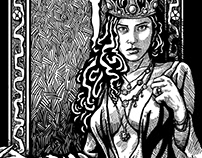
The middle card in the image above looks much like depictions of the Lombard Queen Theodelinda, and perhaps the figure on horseback as well. Compare those images to the example of the art depiction of Theodelinda on the left, from the Cathedral she had constructed at Monza, Lombardia. What other monarchical figure in Lombardia appeared like that... blonde.. monarchical.. so grand? Clearly someone important, a queen. I can't think of too many others. Was there a Queen Theodelinda card(s) on the Pierpont Morgan Bergamo deck? She ruled some seven centuries earlier.
Milanese tarocchi, c. 1500
A terrific head of state, Theodelinda could very well have been declared a Catholic saint. The Pierpont Morgan Bergamo card image would be very consistent with her artistic portrayals, downplaying her beauty, and depicting her as merely stately. Early historians had clearly described her as tall and beautiful, and she was later depicted as somewhat shorter as well. I guess it wasn't acceptable to show a woman as beautiful and physically imposing, especially if she was such a great head of state. Things were very touch-and-go when she took over alone as Queen of the Langobards. She was extremely loved by her people, and proceeded to patch things up with the Vatican and other surrounding states, pragmatically codified laws, defined the culture, and was a great patron of the arts. One of the great underappreciated female rulers in world history; one of the great underappreciated heads of state, period!
Trionfi (Italian: 'triumphs') are 15th-century Italian playing cards with allegorical content related to those used in tarocchi games. The general English expression "trump card" and the German "trumpfen" (in card games) have developed from the Italian "Trionfi". Most cards feature the personification of a place or abstraction.
************
History
Many of the motifs found in trionfi are found in trionfo, theatrical processions that were popular in the Italian Renaissance. The Palazzo Schifanoia in Ferrara, once owned by the ducal House of Este, contains many murals depicting these floats. Petrarch wrote a poem called I Trionfi which may have served as inspiration.
The earliest known use of the name "Trionfi" in relation to cards can be dated to 16 September 1440 in the records of a Florentine notary, Giusto Giusti. He recorded a transaction where he transferred two expensive personalized decks to Sigismondo Pandolfo Malatesta.
In a letter from 11 November 1449, Antonio Jacopo Marcello used the expression triumphorum genus for a deck that was produced sometime between 1418 and 1425. It was commissioned by the duke of Milan, Filippo Maria Visconti, painted by Michelino da Besozzo and described in an accompanying text by Martiano da Tortona.
Two decks from June 1457 seem to relate to a visit at Ferrara of the young Milanese heir of the dukedom Galeazzo Maria Sforza in July/August 1457. Each deck consisted of 70 cards — the modern Tarot deck typically has 78.
The earliest known appearance of the word "Tarocho" as the new name for the game is in Brescia around 1502).
[Depaulis, Thierry (2008). "Entre farsa et barzelletta: jeux de cartes italiens autours de 1500". The Playing-Card. 37 (2): 89–102]
Tarocchini (plural for tarocchino) are point trick-taking tarot card games popular in Bologna, capital city of the Emilia-Romagna region of Italy and has been confined mostly to this area. They are the diminutive form of tarocchi (plural for tarocco), referring to the reduction of the Bolognese pack from 78 to 62 cards, which probably occurred in the early 16th century.
The games of Tarocchini are very complex, yet the rules have changed little over the years.
The Visconti-Sforza tarot is used collectively to refer to incomplete sets of approximately 15 decks from the middle of the 15th century, now located in various museums, libraries, and private collections around the world. No complete deck has survived; rather, some collections boast a few face cards, while some consist of a single card. They are the oldest surviving tarot cards and date back to a period when tarot was still called Trionfi ("triumphs" i.e. trump) cards, and used for everyday playing. They were commissioned by Filippo Maria Visconti, Duke of Milan, and by his successor and son-in-law Francesco Sforza. They had a significant impact on the visual composition, card numbering and interpretation of modern decks.
************
Overview
The surviving cards are of particular historical interest because of the beauty and detail of the design, which was often executed in precious materials and often reproduce members of the Visconti and Sforza families in period garments and settings. Consequently, the cards also offer a glimpse of nobiliary life in Renaissance Milan, which the Visconti called home since the 13th century.
************
Pierpont Morgan Bergamo (card deck)
This deck, also known as Colleoni-Baglioni and Francesco Sforza, was produced around 1451. Originally composed of 78 cards, it now contains 74, i.e. 20 trumps, 15 face cards, and 39 pip cards. The Morgan Library & Museum in New York City has 35, the Accademia Carrara has 26 in its catalogue, while the remaining 13 are in the private collection of the Colleoni family in Bergamo. Trumps and face cards have a gilt background, while the pip cards are cream-coloured with a flower and vine motif. The two missing trumps are the Devil and the Tower. Modern published reproductions of this deck usually contain attempted reconstructions of missing cards.
[The Tarot] first known as trionfi and later as tarocchi or tarock, is a pack of playing cards, used from at least the mid-15th century in various parts of Europe to play games such as Italian tarocchini; many games are still played today; in the late 18th century, some tarot decks began to be used for divination via tarot card reading and cartomancy leading to custom decks developed for such occult purposes.
************
History
The first documented tarot packs were recorded between 1440 and 1450 in Milan, Ferrara, Florence and Bologna when additional trump cards with allegorical illustrations were added to the common four-suit pack. These new decks were called carte da trionfi, triumph cards, and the additional cards known simply as trionfi, which became "trumps" in English. The earliest documentation of trionfi is found in a written statement in the court records of Florence, in 1440, regarding the transfer of two decks to Sigismondo Pandolfo Malatesta.
The oldest surviving tarot cards are the 15 or so Visconti-Sforza tarot decks painted in the mid-15th century for the rulers of the Duchy of Milan. A lost tarot-like pack was commissioned by Duke Filippo Maria Visconti and described by Martiano da Tortona probably between 1418 and 1425, since the painter he mentions, Michelino da Besozzo, returned to Milan in 1418, while Martiano himself died in 1425. He described a 60-card deck with 16 cards having images of the Roman gods and suits depicting four kinds of birds. The 16 cards were regarded as "trumps" since in 1449 Jacopo Antonio Marcello recalled that the now deceased duke had invented a novum quoddam et exquisitum triumphorum genus, or "a new and exquisite kind of triumphs". Other early decks that also showcased classical motifs include the Sola-Busca and Boiardo-Viti decks of the 1490s.
In Florence, an expanded deck called Minchiate was used. This deck of 97 cards includes astrological symbols and the four elements, as well as traditional tarot motifs.
The expansion of tarot outside of Italy, first to France and Switzerland, occurred during the Italian Wars. The most important tarot pattern used in these two countries was the Tarot of Marseilles of Milanese origin.
************
Etmology
The word Tarot and German Tarock derive from the Italian Tarocchi, the origin of which is uncertain but taroch was used as a synonym for foolishness in the late 15th and early 16th centuries. The decks were known exclusively as Trionfi during the fifteenth century.
The new name first appeared in Brescia around 1502 as Tarocho.
[Depaulis, Thierry (2008). "Entre farsa et barzelletta: jeux de cartes italiens autours de 1500". The Playing-Card. 37 (2): 89–102]
During the 16th century, a new game played with a standard deck but sharing a very similar name (Trionfa) was quickly becoming popular. This coincided with the older game being renamed tarocchi. In modern Italian, the singular term is Tarocco, which, as a noun, refers to a cultivar of blood orange. The attribute Tarocco and the verb Taroccare are used regionally to indicate that something is fake or forged. This meaning is directly derived from the tarocchi game as played in Italy, in which tarocco indicates a card that can be played in place of another card.
************
Gaming decks
The original purpose of tarot cards was to play games. A very cursory explanation of rules for a tarot-like deck is given in a manuscript by Martiano da Tortona before 1425. Vague descriptions of game play or game terminology follow for the next two centuries until the earliest known complete description of rules for a French variant in 1637. The game of tarot has many regional variations. Tarocchini has survived in Bologna and there are still others played in Piedmont and Sicily, but in Italy the game is generally less popular than elsewhere.
************
Tarocco Piemontese: the Fool card
These were the oldest form of tarot deck to be made, being first devised in the 15th century in northern Italy. Three decks of this category are still used to play certain games:
The Tarocco Piemontese consists of the four suits of swords, batons, cups and coins, each headed by a king, queen, cavalier and jack, followed by the pip cards for a total of 78 cards. Trump 20 outranks 21 in most games and the Fool is numbered 0 despite not being a trump.
The Swiss 1JJ Tarot is similar, but replaces the Pope with Jupiter, the Popess with Juno, and the Angel with the Judgement. The trumps rank in numerical order and the Tower is known as the House of God. The cards are not reversible like the Tarocco Piemontese.
The Tarocco Bolognese omits numeral cards two to five in plain suits, leaving it with 62 cards, and has somewhat different trumps, not all of which are numbered and four of which are equal in rank. It has a different graphical design than the two above as it was not derived from the Tarot of Marseilles.
************
Card reading
The earliest evidence of a tarot deck used for cartomancy (fortune telling) comes from an anonymous manuscript from around 1750 which documents rudimentary divinatory meanings for the cards of the Tarocco Bolognese.
Terence McKenna (November 16, 1946 – April 3, 2000) was an American ethnobotanist, mystic, psychonaut, lecturer, author, and an advocate for the responsible use of naturally occurring psychedelic plants. He spoke and wrote about a variety of subjects, including visionary experiences, plant-based entheogens, shamanism, metaphysics, alchemy, language, philosophy, culture, technology, environmentalism, and the theoretical origins of human consciousness.
Coastal Animist (thread): If 2020 hasn't opened people's eyes to this reality, I can't imagine what will...
Eric Surf Veganarchist: Yeah even the people who seemed anti establishment pre 2020 became authority worshipers in 2020.
Ryugo7 7: @Eric Surf Veganarchist Crazy ain’t it?
BrookerOfTheBorealValley: Watch Watchman and Read Watchmen ( AND MORAL OREL!)
luke smedley: @Eric Surf Veganarchist Fear and propaganda do an amazing job at doing that unfortunately 😪
Joseph (me): AOC is the perfect example of the psychological derangement of our age. Nobody seems to doubt her eminence as a Liberal/Progressive, despite the fact that she wakes up each morning with one chief goal in mind which she has sworn to fight tooth-and-nail to help bring about. She seeks for all of the poor people of the world to be forced to pay a permanent WORLD TAX directly to the fronts of international banking cartels---whose combined net worth is the equivalent of hundreds of trillions of dollars according to their own biographies---literally for the air that they breathe.
*************************
THE 4 MINUTE SPEECH THAT WILL CHANGE YOUR LIFE | David Goggins (2021)
In this video, David Goggins mentions that self-discipline is everything. It's all on you! The self part is what's big. Do not allow yourself to become civilized. Be uncommon amongst uncommon people. We have 2 voices in our minds. The coddling voice and the demon voice. The soft voice that is nurturing. The other voice that says to get up and pushes you. That's the voice you need to listen to. People look for inspiration. Inspiration is found in every first step you take. It's found in suffering. We believe we work harder than we actually are. Drop your entitled mindset. Most of us haven't worked hard. Learn to help yourself. Don't count on other people to help you. We all have our own tests. The only way to overcome it is for you and you alone to face it! Stay Hard!
I could make a career off of this guy! The manner in which he plays up the stereotype is the stuff of Hollywood. He resembles the character "Warden Norton" from the 'Shawshank Redemption'. I left the following comment on one of these videos:
Pastor MacArthur is very similar to Warden Norton from the 'Shawshank
Redemption'. Warden Norton was a zealous Christian, stuck firm to prison
doctrine, and actually had quite a dry sense of humor if you watch closely.
However, just like Warden Norton, Pastor MacArthur occasionally "goes a
little too far" (((sarcasm))).
Pastor MacArthur (in jest): "She doesn't bother doing much prep work for her
sermons, she's such a good off-the-cuff storyteller, a lot of people are
starting to listen to her, she makes them laugh, and she's so cute!"
His Judgement Cometh
....and that Right Soon
-- Warden Norton's mantra
************
Dear Warden,
You were right.
.....Salvation lay within
-- Andy Dufresne's parting message to the warden
************
I'm almost a bit surprised that nobody seems to have picked up on the Warden Norton/Pastor MacArthur thingie. The following video is the scene where "judgement cometh" for the warden, including the above quotes, and beneath it another sarcastic comment by myself on the video...
"This is how Pastor John MacArthur got his start! In 1970 after recovering from the bullet wound that just barely missed his brain, John MacArthur Norton was let off on a technicality, then moved to Simi Valley, Califrornia and became a pastor, and the rest is history..."
Jokes aside, the two do indeed have many similar traits, including a dry sense of humor. Even their appearance is similar, although the pastor is older than the warden, and they have the same dress and basic demeanor. The warden does have a bolder temperment, and is more violent.
Beth Moore is an eccentric pastor who deviates away from Biblical teachings to tell silly and entertaining stories, and has a certain cutsy manner about her. I can almost read Pastor MacArthur's thoughts when watching her!: "Where's the ole fire and brimstone!? She's making them laugh! She's too cute! GRRRR"
These are great real-life characters! This would make a great high school theater production. You almost couldn't make this stuff up... because anyone would tell you that the two main characters were just too over-the-top! That in real-life, they wouldn't be soo stereotypical. Well, they are! Who would she be like? Lucy Ricardo? An old Goldie Hawn character? Sort've a Kelly Ripa behind the pulpit, or how about 'Long Island Medium' of the Gospel? Here are a few examples of Pastor Moore's Biblical stand-up routine...
"In 1985 I had an Lisa-Apple Computer. I wrote programs for it and my 64 Commodor, and in my Computer Magazine was a long article about how Bill Gates was digitizing the Book of Enoch. Legal battle persued because he did not produce it in a timely manner and return after he was given it at a meeting above a Pizza Diner. By the time the original was given back tons of pages were missing and destroyed. Why do I remember this? I was in college and working for a Pizza diner and a re-stocking at local and college libraries to put myself through college. I read the old paper version as it was written long before the crime took place. I know for a fact you have not read an old pre-1930's paper version. Beware of Digital Enoch." -- Love Love, YouTube
"You have ultimate responsibility for your experience. What you experience, who you are, it's your responsibility. There's no one else thats going to fix it for you."
-- Richard Gere
*************************
Full Sturgeon Moon – August
This will be something of a tweener between two evenings (8/22@8:02 est), but it will be at it's brightest on the evening of Saturday, August 21st/the early morning hours of Sunday, August 22nd.
The fishing tribes are given credit for the naming of this Moon, since sturgeon, a large fish of the Great Lakes and other major bodies of water, were most readily caught during this month. A few tribes knew it as the Full Red Moon because, as the Moon rises, it appears reddish through any sultry haze. It was also called the Green Corn Moon or Grain Moon.
The above was a Christian video series produced by Steve Wohlberg/White Horse Media about ten years ago about how "omg! witchcraft is going mainstream!" He obviously put a lot of work into it, but it never really took off in the way he wanted it to with about a thousand views a year. I thought it was funny that one YouTube user, Carla Brown, left a comment regarding how all these references would actually be an education for someone who was actually interested in the subject of Wicca: "Man this guy is giving out good books on wicca." I replied to her....
I remember something Stephen Flowers said several years ago in an interview. He brought up how his childhood Christian community (pastor, parents, sunday school teachers, etc) in Texas had brought to his attention a whole slew of pagan and occult things to avoid... and instead of avoiding them he thought: "wow, this looks like the kinda stuff that I should be getting into!"
*************************
Actually, we had a summer rain early this morning before the sun arose
You're watching the official music video for Whitesnake - "Here I Go Again '87" from the album 'Whitesnake'. "Here I Go Again" reached No. 1 on the Billboard Hot 100 in 1987.
Hey 80's kids, always remember how fortunate we were to have lived during those days. We ROCKED. RIP Tawny, the leg poses were gorgeous in this and that cartwheel was EPIC. We'll remember you, you're an icon.
-- Jamil Gotcher, YouTube
*************************
American Horror Story: Double Feature | Bad Omen - Season 10 Teaser | FX 2,063,564 views - Jul 27, 2021
In American Horror Story: Double Feature a struggling writer, his pregnant wife, and their daughter move to an isolated beach town for the winter. As they settle in, the town’s true residents make themselves known.
American Horror Story: Double Feature is the 10th installment of the award-winning anthology series created by Ryan Murphy and Brad Falchuk, produced by 20th Television.
The vineyards of Franciacorta were planted in ancient times, as witnessed by the grape seeds from prehistoric times and the archaeological material found throughout the territory. There are also other testimonies of classical authors such as Plinio and Columella a Virgilio. Through historiographical evidences it is possible to trace the passage of different peoples: the Cenomani Gauls, the Romans and the Lombards. The most abundant material is the Roman one and consists mainly of commemorative funeral inscriptions and military stones. Also some places' names and localities' names, such as Cazzago and Gussago, come from Roman courtesy.
The most valuable archaeological resource is the temple architrave (from Erbusco) that was brought to Brescia and then walled in the facade of the palace of Monte di Pietà della Loggia.
Berlucchi Franciacorta Brut Cuvee Imperiale 750ml Lombardy, Italy - Clean-cut and full-bodied with appealing, emphatic fruity notes and fine acidity. Rich, lingering, and complex. An ideal aperitif as well as with starters, and dishes based on fish, rice, pasta, white meats, full-flavored fish and fresh cheeses. BRAND: Berlucchi COUNTRY / STATE: Italy REGION: Lombardy WINE TYPE: Champagne & Sparkling Wine VARIETAL: Sparkling Wine STYLE: Elegant TASTE: Apple, Pear, Spice BODY: Medium-bodied SKU: 82158750-1
Roscato Rosso Dolce 750ml Lombardy, Italy- An irresistible, delicately sweet, gently fizzy red wine from the northern Italian region of Lombardy. Makes a wonderful aperitif and is also incredibly food-friendly. BRAND: Roscato COUNTRY / STATE: Italy WINE TYPE: Champagne & Sparkling Wine VARIETAL: Sparkling Red Wine STYLE: Sweet SKU: 120178750-1
Roscato Rosso Dolce 2-250ml can pack Lombardy, Italy- An irresistible, delicately sweet, gently fizzy red wine from the northern Italian region of Lombardy. Makes a wonderful aperitif and is also incredibly food-friendly. BRAND: Roscato COUNTRY / STATE: Italy WINE TYPE: Red Wine VARIETAL: Red Blend STYLE: Sweet SKU: 120178266-2
Despite boasting a long history, the new course of viticulture of Franciacorta began in all respects at the beginning of the Sixties with the birth of the first wineries. At the end of the Seventies, Italian enology experienced a period of great ferment and in Franciacorta several entrepreneurs invested and focused on the cultivation of vineyards. In fact, even today many wineries that produce Franciacorta have been founded by entrepreneurs from Brescia and province. Afterwards the growth has been very fast until today's Franciacorta fame, a national reference for the wine's production with the classic method.
The production and marketing of bubbles has become increasingly important in the last twenty years, so as to boast the DOCG brand and be known in the wine world for the high quality achieved. The name "Franciacorta" has over time become synonymous with the same DOCG sparkling wine produced in the many vineyards of the area.
Since July 2008, with the publication of the new specification, the name of the DOC "Terre di Franciacorta", used for red and white still wines, has been replaced with Curtefranca.
Today the area is just over two thousand hectares, its increase, which was considerable in the first decade of the 2000s, has now slowed sharply partly because of the global crisis. In fact, no further major growth developments are expected in the coming years. The slowdown is also due to some choices of the consortium Franciacorta aimed at not creating an excess of supply in order to safeguard the producers currently present on the territory.
In 1995 Franciacorta was assigned the first refermented in Italian bottle with the denomination DOCG. This is obtained from Chardonnay and/or Pinot Noir and/or Pinot Blanc grapes and is produced in three types: Franciacorta, Franciacorta Satèn and Franciacorta Rosé. In addition to these, Millesimato and Riserva, which require longer aging, are also produced. Franciacorta has also two other DOC denominations: a white wine and a red wine.
The wine cellars are over one hundred and some are located in buildings of artistic and architectural interest. They are open to the public, so the visitor can learn about the methods of wine production, participate in tastings and buy the product.
************
Franciacorta DOCG
Franciacorta is a sparkling wine from the Province of Brescia (Lombardy) with DOCG status. It is produced using the traditional method from grapes grown within the boundaries of the territory of Franciacorta, on the hills located between the southern shore of Lake Iseo and the city of Brescia. It was awarded DOC status in 1967, the designation then also including red and white still wines. Since 1995 the DOCG classification has applied exclusively to the sparkling wines of the area.
History
The still wines from this area have ancient traditions, referred to by Virgil and Pliny the Elder, and documented in Brescia City council books as "Franzacurta" as far back as in 1277. The name may derive from the tax-exempt (francae) status of the region's towns (curtes) in the Middle Ages. The wines were not called Franciacorta until 1957, when Guido Berlucchi released a white wine named Pinot di Franciacorta. An ambitious young winemaker working for Berlucchi, Franco Ziliani, was permitted to pursue an ambition of producing a fine sparkling wine, and in 1961 was allowed to produce for release 3,000 bottles of a sparkling wine, also sold under the name Pinot di Franciacorta.
Instant interest allowed the following vintage production to be set at 20,000 bottles, and eventually the annual production was 100,000 bottles. The national prominence that followed was soon exploited by several entrepreneurs from Milan and Brescia, and by the time the region was granted DOC status in 1967 there were 11 producers of sparkling Franciacorta, although Berlucchi represented more than 80% of the production.
With its directives, Franciacorta became the first DOC to specify that its sparkling wines must be made by metodo classico. In 1990, the Consorzio per la tutela del Franciacorta was formed, instigating codes of self-regulation with a gradual reduction of yields and elimination of the use of Pinot grigio, becoming the body considered responsible for the efficient elevation of sparkling Franciacorta to DOCG status in 1995. Since August 1, 2003, Franciacorta has been the only Italian wine not obliged to declare its DOCG appellation on the label, in the same manner that a Champagne is permitted to exclude from labels its AOC.
From 1996 to 2006, sales of Franciacorta grew from 2.9 million to 6.7 million bottles. According to Tom Stevenson, the Franciacorta region is "the only compact wine area producing world class sparkling wine in Italy."
2 other wines from Lombardy
Roscato Moscato (Mantua) 750ml Lugana, Italy - Roscato Moscato is an irresistible, delicately sweet, frizzante wine from Northern Italy. With a touch of sparkle to flawlessly balance the sweetness, Roscato Moscato is the ideal complement for today's cuisine. Enjoy it with delicate cheeses, fresh fruit or spicy food. BRAND: Roscato COUNTRY / STATE: Italy REGION: Lombardy APPELLATION: Lugana WINE TYPE: Champagne & Sparkling Wine VARIETAL: Muscat/Moscato SKU: 225728750-1
InVino Pinot Noir (Pavia) 750ml Italy - InVino Pinot Noir is an elegant and light bodied red wine. Flavors and aromas include black cherry, black fruit, currant, wild cherries and dark berry. InVino Pinot Noir pairs well with salmon, roasted chicken or pasta dishes. Enjoy with a group of friends or by yourself! BRAND: InVino COUNTRY / STATE: Italy REGION: Lombardy WINE TYPE: Red Wine VARIETAL: Pinot Noir STYLE: Elegant ABV: 12% TASTE: Black Cherry, Currant, Fruity SKU: 219439750-1
1 famous "honorary Lombard" wine from Novara, Piemonte
[an area which has historically & linguistically been a part of Lombardia; although the winery is located in Novara, it is long associated with Milan]
Campari 50ml Italy- The shockingly red liqueur is infused with 68 different bitter herbs and aromatic plants, a secret recipe of natural ingredients that dates back to 1860 and has become an Italian tradition. BRAND: Campari COUNTRY: Italy SPIRITS TYPE: Dessert & Fortified Wine SPIRITS STYLE: Aperitif SKU: 226725050-1
Vineyards in Valtellina
In Valtellina, wines are produced mainly from Chiavennasca (the local name of Nebbiolo grape variety) with other minor varieties such as Rossola nera permitted up to 20% for the Denominazione di origine controllata (DOC) and 10% for the Denominazione di Origine Controllata e Garantita (DOCG). Grapes are limited to a harvest yield of 12 tonnes/ha. The finished wine must be aged for at least 2 years prior to release (3 years if a Riserva bottling) with a minimum alcohol level of at least 11%. Yields for the DOCG wines are further restricted to a maximum of 8 tonnes/ha. While the aging requirements are the same as the DOC, the minimum alcohol level for the DOCG wine is 12%.
The best-known villages for red wines are: Grumello, Sassella, Inferno, Valgella, and Maroggia. The village names are normally indicated on the label. Additionally there is an Amarone style DOCG wine called Sforzato (Sfursat).
************
Valtellinese wines, such as Il Pettirosso Valtellina Superiore 2016, are easy to purchase online. Total Wine & More stores are all over the country, so I thought that was more noteworthy that you could just walk in and purchase a Franciacorta if one was nearby. I found one Valtellina winery--Bagera Vini di Valtellina--which as a U.S. website: www.ViniBagera.us and facebook page: https://www.facebook.com/BalgeraViniDiValtellina/
Final thoughts
Of course there are some wineries right here locally which are still in the hands of the same old Swiss Italian/Ticinese families, such as the Nichelini Winery in St. Helena, California founded in 1890. They now have a Wikipedia page as well: Nichelini Family Winery. If you're never visited there, make sure that you do! That incredible home that sits above a stone mason cellar was constructed by Anton Nichelini 130 years ago, and it's beautiful as well as the property that sits along the edge of the wooded valley.
Another interesting winery is Raffaldini Vineyards in Ronda, North Carolina. Founded by Jay Raffaldini whose family roots are in Mantua (Mantova). According to the website: "In 2009 Raffaldini Vineyards was voted one of the top ten new vineyards in all of North America, the first time any such vineyard from the Mid Atlantic received that award." The winery hosts a Festa Italiana every fall season. Of course, these wines can be ordered online.
Also known as Nemoralia, Festival of Torches, and Hecatean Ides. In Stregheria it is known as the Festival of Diana. The Old Religion predates the Etruscans and Romans. Nemoralia no doubt comes from the fabled Lake Nemi. From very ancient times, Lake Nemi was known as Diana's Mirror, or Speculum Dianae to the Romans. The Goddess Diana (Diana Nemorensis: Diana of Nemi or Diana of the Wood) is deeply associated with the lake and surrounding woods. Near the temple of Diana was the sacred grove of Aricia.
A Rex Nemorensis was the name of the head of a Dianic preisthood at the temple. However this was during Roman times, and not of the time of the original Dianic tradition(s). The Temple of Diana at Lake Nemi was constructed near the north shore by the ancient Romans about 300 BCE, and was called the 'Temple of Diana Nemorensis'. Ancient Rome, just like the United States today, fostered various cults to occupy the minds of the common people. However, there is something far more spiritually essential about the pre-Roman and pre-Etruscan folkways. The ways of the mysterious Euganei; a Proto-European people of the Italian peninsula. Probably even more mysterious than the Etruscans.
Roman ruins of the Temple of Diana at Lake Nemi
1st century BCE Roman poet Ovid described the celebration:
"In the Arrician valley, there is a lake surrounded by shady forests, Held sacred by a religion from the olden times... On a long fence hang many pieces of woven thread, and many tablets are placed there as grateful gifts to the Goddess. Often does a woman whose prayers Diana answered, With a wreath of flowers crowning her head, Walk from Rome carrying a burning torch... There a stream flows down gurgling from its rocky bed..."
A more modern statue of Diana overseeing Lake Nemi
1st century CE Roman poet Propertius observed the festival, apparently from a distance, and wrote to his beloved:
"Ah, if you would only walk here in your leisure hours. But we cannot meet today, When I see you hurrying in excitement with a burning torch To the grove of Nemi where you Bear light in honour of the Goddess Diana."
From Nemoralia (Wikipedia) in regards to the Roman Festival of Diana:
On
this day, worshipers formed a procession of torches and candles around
the waters of Lake Nemi (the name Nemi, from the Latin nemus, means a
sacred wood or sacred grove), also known as Diana's Mirror. Hundreds
join together at the lake, wearing wreaths of flowers. According to
Plutarch, part of the ritual (before the procession around the lake) was
the washing of hair and dressing it with flowers.
It
is a day of rest for women and slaves. Hounds are also honored and
dressed with blossoms. Travelers between the north and south banks of
the lake were carried in small boats lit by lanterns. Similar lamps were
used by Vestal virgins and have been found with images of the goddess
at Nemi.
Requests
and offerings to Diana may include small baked clay or bread statuettes
of body parts in need of healing; small clay images of mother and child;
tiny sculptures of stags; dance and song; and fruit such as apples. In
addition, offerings of garlic are made to the Goddess of the Dark Moon,
Hecate, during the festival[citation needed]. Hunting or killing of any
beast is forbidden on Nemoralia.
************
The pre-Etruscan/Roman Dianic cult
I suppose that it could be an area of debate within practitioners of Stregheria as to how much latter influence should be adhered to. In truth, we really don't know a lot about the Euganei or their ancient spiritual traditions. What we do know is that during the last glacial movement, ending about 9,000 years ago, about two-thirds of Europe was covered by a mile high sheet of ice. A clearly related Proto-European lunar Goddess tradition essentially stretched from Wales to Portugal to Greece and to Bavaria. The name of the Goddess was different from region to region (Diana, Hecate, Mona, etc), and other names of the finite aspects of this tradition were different, but overall it was all closely related. Remember this was basically "a little Europe" at the time. A very similar primal people existed throughout at that time, prior to the latter incoming movements of Teutons or Mediterraneans.
The Etruscans had a mysterious culture, and brought with them their own pantheon of gods and spiritual folkways which merged with the natives. Then the Romans took over and started anew; erasing much of what had been Etruscan culture, architecture, spirituality, history, etc. They had their own, often conflated, pantheon of gods and spiritual folkways. I think it was all more planned and calculated by the Romans, while the Etruscan culture likely merged with the local native folkways in a much more organic manner. So for a modern Stregheria movement... which aspects of all this do we adhere to? While in ancient Greece, the Olympian gods seem to have been separate from the more ancient Hecate cult; in ancient Italy the whole thing was more convoluted.
While it would be exciting to explore the pantheon of Etruscan gods, there does become a confusion... especially since the latter manifestations of the Old Religion which have existed in the periphery over the centuries have their own local folkways. To a large extent, what we might call Stregheria today is a confusion of time periods and regional influences as they survived in spiritual exile from the mainstream society. In the Gaulish north, not surprisingly there is Gaulish and ancient German influences, even Slavic influences. The Goddess was called Mona, the same as in Gaul proper and other ancient northern European locales. The story of the 'Witches of Benevento' is a good example of one of the many migrating peoples on the peninsula whom had an influence on the pre-existing pagan traditions... in this case, the south-migrating Langobards.
Over the centuries there were numerous, more often small, migrations of other peoples into the peninsula. Other Europeans, and even non-Europeans in the south, either invaded to migrated and had some affect on the culture and traditions. Overall, these spiritual influences--if there were any--were probably small. One thing which is not helpful, for example, is when Raven Grimassi was attacked by some for a perception that he was speaking for all who practice Stregheria. Also, some even deny Stregheria itself, insisting that it should all be about Benecaria or something else. I think that we should approach this in the following manner:
1) Acknowledge that, although there was much in common throughout the various provinces and villages of Italy, there's enough difference that there will never be full agreement on any finite codex.
2) Create levels of commonality. A chronological system where we can agree on some things, and also allow for a lot of spiritual diversity.... both individually and by small groups.
3) Proto-European witchcraft: Always acknowledge the "very ancients" from the last ice age. These were they're ways, and we're their descendants.
4) Euganei: It is essential to acknowledge that this was the primal population of Italy at one point, and they are all of our ancestors. This is the link that ties us all together, and the most important step! If we can't at least do this, then we're truly just wasting our time as far as a greater revival. We must keep this area of study and practice, pure; at least academically, and in a unifying manner. Creating a nucleus of folk-spiritual sameness of which we can all agree one.
5) Acknowledge the main contributors to latter traditions: Etruscans, Gauls, and Romans.
6) Acknowledge influences from the Middle Ages.
7) Acknowledge post-Medieval influences.
8) Allow those who are not interested in the very ancient folkways--the Euganei--to go their own way. This isn't to say that, for example, cryptic-traditions within the Church are not a big part of our history. They certainly are, but the essential basis of Stregheria must be of these ancient ancestors. I would also think the folklore of Aradia as well. If someone can't handle that, then we go our separate spiritual ways. Also, of course, there are other influences: Masonic, Hemetic, Eastern, Astrology, etc. However, at the primal heart must always be the ancient folkways! Beyond that, there can be all sorts of individually-inspired, small group, or regional flavors. Italian-Americans in New England might adopt something from earlier English pagans, or Italian-Argentines might adopt something from Basque pagans. The common American "welcome star" comes directly from Dutch/German pagan tradition. Italian-Americans in Pennsylvania might adopt that symbol to an extent. Personally, I place a little hand-made wooden red solar cross up along the trails where I usually walk, conduct ritual, alone or with others. When the early Christians were eliminating Odinic tradition from German-speaking areas, Hungary and elsewhere, the pagans would replace their old altars in the woods with a red cross to mask their holy altars in hopes that they could return to them at a later point. Of course, it never happened. So I use that same concept, using a red solar cross instead; in this case as a type of altar in of itself. There seems to be another pagan coven of some type whom places little hand-weaved hearts in the area; and I also see rocks stacked or little stone labyrinths. Meaningful things like this are fine on the surface, and don't replace the primal Stregheria which we would need to agree upon.
************
Having passed away in 2019, Raven Grimassi left us too soon. I strongly feel, despite the trail that he blazed, that there was still work to be done. I suppose that we would all feel that way when someone important to us passes... if there only was more time. We still must finally iron out a foundation as far as creating an "Aradianist Folk Revival." Basically agree on the essentials, and agree-to-disagree on the less important things.