Showing posts with label Nichelini family winery. Show all posts

Saturday, July 31, 2021

Total Wine & More: 6 wines available from Lombardia - 4 of them from the famous Franciacorta wine region in Brescia!

L'Albereta Hotel at the L'Albereta Winery, Erbusco, Brescia (Franciacorta wine region)


Franciacorta wine region

Ancient Viticulture

The vineyards of Franciacorta were planted in ancient times, as witnessed by the grape seeds from prehistoric times and the archaeological material found throughout the territory. There are also other testimonies of classical authors such as Plinio and Columella a Virgilio. Through historiographical evidences it is possible to trace the passage of different peoples: the Cenomani Gauls, the Romans and the Lombards. The most abundant material is the Roman one and consists mainly of commemorative funeral inscriptions and military stones. Also some places' names and localities' names, such as Cazzago and Gussago, come from Roman courtesy.

The most valuable archaeological resource is the temple architrave (from Erbusco) that was brought to Brescia and then walled in the facade of the palace of Monte di Pietà della Loggia.


TotalWine.com


4 Franciacorta wines

Berlucchi Franciacorta Brut Cuvee Imperiale
750ml
Lombardy, Italy - Clean-cut and full-bodied with appealing, emphatic fruity notes and fine acidity. Rich, lingering, and complex. An ideal aperitif as well as with starters, and dishes based on fish, rice, pasta, white meats, full-flavored fish and fresh cheeses.
BRAND: Berlucchi
COUNTRY / STATE: Italy
REGION: Lombardy
WINE TYPE: Champagne & Sparkling Wine
VARIETAL: Sparkling Wine
STYLE: Elegant
TASTE: Apple, Pear, Spice
BODY: Medium-bodied
SKU: 82158750-1

Roscato Rosso Dolce
750ml
Lombardy, Italy- An irresistible, delicately sweet, gently fizzy red wine from the northern Italian region of Lombardy. Makes a wonderful aperitif and is also incredibly food-friendly.
BRAND: Roscato
COUNTRY / STATE: Italy
WINE TYPE: Champagne & Sparkling Wine
VARIETAL: Sparkling Red Wine
STYLE: Sweet
SKU: 120178750-1

Roscato Rosso Dolce
2-250ml can pack
Lombardy, Italy- An irresistible, delicately sweet, gently fizzy red wine from the northern Italian region of Lombardy. Makes a wonderful aperitif and is also incredibly food-friendly.
BRAND: Roscato
COUNTRY / STATE: Italy
WINE TYPE: Red Wine
VARIETAL: Red Blend
STYLE: Sweet
SKU: 120178266-2

Franciacorta Brut Rose
750ml
BRAND: Franciacorta
COUNTRY / STATE: Italy
WINE TYPE: Champagne & Sparkling Wine
VARIETAL: Sparkling Wine
SKU: 195500750-1


Franciacorta vineyard in Erbusco


Modern Viticulture

Despite boasting a long history, the new course of viticulture of Franciacorta began in all respects at the beginning of the Sixties with the birth of the first wineries. At the end of the Seventies, Italian enology experienced a period of great ferment and in Franciacorta several entrepreneurs invested and focused on the cultivation of vineyards. In fact, even today many wineries that produce Franciacorta have been founded by entrepreneurs from Brescia and province. Afterwards the growth has been very fast until today's Franciacorta fame, a national reference for the wine's production with the classic method.

The production and marketing of bubbles has become increasingly important in the last twenty years, so as to boast the DOCG brand and be known in the wine world for the high quality achieved. The name "Franciacorta" has over time become synonymous with the same DOCG sparkling wine produced in the many vineyards of the area.

Since July 2008, with the publication of the new specification, the name of the DOC "Terre di Franciacorta", used for red and white still wines, has been replaced with Curtefranca.

Today the area is just over two thousand hectares, its increase, which was considerable in the first decade of the 2000s, has now slowed sharply partly because of the global crisis. In fact, no further major growth developments are expected in the coming years. The slowdown is also due to some choices of the consortium Franciacorta aimed at not creating an excess of supply in order to safeguard the producers currently present on the territory.

In 1995 Franciacorta was assigned the first refermented in Italian bottle with the denomination DOCG. This is obtained from Chardonnay and/or Pinot Noir and/or Pinot Blanc grapes and is produced in three types: Franciacorta, Franciacorta Satèn and Franciacorta Rosé. In addition to these, Millesimato and Riserva, which require longer aging, are also produced. Franciacorta has also two other DOC denominations: a white wine and a red wine.

The wine cellars are over one hundred and some are located in buildings of artistic and architectural interest. They are open to the public, so the visitor can learn about the methods of wine production, participate in tastings and buy the product.


************
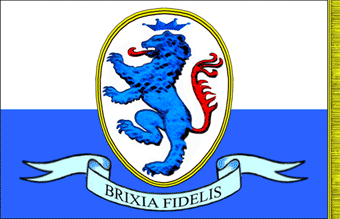
 

Franciacorta DOCG

Franciacorta is a sparkling wine from the Province of Brescia (Lombardy) with DOCG status. It is produced using the traditional method from grapes grown within the boundaries of the territory of Franciacorta, on the hills located between the southern shore of Lake Iseo and the city of Brescia. It was awarded DOC status in 1967, the designation then also including red and white still wines. Since 1995 the DOCG classification has applied exclusively to the sparkling wines of the area.

History

The still wines from this area have ancient traditions, referred to by Virgil and Pliny the Elder, and documented in Brescia City council books as "Franzacurta" as far back as in 1277. The name may derive from the tax-exempt (francae) status of the region's towns (curtes) in the Middle Ages. The wines were not called Franciacorta until 1957, when Guido Berlucchi released a white wine named Pinot di Franciacorta. An ambitious young winemaker working for Berlucchi, Franco Ziliani, was permitted to pursue an ambition of producing a fine sparkling wine, and in 1961 was allowed to produce for release 3,000 bottles of a sparkling wine, also sold under the name Pinot di Franciacorta.

Instant interest allowed the following vintage production to be set at 20,000 bottles, and eventually the annual production was 100,000 bottles. The national prominence that followed was soon exploited by several entrepreneurs from Milan and Brescia, and by the time the region was granted DOC status in 1967 there were 11 producers of sparkling Franciacorta, although Berlucchi represented more than 80% of the production.

With its directives, Franciacorta became the first DOC to specify that its sparkling wines must be made by metodo classico. In 1990, the Consorzio per la tutela del Franciacorta was formed, instigating codes of self-regulation with a gradual reduction of yields and elimination of the use of Pinot grigio, becoming the body considered responsible for the efficient elevation of sparkling Franciacorta to DOCG status in 1995. Since August 1, 2003, Franciacorta has been the only Italian wine not obliged to declare its DOCG appellation on the label, in the same manner that a Champagne is permitted to exclude from labels its AOC.

From 1996 to 2006, sales of Franciacorta grew from 2.9 million to 6.7 million bottles. According to Tom Stevenson, the Franciacorta region is "the only compact wine area producing world class sparkling wine in Italy."


2 other wines from Lombardy

Roscato Moscato (Mantua)
750ml
Lugana, Italy - Roscato Moscato is an irresistible, delicately sweet, frizzante wine from Northern Italy. With a touch of sparkle to flawlessly balance the sweetness, Roscato Moscato is the ideal complement for today's cuisine. Enjoy it with delicate cheeses, fresh fruit or spicy food.
BRAND: Roscato
COUNTRY / STATE: Italy
REGION: Lombardy
APPELLATION: Lugana
WINE TYPE: Champagne & Sparkling Wine
VARIETAL: Muscat/Moscato
SKU: 225728750-1

InVino Pinot Noir (Pavia)
750ml
Italy - InVino Pinot Noir is an elegant and light bodied red wine. Flavors and aromas include black cherry, black fruit, currant, wild cherries and dark berry. InVino Pinot Noir pairs well with salmon, roasted chicken or pasta dishes. Enjoy with a group of friends or by yourself!
BRAND: InVino
COUNTRY / STATE: Italy
REGION: Lombardy
WINE TYPE: Red Wine
VARIETAL: Pinot Noir
STYLE: Elegant
ABV: 12%
TASTE: Black Cherry, Currant, Fruity
SKU: 219439750-1


1 famous "honorary Lombard" wine from Novara, Piemonte

[an area which has historically & linguistically been a part of Lombardia; although the winery is located in Novara, it is long associated with Milan]

Campari
50ml
Italy- The shockingly red liqueur is infused with 68 different bitter herbs and aromatic plants, a secret recipe of natural ingredients that dates back to 1860 and has become an Italian tradition.
BRAND: Campari
COUNTRY: Italy
SPIRITS TYPE: Dessert & Fortified Wine
SPIRITS STYLE: Aperitif
SKU: 226725050-1


Vineyards in Valtellina

In Valtellina, wines are produced mainly from Chiavennasca (the local name of Nebbiolo grape variety) with other minor varieties such as Rossola nera permitted up to 20% for the Denominazione di origine controllata (DOC) and 10% for the Denominazione di Origine Controllata e Garantita (DOCG). Grapes are limited to a harvest yield of 12 tonnes/ha. The finished wine must be aged for at least 2 years prior to release (3 years if a Riserva bottling) with a minimum alcohol level of at least 11%. Yields for the DOCG wines are further restricted to a maximum of 8 tonnes/ha. While the aging requirements are the same as the DOC, the minimum alcohol level for the DOCG wine is 12%.

The best-known villages for red wines are: Grumello, Sassella, Inferno, Valgella, and Maroggia. The village names are normally indicated on the label. Additionally there is an Amarone style DOCG wine called Sforzato (Sfursat).


************


Valtellinese wines, such as Il Pettirosso Valtellina Superiore 2016, are easy to purchase online. Total Wine & More stores are all over the country, so I thought that was more noteworthy that you could just walk in and purchase a Franciacorta if one was nearby. I found one Valtellina winery--Bagera Vini di Valtellina--which as a U.S. website: www.ViniBagera.us and facebook page: https://www.facebook.com/BalgeraViniDiValtellina/


Final thoughts

Of course there are some wineries right here locally which are still in the hands of the same old Swiss Italian/Ticinese families, such as the Nichelini Winery in St. Helena, California founded in 1890. They now have a Wikipedia page as well: Nichelini Family Winery. If you're never visited there, make sure that you do! That incredible home that sits above a stone mason cellar was constructed by Anton Nichelini 130 years ago, and it's beautiful as well as the property that sits along the edge of the wooded valley.

Another interesting winery is Raffaldini Vineyards in Ronda, North Carolina. Founded by Jay Raffaldini whose family roots are in Mantua (Mantova). According to the website: "In 2009 Raffaldini Vineyards was voted one of the top ten new vineyards in all of North America, the first time any such vineyard from the Mid Atlantic received that award." The winery hosts a Festa Italiana every fall season. Of course, these wines can be ordered online.


The beautiful Nichelini house in St. Helena
.

Saturday, November 15, 2008

Raffaldini Vineyards and Winery

From the main page of the Raffaldini website:

"The Raffaldini family dates back to the year 1348 in the town of Mantua, located in the Northern Province of Lombardy, Italy. Since that time, our family has owned and continues to live on the farm where the great classical poet-philosopher Virgil spent his youth. The romantic town of Verona, home to the ill-fated lovers Romeo and Juliet, lies just to the east.

The Raffaldini family motto, “Audentes Fortuna Iuvat” means, “Fortune favors he who dares.” This Latin phrase originates from the Aeneid, Virgil’s most famous work. Born in 70 BC during the reign of Julius Caesar, Virgil is best known as the author of this epic poem that links the birth of Rome to the Trojan War.

The fusion of family, food and wine is an integral part of our daily life. For more than six hundred and fifty years, the Raffaldini family has witnessed many historic events and has often marked such occasions with special family dinners and homemade Italian wine.

The Raffaldini family made a decision to share our centuries-old winemaking experience with the New World. After a long and exhaustive search for land that would reflect this experience, Raffaldini Vineyards was established in the Swan Creek area of the Yadkin Valley. From this vineyard, we handcraft our Italian wines; wines that express not only their “sense of place”, but also utilize winemaking skills that have been refined throughout the ages.

As you enter our tasting room, let the spirit of the Raffaldini family history, importance of family and celebration of life transport you to our ancestral home. The wine, food and artwork within hold deep meaning for the Raffaldini family and we are delighted to share them with you. Close your eyes as you taste our wine and imagine what it would have been like to celebrate life so long ago…

Salute!"


From the Heritage Page:

"Virgil, the poet, born of Mantua

"The great poet Publius Vergilius Maro ("Virgil") was born to a middle class family in October of 70 BC in the town of Mantua during the reign of Julius Caesar. Mantua was a Roman city in the province of Cisapline Gaul (now Lombardy). The province extended to the Alps and covered the most fertile part of the Po valley. Mantua traces its founding to the Etruscan civilization that ruled most of Italy but quietly disappeared leaving little known of it. In the time of Virgil, Mantua was a quiet agrarian community dominated by farming and shepherding. The beauty of the area so transfixed Virgil that he once wrote, 'dove il Po discende per aver pace con sequcai sui': 'where the Po runs down among its followers to find peace'. Not far to the east of Mantua lies the town of Verona, home to Romeo and Juliet.

"Fertile destiny

"According to legend, while Virgil was in his mother's womb, she dreamt that she gave birth to a laurel branch. Upon touching the earth the laurel branch took root and at once grew to the size of an adult tree, covered with fruits and flowers of various kinds. The following day, whilst traveling to a neighboring part of the country with her husband, Virgil's mother turned aside and gave birth to her child in a ditch beside the road. Legend has it the infant did not cry at its birth, and had such a gentle expression as even then to give assurance of an unusually happy and fertile destiny.

"There was yet a further symbol of Virgil's exceptionally rich contribution to the future land and its people. Traditional to that region on such occasions, a poplar branch is planted where birth occurs. The branch planted where Virgil was born grew so fast that it was equal in size to others planted long before. The poplar branch became known as "Virgil's Tree", and was worshipped with great veneration by women about to give birth, who made their vows beneath it.

"Mantua's history continues

"The history of the Raffaldini Family can be traced back to 1348. The Raffaldini heritage is centered in Mantua where they were extensive landholders, together with the Gonzaga and Bonacolsi families. The Raffaldini Family has for centuries owned and continues to live on the farm where Virgil lived during his youth. The influence of this great poet and philosopher upon the Raffaldini Family has been profound over the multitude of generations.

"The founding principles of Raffaldini Vineyards and Winery are deeply rooted in much of Virgil's philosophy: the belief that by working with the land and understanding its life essence, rather than trying to change it, enables the vineyard to produce grapes of exceptional quality. This harmonious relationship is the cornerstone for the making of great wines. The Raffaldini Family has always believed that the miracle of winemaking does not happen in the winery, but rather in the vineyards. A deep respect for the land, a long sense of history and centuries of aspiring for high achievement all combine to produce a single expression of wine that captures the heritage of the Raffaldini Family - 'Audentes Fortuna Iuvat': Fortune Favors the Daring."

Raffaldini Vineyards & Winery (North Carolina)

Tasting Room Hours
Wednesday – Saturday 10am – 5pm; Sunday 1pm – 5pm and by appointment
Tours: Wed-Sun 1pm & 3pm


Friday, August 29, 2008

Third, fourth and fifth generation keeps Nichelini Winery alive

Third, fourth and fifth generation keeps Nichelini Winery alive

Paul Franson - Napa Life [originally published in the St. Helena Star]

Though tourists flock to Napa’s old Beringer and Charles Krug Wineries, another historic treasure lies so far off the beaten path that only the determined – or lucky – stumble onto it.

In 1884, Swiss-Italian immigrant Anton Nichelini homesteaded property high up in Sage Canyon that probably reminded him of his home in the Ticino canton of Switzerland.The French-trained stone mason built Nichelini Winery in 1890 and it still hangs on the side of the hill, close to the road like those found back home.

The rustic winery remains in family hands after more than 100 years, the oldest winery still operating by the original family in Napa County, and one of very few with that pedigree in California.

The present owners of the winery are grandchildren and great-grandchildren of Anton and Caterina Nichelini, for while three generations isn’t many to span 116 years, Anton and Caterina had 12 children, and they stretched the equivalent of a generation among themselves.


Recollections of history

Anton actually met Caterina in San Francisco, even though she was also from Ticino in Switzerland. She largely ran the vineyard and winery as Anton worked as a stonemason.

Like most wine-making families—they didn’t call them vintners then—they made wine and sold it during Prohibition, making regular deliveries to Oakland and other places with wine hidden under the floorboards of a ’24 Lincoln that once belonged to the mayor of San Francisco.

Caterina also served meals to rare passers by; the steep and rough road was only paved in the early ‘40’s and electricity came in 1947.

Family legend says Caterina accidentally sold wine to treasury agents during Prohibition, but since they didn’t then jail women, Anton had to serve her sentence, though only on weekends so he could work.

All the Nichelini cousins lived or visited regularly, though the old homestead in now occupied only when they visit. The original tiny cabin where four children were born has been moved down the hill to a site near the winery and awaits restoration.

It would take a genealogical chart to clarify the family’s relationships, but the present owners are Marie “Toni” Nichelini-Irwin, Greg Boeger, Dick Wainright and Joe, Jr. and Mike, the sons of Joe Nichelini, who died three years ago.

Other cousins from the fourth and fifth generation are also involved and help at the winery.

And just to confuse things, one branch of the family owns the vineyards used to source grapes and a family corporation owns the property.

To try to clarify the present ownership, Anton's oldest son Bill acquired the winery business in 1934 at the end of Prohibition and he handed it down to his son, Jim, in 1959.

Jim updated the winery after the years of neglect during Prohibition and ran it until he died in 1985.

Three of Jim's cousins and his sister formed a partnership and acquired the winery from Jim's estate in 1990.

Jim’s sister, Marie "Toni" Nichelini-Irwin, is the daughter of Bill and acts as director of the tasting room and outside sales and marketing.

Dick Wainright, son of the eighth child, helped Jim in the winery and is now secretary/treasurer and in charge of operations.

The winemakers are Greg Boeger, son of the youngest child (a daughter) and his son Justin who bring over 30 years of experience as the owner-winemakers of Boeger Winery in El Dorado County.

In addition to the 500-acre winery property, Anton Nichelini's two eldest sons, Bill and Joe F., acquired property in nearby Lower Chiles Valley in the late l920s. With their father, they planted the vineyards.

Although planting has expanded over the years to about 80 acres, about 20 acres of zinfandel planted by Anton in the late 1920s remain in production, as do 3 acres planted by Bill & Joe F. in 1946.

Joe A. Nichelini, son of Joe F., also served as president of the winery as well as grape supplier. He passed away in March 2003 and the vineyards are now farmed by his sons, Joseph C. & Michael Nichelini.

None of the original plantings on the original winery property remain, though a level spot suitable for grapes may be replanted in the future.


A new era

The first crush under the new management was the 1990 old-vine centennial zinfandel, which has been produced at Nichelini since 1890, now partly from vines planted in 1929.

The winery makes about 3000 cases per year, and is also focusing on cabernet sauvignon, merlot and petite sirah and expects to add other Italian varietals besides primitivo, the Italian cousin of zinfandel it already makes.

It also produces sauvignon vert, also called muscadelle, a rare Bordeaux white from the 1946 planting.

This third and fourth generation of Nichelini's continue to carry on the 100 + year-old traditions of their historic Napa Valley winery.

Nichelini also produces a sweet muscat dessert wine.

All are reasonably pricesd particularly for Napa Valley mountain wines from historic vines.

The winery building is a historic site that demonstrates Anton's stonework. Though the winery equipment has been modernized, the old Roman press he once used highlight’s the visitor center, a rustic tasting room and family museum they extends outside in benign weather.

For the future, the clan is considering some capital improvements including additional planting. In addition to fourth generation family members like Justin Boeger, Joe Jr and Michael Nichelini and Robert Oswald (Dick Wainright’s daughter), a fifth generation is now involved as well: Aimée Sunceri, who like the Boegers has a degree in enology from UC Davis, also helps out with winemaking.

Tasting at Nichelini Winery is free, a rare treat in Napa Valley these days. The winery is open on weekends and by appointment (963-0717). It is on Hwy. 128 about 11 miles east of Rutherford on the way to Lake Berryessa. Be sure to bring a picnic if you visit, for it’s one of the best places nearby to enjoy dining outside.

**************************************************

Nichelini Winery website

Monday, February 25, 2008

The Story of Anton Nichelini & His Family


by Kathy Kernberger and Shirley Penland

St. Helena Star, Discover St. Helena, Summer 1998

Edited by Douglas A. Patterson


Between 1875 and 1910 world wide depression, poor crops and political unrest in Italy drove thousands of Italians and Swiss-Italians to the United States, with many of the Swiss-Italians settling in the San Francisco Bay area. Most sought opportunity in the large cities like San Francisco but some who knew about both farming and business chose to look for opportunity in the countryside like in Napa and Sonoma counties.

Anton’s father, Franceso Nichelini, was a prime example of this type of immigrant and Anton followed him there later on once Francesco had earned enough money for Anton’s passage. Anton was born Giuseppe Antonio Nichelini on November 22, 1862 to Francesco and Carolina Cotti Nichelini in Verscio, Canton Ticino, Switzerland. The family included six children.

At the age of nine, Anton was sent to Paris to live with his uncle Martino and aunt, Antonesca, in order to learn the art of stone masonry. While living with them, he was able to go to school, and it was thought that for a time he was an altar boy at Notre Dame Cathedral.

At the age of 17, he returned to the family home in Switzerland, an accomplished stone mason. These skills were later put to use in building his house and winery in Napa County’s Chiles Valley. The Nichelinis were one of the Patriziato or leading families in Verscio, good businessmen and, among other things, owned and operated the local grist mill. A visit to the local Catholic church in Verscio today will show that they were very influential in the church with their many crypts honored in the walls.

The records of the church in Verscio start in the year 1600 and there is a Nichelino recorded who, after his first wife died, married another woman and changed his name to Nichelini as best we can tell. All Nichelinis today are descended from him.

The romantic story, not proven, is that in the late 1500’s this fellow Nichelino lived in Nichelino, Italy, a suburb of Turino. His last name was Righetti, and he had fallen in love with a woman with whom neither family approved. So, they eloped, with sufficient money, of course, to Verscio, Switzerland, and became Patriziato. They sort of bought their way in. Supposedly, in those days in Italy one was not allowed to have the name of a town or city as one’s own name. No longer being in Italy, and wanting to have a unique name, they picked Nichelino, their home town. No one the town of Verscio had a name ending in the letter “o”. So, when he remarried, he changed the “o” to an “i”, or so the story goes.

Anton’s uncle, Giuseppe Secondo, had immigrated to San Francisco in 1849. He found gold, not in the Sierra Foothills, but in a pasta factory which he started in 1853.Guiseppe sold the pasta factory in 1865 for a tidy profit which he mentioned far and wide on his return to Switzerland.

Lured by the tales of his brother, Anton’s father, Francesco, came to San Francisco area to seek his fortune as things were looking pretty bleak at home. In 1875, he applied for a homestead grant on the Sonoma side of Mt.Veeder.

Here, he started a vineyard, built a house, and made plans for his family to join him. After he had saved enough money, he sent for some of the children to join him. In typical fashion, the mother sent the oldest child over first, his sister, even though Francesco had asked for Anton, who was younger to be in the first, as he was the most educated and able. He had to wait.

In 1882, at the age of 19, Anton arrived in Sonoma County. He thereafter changed his name to Anton, the French version of Antonio. He emphatically said that he was Swiss and not Italian, an important distinction as the Italians had just replaced the Chinese at the bottom of the local socio-economic ladder. There, he went to work for pioneer winemaker Joshua Cheuvet, who had originally come from France.

Under Chauvet’s guidance, Anton added the skills of viticulture and winemaking to those of stone mason. It also helped business that Anton was very fluent in French, Italian and German with so much of the population first generation Americans. His English textbook was a dictionary, which also helped him with pronunciation as well as understanding and meaning and he very quickly became fluent in his new country’s tongue.

In 1884, Anton decided to apply for a homestead in Napa County. He had heard about the Napa Valley from the Chauvet family, and decided to apply for a homestead of 160 acres in Chiles Valley.

Named for J. B. Chiles, the area was not well known to many people. However, he found a property that was rich in both chrome and magnacite, the later an alloy used in the making a special steel. In addition, Anton felt that hillside grapes were better for making quality wines than fruit on the valley floor. This was the place he hoped to settle and, someday, raise a family.

At that time, in order to acquire a homestead, it was necessary to become a citizen and make a certain amount of yearly “improvements” to the property. Anton, with Caterina’s later help, fulfilled these requirements and was granted a homestead by President Benjamin Harrison in 1892.

In 1890, the Chauvet family urged Anton to go to San Francisco to meet a charming young lady named Caterina Corda. Also a Swiss immigrant from Ticino, she was working at a hotel there. She claimed the Hotel owners would never let her out and it was really more like a prison.

Anton followed the Chauvet’s urgings, and three weeks later, the couple was married in Santa Rosa on July 7, 1890, with Henry Chauvet acting as Anton’s best man.

Family lore has it that Caterina, who was born in Switzerland in 1869, had fallen in love with a man in Switzerland whom her family considered “unsuitable.” Forbidden to marry him, she had come to San Francisco.

On her first “date” with Anton, as the story goes, they had gone for a ride in his buggy. During this ride, Caterina, obviously, a very forthright lady, is said to have asked Anton if he “had honorable intentions” and if so, was he going to marry her or not, and how long it would take him to do it.

After their marriage, not having a house of their own, they lived with relatives. One day, they went to see his homestead in Chiles Valley. Greatly taken with the beauty of the property, she told him “This is where I want to make our home.”

Shortly after, they moved to the small cabin, which Anton had already built on the property. The first four of their twelve children were born in this little cabin. The cabin is still on the Nichelini property today.

The decade from 1890 to 1900 was a busy one for the growing family. Anton worked as a magnacite miner for the Stanley and Bartlett Mines in Chiles Valley. He also started making wines from the vineyard which he and Caterina were expanding. Their growing family required more space than the small homestead cabin could provide.

Anton started building the hand-cut stone winery, and the family home that sits above it. It is still a familiar site for travelers on Highway 128 near the intersection of Lower Chiles Valley Road.

These buildings were completed in 1896. A gala housewarming included more than 100 guests with the as yet unfinished upstairs used as a dance floor with music provided by the Miller and Payne’s orchestra. A midnight supper completed the celebration.

Later, the upstairs was partitioned into the four bedrooms that remain today. Eight more children were born to the couple in the “new house” with Anton acting as “midwife.”

The dozen children were William, Joseph, Josephine, Ida, Rosa, Catherine, Mary, Frederic, Allen, Emma, Antoinette, and Inez.

Dates of the births spanned the years from William in 1891 to Inez in 1916.

In 1902, Father Blake, of the St. Helena Catholic Church, baptized all the five older girls at a family gathering.

“Brother Allen” became a noted football player. At a game between rivals, Napa and St. Helena, he played so well that the Napa fans forgot themselves and began cheering for the St. Helena High School team.

At St. Mary’s College, he was one of the “Galloping Gaels,” under the leadership of coach Edward Madigan. As an All American, he played on the winning team in the Shrine East-West game against President Gerald Ford.

Professionally. Allen played for both the Chicago Cardinals and Los Angeles Bulldogs. And in 1973, he was inducted into the National Professional Football Hall of Fame in Canton, Ohio. One of his helmets remains on display there.

By 1910, Anton was Superintendent of the Red Mountain Mining Company in Livermore. When World War I broke out, he returned to Chiles Valley to work for the Tulare Mining Company. He patented several commercially successful magnacite ore smelting techniques which were later successfully applied to borax mining, including mines in Death Valley where he worked for a while bringing them on line.

His own property had also had chromium deposits that he developed. In 1916, he sold four of these mines to a San Francisco group.

Heart problems caused his health to begin to fail in 1934. On November 9, 1937, Anton died at the St. Helena Sanitarium (now St. Helena Hospital) after a severe heart attack.

Caterina lived until August 19, 1952. That year, she celebrated her 83rd birthday at a party with her 11 children (her daughter Rosa died in 1932). Many of her 29 grandchildren and 24 great grandchildren also attended the party. Many people remembered both “Ma and Pa Nick” for their many acts of kindness and open hospitality.

Today, the winery which Anton and Caterina started is still family-owned, making it the oldest continuously operated family winery in Napa County.

Great grandsons Joseph and Philip Sunseri supply the grapes from vines, some of which were planted by Anton in the late 1920s. Another great grandson, Jim also supplies grapes from his Chiles Valley vineyard.

Yet, another grandson, Greg Boeger, and his son Justin Boeger, and great great granddaughter Aimee Sunseri, all UC Davis graduates, act as winemakers. Sitting literally at the edge of the road, the winery also contains Anton’s original Roman style wine press. To this press, believed to be the only one of its kind in left in tact in California, is well worth a visit. Otherwise, stay, have a glass of wine and enjoy playing bocce ball.

Our thanks to Inez Nichelini Boeger for her help in this article. Also, to Pauline Locey for her help.

Article link at NicheliniWinery.com