Showing posts with label Pennsylvania. Show all posts

Wednesday, July 20, 2016

Folkish Summer Hollowing - August 18-21 - Milford, PA


[Posted by AsatruFolkAssembly.org]

The Irminfolk Odinist Community will be holding their 6th annual Folkish Summer Hallowing on August 18-21st in Milford PA.

The Irminfolk forward to honoring the Gods and our ancestors with our family and friends, and creating new bonds of friendship with fellow heathens.

www.folkishsummerhallowing.com


*************************

It's good to see Asatru folk associations cooperating with each other. Asatru, in addition, conflats a lot with the old German/Dutch magical tradition of Pennsylvania. In the age of easy communication, like-groups should be socially cross-pollinating a lot more.

.

Thursday, May 19, 2016

May Harvest/Flower Moon 2

Winter Grain Harvest/May Harvest Moon

May Harvest

Mid-May has traditionally been the time of the early harvest in the old European cultural, agricultural, and pagan societies. I believe that it was also called the "Winter Grain Harvest," as like.. the harvest coming out've the late winter.

Full Flower Moon

This coming Saturday evening is the Full Flower Moon. I believe that it has also been called the "May Harvest Moon," tying the two concepts together.


Raven Grimassi on Blog Talk Radio 2016

Main Street Universe hosted an hour long interview with Raven and Stephanie Taylor Grimassi on Blog Talk Radio. Blogspot won't support this embedding, so it's located at the above link.


Russian film 'Viking' due for 2016 release

This film is not connected to the very popular cable tv series

VIKING 2016 movie trailer from SkyPIX on Vimeo.


Horror movies and evolutionary memory

Recently I watched the movie 'Krampus', which was perhaps more in the category of "scary" than the horror genre. Despite its origin in folklore, it's not really the type of movie I would review. It was more of just a scary family Christmas movie. Krampus is very similar to other Alpine legends, such as the Badalisc of Camunian folklore. While watching, it occurred to me that part of the appeal of horror movies is that they subconsciously appeal to our DNA memory from virtually all of our history of living amid the harshness and danger of nature and its evolutionary struggle.

During all of that time, our ancestors lived in constant danger... from weather, dangerous predators, starvation, discomfort, or other competing tribal groups. They particularly feared the night. The night was truly a dark time where they shut themselves off from their environment as much as they could. It's not hard to figure out why the sun and moon were so revered. The typical "cabin in the woods" theme of many horror movies, ties directly to our ancestral memory of living in isolation... the dangers. "Help" would never be on its way. They had to fend for themselves.

I read once that rabbits, although they can make good pets, never fully trust you. They have been at the bottom of the food chain for so long that they maintain their tense nature. Dogs and cats descended from small predators, so they don't feel this psychological-social strain. Our bodies actually crave being scared. We get a certain chemical rush from it. Most people live relatively safe lives, so they're disconnected from nature.

Wild animals possess a "sixth sense"... the ability to sense danger, as well as other heightened senses and awareness. We've lost this ability, although some people can develop it if they live in remote areas, and are close to nature. Horror movies allow us to get that chemical rush which our bodes crave. Our struggling ancestors didn't know what to expect, as a danger could present itself at any time. This is a lot like in horror movies... a theater of the unexpected. The vampire, werewolf, or Krampus of the Middle Ages have morphed into the Mr. Hyde, killer clown, or Jack the Ripper of today.


A town on fire for over 50 years


Urban Exploration: Centralia, PA Ghost Town Burning Underground

TikiTrex

Centralia, PA is a modern day ghost town with an ongoing underground inferno. Silent Hill was inspired by Centralia's plight. It was also a model for various movies that wanted to give a hell-like appearance in a ghost town.

There used to be a WARNING - DANGER sign posted here from the Commonwealth of Pennsylvania stating that walking or driving in this area could result in serious injury or death; that dangerous gases are present and the ground is prone to sudden collapse.

Centralia was once a prosperous coal mining town with 1,100 population. It included 4 movie theatres, 7 bars, a school and a gas station.

In the spring of 1962, a fire which started at the town dump during spring cleanup ignited the coal present at the ground level as this area is very rich in coal. As firefighters worked to try and extinguish that fire, it had already spread to the underground abandoned coal tunnels that are 100 meters in depth. After a couple of decades, attempts to put out the fire failed. State and federal authorities said they didn't have enough funding to do the job right. They tried digging up the coal around the burn site but it was burning faster than they could dig and there are too many tunnels too flood.


Approximately 450 acres of underground coal has been on fire since. This type of coal is called anthracite which is difficult to ignite, but very difficult to extinguish. There are 3000 acres of coal field here underground, so with enough oxygen feeding this fire from other mining tunnels, the fire is expected to last at least another 100-200 years, maybe longer. The temperature of the active burn area below ground is 1100-1200 degrees Farhenheit. Tests by scientists and geologists were done here that showed the ground temperature to be around 440 degrees Celsius a foot into the ground.

With the threats of hydrogen explosions, carbon monoxide and cave-ins, most residents were relocated in the 80s. The houses were then torn down leaving approximately 11 people behind who refused to evacuate despite the danger and risks involved such as dangerous gasses, explosions and sink holes. The ground beneath could collapse and has done so already. Looking down the now-empty streets, you can see that nature has reclaimed her land, albeit, a dangerous one. Buildings, cars and trees can fall into this pit at any time.

The old Hwy 61 that used to bring traffic to Centralia has been destroyed by the underground fire. It is constantly subsiding with smoke usually billowing out from the pits and separations that will continue to get wider and deeper day-by-day. This is called subsidence. This is due to the coal seams the run below ground at steep angles which cause the road above ground to collapse as the coal burns.

According to engineers, the only way to stop this fire is to dig the entire 3000 acres of coal field under this town and surrounding area. This would cost $600 million which is more than the US governments were willing to pay.


Ironically, a small town just south of Centralia, Byrnesville (of all names) was also evacuated and now empty. Mostly coal miners resided here of an Irish-Catholic desent. Both Centralia and Byrnesville were a tight-knit community, and many did not want to leave.

There is a time capsule that still lies buried in the ground in Centralia. This was set up as a memorial for the working class town to be opened in 2016 which would be Centralia's 150th Anniversary. Whether the residents return to open it on that date is yet to be seen.

The Weather Channel selected portions of this video for their "Most Toxic Ghost Towns" video.

Thanks for watching!

*UPDATE* The time capsule ended up being opened on October 4, 2014 which was much earlier than expected.

'Centralia PA Time Capsule Opened Early'

Centralia - Full Documentary


Juice Newton - Angel Of The Morning

emimisic

Official video of Juice Newton performing Angel Of The Morning from the album Angel Of The Morning.

Buy It Here: http://smarturl.it/yjp0ie

Official Website: http://juicenewton.com/


Scarlet Johansson - 2 early underrated movies

A couple of weeks ago I watched Scarlet Johansson in 'Lucy', in which through a fluke a young woman started being able to use more and more than the average 10% of her brain and manipulate the laws of nature. At times I found myself fantasizing that this character was like perhaps the Goddess Iduna, returning to the modern world. A pack of guys with guns are coming towards her.... and she raises one hand and they all instantly fall and go fast asleep. Wow! Just like the divine feminine... she didn't even harm them. "She is a god or something like that ?" -- Shaco, YouTube user

In 1996, at about age 12, she stared in a movie entitled 'Manny and Lo' about two sisters who run away from their foster homes. Although it may not sound especially interesting or even for adults, it's really a good movie. I haven't seen it for a long time, but part of the movie revolves around them breaking into an unoccupied house in the country... which then became their "paradise" as one reviewer described it. It's more than just cute, and I would recommend it.

'Ghost World' (2001) was a movie about two semi-social outcasts during the summer after they graduated from high school. Johansson stars along with Thora Birch who was excellent in this. The writers/producers took some creative liberties, such as giving the film a slight 50s/60s visual and feel to it, and giving Birch's character a fetish for the 50s... which would be rather unlikely for teens any time after 1990. She goes to garage sales and swap meets to find unusual clothes in an almost theater-like endeavor. I'm not going to review it, but it's interesting.... interesting characters, and very different. Just as with the previous, this movie could be enjoyed by any age I think.


"Portals to Hell"


The Door to Hell

SciShow

In this episode of SciShow, Hank talks about a crater in Turkmenistan that has been on fire for decades and has earned itself the title of: The Door to Hell!

*************************

There are numerous "doorways to Hell," such as St. Patrick's Purgatory in Ireland, the Necromanteion temple in Greece, and Mt. Hekla in Iceland.


The red bead necklace

I confess, I've never been a fan of pearl, shell, or white bead necklaces. They just seem a bit gaudy, at least with white, or even black. Those colors are all wrong.. However, a red bead necklace looks so sightly. The red works perfectly. Just a thought.


The real Lagertha

Did you know that the character Lagertha, Ragnar Lothbrok's wife, in History's Vikings is loosly based on a real historical figure? Lagertha was, according to legend, a Danish Viking shieldmaiden from what is now Norway, and the onetime wife of the famous Viking Ragnar Lodbrok (D. 840 or 865), Her tale, as recorded by the chronicler Saxo in the 12th century, may be a reflection of tales about Þorgerðr Hölgabrúðr, a Norse deity. Her name, latinized to Lathgertha by Saxo, probably derives from the Old Norse Hlaðgerðr (Hladgerd).

His frequently rendered in English-language sources as "Lagertha", and has also been recorded as Ladgertha, Ladgerda or similar. Lagertha's tale is recorded in passages in the ninth book of the Gesta Danonum, a 12th century work of Danish history by Saxo Grammaticus. According to the Gesta, Lagertha's career as a warrior began when Frø, king of Sweden, invaded Norway and killed the Norwegian king Siward, Frø put the women of the death king's family into a bothel for public humilation. Hearing of this Ragnar Lodbrok came with an army to avenge his grandfather Siward. Many of the women Frø had ordered abused dressed themselves in men clothing and fought on Ragnar's side. Chief among them, and the key to Ragnar's victory was Lagertha.

Saxo recounts:

"Ladgerda, a skilled Amazon, who, though a maiden, had the courage of a man, and fought in front among the bravest with her hair loose over her shoulders. All marveled at her matchless deeds, for her lock flying down her back betrayed that she was a woman." Impressed with her courage, Ragnar courted her from afar. Lagertha feigned interest and Ragnar arrived to seek her hand, bidding his companions wait in the Gaular Valley. He was set upon by a bear and a great hound which Lagertha had guarding her home, but killed the bear with his spear and choked the hound to death. Thus he won the hand of Lagertha in marriage. According to Saxo, Ragnar had a son with her, Fridleif, as well as two daughters, whose names are not recorded.


After returning to Denmark to fight a civil war, Ragnar (who, was still annoyed that Lagertha had set beasts against him) divorced Lagertha in order to marry Þóra Town-Hart, the daughter of king Herrauðr of Sweden. He won the hand of his new love after numerous adventures, but upon returning to Denmark was again faced with a civil war. He sent to Norway for support, and Lagertha, who still loved him, came to his aid with 120 ships, according to Saxo. When at the height of the battle, Ragnar's son Siward was wounded, Lagertha saved the day for Ragnar with a counter attack:

"Lagertha, who had a matchless spirit though a delicate frame, covered by her splendid bravery the indination of the soldiers to waver. For she made a sally about, and flew round to the rear of the enemy, taking them unawares, and thus turned the panic of her friends into the campn of the enemy." upon returnng to Norway, she quarreled with her husband, and slew him with a spearhead she concealed in her gown. Saxo concludes that she then "usurped the whole of his name and sovereignty; for this most presumpuous dame thought it pleasanter to rule without her husband than to share the throne with him.

-- Huscarl, Anglo Saxon Foundation


Horseless carriage

One of the first models of automobile was the Hupmobile, manufactured by Hupp Motor Car Company in Detroit, Michigan starting in 1909. One of my past relatives, whose family had arrived in the U.S. before mine did, was apparently the first to own an automobile in Milaca, Minnesota. The above image may be a different model, but it was from around that period and it looks so fancy and restored. Over the years, I have come across a couple of financially well off guys who've rented one of those small light industrial property units, with a front desk, a couple of offices, and an operations area with a back garage door. They used them as sort've a clubhouse with perhaps one employee - a mechanic to work on a couple of auto projects. Wouldn't that just be ~perfect~


The Hollies "The Air That I Breathe" 

catman916


Graham Nash played an important role in the early history of the Hollies, but after his departure in December 1968, the group achieved some of its greatest successes. After hearing Phil Everly's fine version of "The Air That I Breathe" written by Albert Hammond and Mike Hazlewood, the Hollies recorded the definitive version, engineered by Alan Parsons. Released as a single in January 1974 on Polydor Records, it reached #2 in the UK. In the US it was released on the Epic label and achieved #6. It can be found on the CD on Best of the Hollies: Air That I Breathe and The Hollies' Greatest Hits on EMI. It clearly demonstrates that Allan Clarke was one of the best lead singers of the era. Terry Sylvester's background singing and Tony Hicks' guitar add to the great sound. 


************************* 

It's funny how you can have an association between a song, a place, and a time. I do with this one; half reality/half fantasy. Great ethereal sound.

Approaching 100,000 views here..

.

Sunday, March 6, 2016

Countdown to the Pagan New Year - Part 2

The old historical flag of Bohemia (white over red bars), along with its historical arms (white lion on red background), would make a perfect modern national flag

Why not... "Bohemia" ...?


Bohemia

Bohemia (Czech: Čechy; German: Böhmen; Polish: Czechy; French: Bohême; Latin: Bohemia) is a region in the Czech Republic. In a broader meaning, it often refers to the entire Czech territory, including Moravia and Czech Silesia, especially in historical contexts: the lands of the Bohemian Crown. Bohemia was a kingdom in the Holy Roman Empire and subsequently a province in the Habsburgs’ Austrian Empire. It was bounded on the south by Upper and Lower Austria, on the west by Bavaria, on the north by Saxony and Lusatia, on the northeast by Silesia, and on the east by Moravia. From 1918 to 1939 and from 1945 to 1992 it was part of Czechoslovakia; and, since 1993, it has formed much of the Czech Republic.


Etymology

In the 2nd century BC, the Romans were competing for dominance in northern Italy, with various peoples including the Boii. The Romans defeated the Boii at the Battle of Placentia (194 BC) and the Battle of Mutina (193 BC). After this, many of the Boii retreated north across the Alps.[4]

Much later Roman authors refer to the area they had once occupied as Boiohaemum, the earliest mention being in Tacitus' Germania 28 (written at the end of the 1st century AD). The name appears to include the tribal name Boi- plus the Germanic element *haimaz "home" (whence Gothic haims, German Heim, English home). This Boiohaemum included parts of southern Bohemia as well as parts of Bavaria (whose name also seems to derive from the tribal name Boii) and Austria. The Czech name "Čechy" is derived from the name of the Slavic tribe of Czechs who settled in the area during the 6th or 7th century AD.


Ancient Bohemia

Bohemia, like neighbouring Bavaria, is named after the Boii, who were a large Celtic nation known to the Romans for their migrations and settlement in northern Italy and other places. Another part of the nation moved west with the Helvetii into southern France, which was one of the events leading to the interventions of Julius Caesar's Gaulish campaign of 58 BC. The emigration of the Helvetii and Boii left southern Germany and Bohemia a lightly inhabited "desert" into which Suebic peoples arrived, speaking Germanic languages, and became dominant over remaining Celtic groups. Both Tacitus and Strabo refer to an area as Boiohaemum named after the Boii. The second component of this name is a Germanic word, related to modern German heim, and English "home", so the term means "Boii-home". To the south, over the Danube, the Romans extended their empire, and to the southeast in Hungaria, were Sarmatian peoples.

Kingdom of Bohemia

************

The concept, style, history, and symbolism of a nation of "Bohemia" appears to me to be much stronger than the current Czech Republic. I can't really determine any good reason that the name was changed in the first place. The modern Bohemia makes up most of today's Czech Republic. Names of nations is no exact science. France is named after the Teutonic tribe the Franks, even though the Frankish period was only a smaller part of the history of the region. The entire north of the Italian peninsula could have been named "Lombardia" due to the geographically-unifying period of Langobard rule; although that tribe was only a part of the region's history. Immigrants from old waves of immigration from specifically Bohemia were referred to--and referred to themselves--as "Bohemians." Old kings and warlords jumbled its borders, which didn't help matters any.


Underrated actor


I watched the 2006 film 'The Hoax' the other evening, and it's clear to me that Alfred Molina is one very underrated actor. Whatever the character role requires, he fits it like a glove. In this movie his character was vulnerable, and he was exactly that. Often with even the better actors, transitions appear somewhat contrived. Molina is much better than, for example, Alec Baldwin who has earned enormous sums for merely playing himself in each role.


Synchronicity, synchronicity..

Yesterday I was working on a new Vehmic symbol, with a four-part shield and a black rose in front of it. I was deep in thought, and this is usually due to my desire to make symbols, colors, and arrangement totally congruent. I decided to take a break, and walked into the living room. As I looked out the large window, I saw four little birds on the telephone wire, and I pondered that they could represent the four sections of the arms, and I amusingly dismissed it on the spot. As I then continued to walk towards the window, I saw a fifth little bird which was initially obstructed.

4 + 1 = 5

4 birds at an approximately six inch equal distance from one another (the symbolic 4-part quadratic shield) + 1  bird approximately one foot from the others (the symbolic detached black rose) = 5 (the sum of the Vehme).

The only problem with synchronicity is that you cannot truly prove it. You may only prove it to yourself, which is it's universal law. It ultimately only applies to you, and it's only message is that you're on the correct path. Even brilliant minds which have tapped into this universal symbolism, which is available to anyone, erroneously have assumed that it made them special. It does not make anyone special. It's only an acknowledgement by the universal consciousness.


'Horned Nephilim Skeletons Found In Valley Of Giants?'

BeforeItsNews.com - January 10, 2013

Several human skulls with horns protruding from them were discovered in a burial mound at Sayre, Bradford County, Pennsylvania, in the 1880′s. With the exception of the bony projections located about two inches above the eyebrows, the men whom these skeletons belonged to were anatomically normal, although at seven feet tall they were considered to be giants. Burial was believed to have been in the neighborhood of 1200 AD.

 con'd

************

I don't like to cover general mysteries here unless it's linked to a related subject. However, I have always found the horned skulls to be particularly strange.


"Love a rainy night" - perfect during current Californa storm

This one by Eddie Rabbit never gets old.


Eddie Rabbitt - I Love A Rainy Night 

Allec Joshua Ibay


Tribute to the late Eddie Rabbitt


.

Wednesday, July 29, 2015

More Blue Moon musings


If you take a Bible and put it out in the wind and the rain, soon the paper on which the words are printed will disintegrate and the words will be gone.

Our Bible IS the Wind and the Rain.

-- Author Unknown

**************************************************

Pennsylvania history of magic, occultism, and folklore

Poke Runyon is a legend within American Hermeticism--aka Alchemy--and he's still going strong with weekly podcasts at Blog Talk Radio every Thursday. There's a good variety of various interesting subjects. Of course, the German magical traditions have long been prevalent in rural Pennsylvania, so this subject immediately caught my eye. I don't know of any American region where Stregheria has any particular presence, although I have have hypothesized about Upper Michigan Alpine "folk medicine."

The Hermetic Hour: Poke Runyon and Frater Julian

**************************************************

Boeing X-37

The Boeing X-37, also known as the Orbital Test Vehicle (OTV), is a reusable unmanned spacecraft. It is boosted into space by a launch vehicle, then re-enters Earth's atmosphere and lands as a spaceplane. The X-37 is operated by the United States Air Force for orbital spaceflight missions intended to demonstrate reusable space technologies. It is a 120%-scaled derivative of the earlier Boeing X-40.

Aside from obvious black ops programs, the X-37 spaceship itself is a remarkable vehicle. The importance of which has been downplayed. This spaceship is able to re-enter earth's atmosphere without being damaged just for starters. Apparently, but not fully provable yet, NASA has a fleet of these craft which has conducted many missions..far beyond what is admitted currently.


**************************************************

The Holographic Universe

The below video is part one of a five part series regarding the unfolding mainstream scientific endeavor of trying to understand matter. It's one of those videos where if you merely start to watch, you may find that you will just want to keep going. I think just watching the first video is sufficient to getting the gist of it. Did you know that during experiments, now known to be true with 100% accuracy, that electrons conduct themselves differently depending on whether or not they're being directly "watched" by someone during the experiment itself. From our understanding, this of course shouldn't be.. but it is; and this is the mainstream talking!


I don't really agree with the wording that it used however. It leaves the laymen with the impression that our physical world literally doesn't exist. A better analogy would be to focus on how matter is viewed. The majority of matter we cannot even see from our perspective. Another way to look at it is the video game example, where the more we learn about particles of matter, the more it looks like pixels of a video game. It's as if we are part of some grand (from our limited perspective) computer-simulated world, created by someone or something.

Another aspect of this is that if we look at the entirety of the known universe, especially between the galaxies, it's very empty. We only perceive it to be "full of stars and stuff." When magnifying particles down to the sub-atomic level, there are comparatively large expanses of "space" like "little universes." Therefore, how do we know that we aren't looking at this all wrong; and that we may be a "tiny universe" within say the fingernail of some "being" in a larger universe... or that the universe of this "being" isn't merely part of..... well, you get the point.

***************************************************

Iberian Lynx Documentary

The regional European lynx in Spain struggles against extinction.


.

Thursday, October 17, 2013

Guido von List: Part 26 - The Mystery of the Vehme: Entry B


Barnstar (Wikipedia)

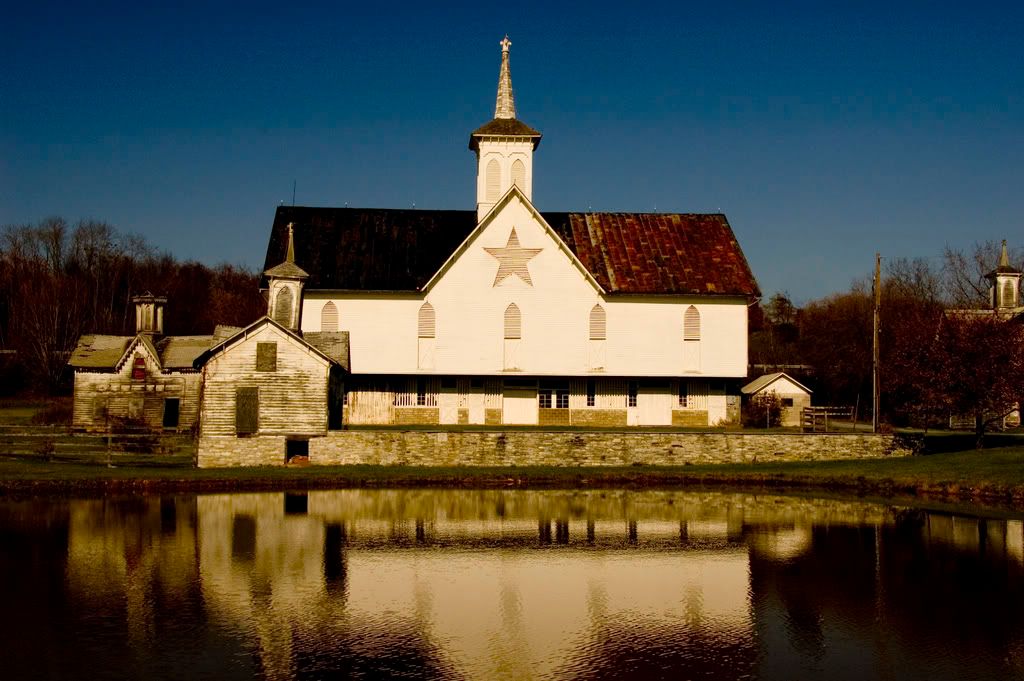
A barnstar (or barn star, primitive star, or Pennsylvania star) is a decorative painted object or image, often in the shape of a five-pointed star but occasionally in a circular "wagon wheel" style, used to adorn a barn. They have no structural purpose, but may be considered lucky, akin to a horseshoe mounted over a doorway. They are especially common in Pennsylvania and frequently seen in German-American farming communities.


History

Barnstars were meant to represent the mark of the builder, but became more frequently used for aesthetic purposes and were added to the building after construction was complete. Enthusiasts have traced a number of wooden barnstars to individual builders in the Pennsylvania area, where numerous examples can still be seen.


Barnstars were used in the United States during the 18th century and as late as 1870 in Pennsylvania, where their popularity increased greatly following the Civil War. Their regular use preceded that time, however, and stars were commonplace on large buildings, particularly factories, in pre-war Richmond, Virginia.[1]

Barnstars remain a very popular form of decoration and modern houses are sometimes decorated with simple, metal, five-pointed stars which the makers describe as "barn-stars". They are often deliberately distressed or rusted, alluding to the traditional decoration.


If you connected the barnstar with the hex signs within Pennsylvania Dutch culture, then you are correct. All of this has an origin in pre-Christian German magical societies and Heathenry, but later revived into Christian society... just as Guido von List described. The above link continues...


Other star-shaped plates
On older buildings in the Pennsylvania Dutch area of the United States it is still possible to find barnstar-like building adornments which are painted, rather than wooden or metal, known as hex signs. Strictly speaking, they are defined apart from barnstars and visually bear only passing resemblance, but the two are often confused and their names are even regarded as interchangeable.[1] Some hex signs incorporate star shapes, while others may take the form of a rosette or contain pictures of birds and other animals.[5]

The term barnstar has been incorrectly applied to star-shaped anchor plates that are used for structural reinforcement, particularly on masonry buildings from the 18th and 19th centuries. These are made of cast iron and are used as tie plates serving as the washers for tie rods. The tie-rod-and-plate assembly serves to brace the masonry wall against tilting or lateral bowing.

Some Wiki-based communities give their users an award called a "barnstar", as a continuation of the "barn raising" metaphor. This originated on MeatballWiki. The image that is frequently used for this purpose is actually a photo of one of the structural tie plates described above, not of a barnstar proper.


Pow-wow (folk magic) [Wikipedia]

Pow-wow, called Braucherei in Deitsch, is a system of American folk religion and magic associated with the Pennsylvania Dutch.


"Hexerei" is the German magical-spiritual tradition; but "Braucherei or Speilwerk" is heavily tied to Christian practice. This sounds very suspiciously like... "permission from daddy"... to play with magic. A little modern reminder and leftover from the "burning times." There are, of course, examples of this from all Christian societies. The above link goes into much greater detail and history.

There have been many complex underground pagan traditions tied to Christian cultures, "hiding in plain sight," and not just German or European. I fully understand the power in symbolism of this.. and how it has become so habit forming over the centuries. The pagan spirit has become so institutionalized within Christianity! I recall a news article from earlier this year, of a man in another country who was released from prison after a lengthy prison sentence. He was begging the authorities to "allow him to stay." That is "institutionalized."

Still, I understand. It's a fun and creative endeavor to craft symbolism within something. It draws upon a unique individual expression. The rural tradition of "Upper Michigan folk medicine," brought there originally by women from the Italian Alps, survives within a Catholic culture. Those women would, of course, say that they're good Catholics.


Pennsylvania Dutch Pow-wow (YouTube)

Powwow: Braucherei (YouTube)

.

Thursday, March 15, 2012

Hexology: Part IV


The above video is part one of eleven of the Hunter Yoder series on Pennsylvania public television. As it finishes, the next part will show somewhere on the screen, or you can simply find the whole series on the FrankBlank231 channel on YouTube. I think I will just wrap this up for now. I could just go on and on, as there are so many facets to Hexology. It's so enriching to briefly emerse yourself in something new that actually has always been part of your folk soul. Below are a few more links:


Symbol Meanings
 

The Symbol
Its Meaning


Circle
Eternity or Infinity
Distelfink (Bird)
Good Luck and Happiness
Dove
Peace and Contentment
Eagle
Good Health, Strength and Courage
Four Pointed Star
Bright Day
Heart
Love and Kindness
Horse Head
Protect Animals from Disease and Building from Lightning
Maple Leaf
Contentment
Oak Leaf
Strength
Quarter Moons (4)
Four Seasons of the Year
Raindrops
Abundance, Fertility, Rain
Rosette
Good Luck. Keep Away Bad Luck and Evil
Star
Good Luck
Triple Star
Success, Wealth and Happiness
Tulip
Faith
Tulips (Trinity - 3)
Faith, Hope and Charity
Twelve Pointed Rosette
A Joyous Month for Each Month of the Year
Unicorn
Virtue and Piety. Belief in God
Wavy Border
Smooth Sailing Through Life


3-20-12 ADDITION: I have started to view this Hexology series, and I noticed that Hunter Yoder referred to the sun of the Alps symbol as a "rosette." I don't know if it's a rosette or not. However, when there's a distinct symbol, it's usually called only by it's proper name. Rosettes are a much larger category. On one hand, the sun of the Alps isn't a greatly-known symbol, such as the triskelion or the triquetra; on the other hand, it would seem that he should know exactly what it is since it's on so many hex signs. So, when do we challenge experts on certain items? I'm quite certain on this one however. It's an Alpine symbol, of either proto-European or Gaulish origin; and which has been found occasionally in other places, such as Portugal or north Germany. It's rare for a symbol to be unique to only one place, like the Rosa Camuna basically is.

.

Wednesday, March 14, 2012

Hexology: Part III

Barn with a hex signs in Oley Township, Berks County, Pennsylvania
Hexology ties into so many areas that I will need to skip many to proceed, although there are a few areas which should be mentioned. One is the "fraktur," which is the name of Pennsylvania German folk art. This goes back to the 1700s and is the name of the art form of which the hex symbols developed out of. Another area is the "tree of life" symbolism within many hex signs, which shows a clear and direct connection to "Wuotanism," as it's known in Germany. That really is a major item because it's a direct tie-in to the spirituality of the ancient world; although it's largely a cultural and decorative thing in Pennsylvania.

Pennsylvania Dutch Country is located in the eastern part of the state, and it's worth mentioning that Monogahelia is in western Pennsylvania. The Monogahelia area is the home to the largest concentration of people of Camun ancestry on this continent. Although the "tree of life" element of the hex signs ultimately tie into the Norse Yggdrasil and general Germanic paganism; this is also tied into the "flower of life" from ancient Cisalpine culture. The flower of life is represented by the symbol of the "sun of the Alps," so there is a clear tie-in there; and of course, the sun of the Alps is a very strong theme in hexology.

It can't be stressed enough that when a hex sign is an eight-pointed star with a sun of the Alps inside of it, the tie-in to our ancient Camuno-Gaulish culture is crystal clear. Each point of the star represents one of the Sabbats, or the eight seasonal festivals on the wheel of the year (Camunic witchcraft); while the sun of the Alps is basically a Gaulish symbol for the sun (Cisalpine Gaulish). I have read where the sun of the Alps symbol was referred to as "a hex symbol," period, with no mention of sun of the Alps. Again, this symbol was basically a pre-Germanic, Celtic symbol; which apparently found it's way into German culture after the Teutonic tribes overran most of the Alpine region.

There is a growing interest in hexology, with some newer books and probably with new ones on the way. However, it should be mentioned that there is one book entitled 'Hexology, the History and the Meaning of the Hex Symbols' (Zook & Ott; 1971), which is only fourteen pages, but always comes up when the subject is mentioned. One other one is 'Hexology: The Art and Meaning of the Pennsylvania Dutch Hex Symbols' (Herrera; 1964). Hunter Yoder mentions other names and books in the interview on Part II.

While reading that interview, it occurred to me something that I've thought about before. So many "Westerners," most often from the English-speaking world, look elsewhere for spirituality. Actually we "have it made" in that department, and really don't need to look beyond our own cultures. Logically, making a comparative study of other spiritual traditions, would be part of the process. Even Guido von List looked to India for this purpose. Since reading 'The Secret of the Runes', I have wondered what von List would have thought about the "Celtic roots" of his homeland? This was not known during his lifetime.

Hunter Yoder used some terms which I thought were interesting. Among them were "radical traditionalist," and "folk magic," which I thought were interesting. I have liked the term "native believer." The person who believes in the native spiritual traditions of their ancestors. There are a lot of interesting items on Yoder's website, including a series his did on local Pennsylvania public television, which I have yet to watch. I get a strong impression that Guido von List would approve.

.

Thursday, March 8, 2012

Hexology: Part II


[Conducted by, and borrowed from, AllFatherWotan.org]


1) Greetings Hunter. To begin please introduce yourself and give the readers some info on your roots in Heathenism.

Heil Georg! I am a Heiden Hexologist, owner and creator of the Hex Factory Gallery in Philadelphia, which is dedicated to Germanic tribal art and Pa German Hexology. I have authored numerous essays on the subject of the new Heathen Hexology and magic plants and the book, The Backdoor Hexologist, Volume One. I am the founder of the online site www.Zaubereigarten.com where I have interviewed the avante garde of the Pa German magical traditions known as Hexerei. I was born and raised in the heart of Pennsylvania Dutch country, Berks County, PA., I began painting hex signs on barns at an early age. I am an avid Netherland Dwarf rabbit breeder, entheologist, and father of four.

My roots in Heathenry are in Berks County, Pennsylvania or Barricks Kaundi in Pennsilfaania in Deitsch, a German dialect spoken there. Der Deitsch Volkskultur where I grew up is the basis for my reanimation of our Folk ist prechristian beliefs and customs. I prefer the Deutsch, 'Heiden' to Heathen which is Anglo Saxon. Berks County is ground zero for Hexerei in the New World. My area of interest has always been Hexerei, or Germanic witchcraft, which is not directly associated with any organized or institutionalized form of religious practice but rather a flexible, individual approach to folk magic, specific to a folk culture in this case the Pennsylvania Germans.


2) Who were the individuals that were the most inspirational in your beginnings with Hexology?

Well let me preface the response to this question by stating that the frequency of Hex signs or Barnstars is the greatest in Northern Berks County then anywhere else in North America, maybe the world. I grew up on a farm near the small town called Virginville on the Maiden Creek which later contributes to the Schuylkill River which runs to Philadelphia. The farm was on the Saucony Creek a Lenni Lenape word for 'little bear' The Barnstars were on all the barns on all the farms. Locally, Milton Hill was the source of most of these barnstars. The great Hexologist, Johnny Ott of Lenhartsville was a couple of miles downstream, where he had the Deitsch Eck Hotel and where he also painted his famous Hexes that he and Jakob Zook of Lancaster made famous. Johnny sold his Hex business to a Johnny Claypoole who was from Upper Darby in Philadelphia, but moved up into an old stead just outside of Lenhartsville. I went to school and ran with his sons engaging in country youth activities such as skinny dipping in the Maiden Creek and jumping off cliffs into quarry lakes. We also drove old Dodge pickup trucks from the early fifties that we bought very cheap and fixed up. Eric, one of Johnny's sons now has the Hex business in Berks County.


3) You originally were from Berks County. Then you lived in Brooklyn and now Philadelphia. What was your interest in moving to Philadelphia?

Philadelphia was the portal for most the German immigration into North America for centuries. My ancestors and yours entered the 'new world' here in Philadelphia. During Colonial times, so many Germans came to Pennsylvania, Ben Franklin called them the Palatinate Moors. My arrival to East Kensington which still today retains a very Germanic population was not by chance. My own spiritual evolution brought me to the source of our Folk to this their new Heimot. Germans love to farm and SE Pennsylvania including my Berks County has 'die besten Ackerboden' I however find the innercity as the new frontier and the retaking of old neighborhoods which our folk built and rebuilding them has been both rewarding spiritually but also materially. I see the future in the city, life there is more efficient less reliant on the petroleum fueled monokultur which has alienated us from our true kultur and has bankrupted us. The culture of the car is growing to a close despite frantic efforts by our governments and world financial players to the contrary.


4) Please explain what Hexology is and also elaborate on it as a magical practice.

Hexology is actually a term invented by Jakob Zook and Johnny Ott in the very late 1940's. The Zook/Ott collaboration has made the term, 'Hexology' internationally famous. It came about at a time after the War, when America was booming, as in Baby Boom. Car Culture was really taking off. Families went places in the car for summer vacations. Lancaster County in Pennsylvania tapped into this tourist trade which continues to this day. The PA Folk Festival in my Hometown of Kutztown, in Berks County started. As we are today, back then people were fascinated with Pa German Barnstars. Ott designed them and painted them on round disks. This differed from the traditional practice of painting them directly on buildings or furniture. Zook took Ott's designs and silk screened them onto masonite disks for the tourist trade. Ott became a self styled Professor of Hexology as Dr Johnny Ott, and there you have it. Hexology was then a commercialization of the darker practice of Hexerei, or as it was called by the Deitsch (Pa Dutch) Hexerie or the Jinks, sometimes called Pow Wow magic.


5) You are a practioner of magic plants. Tell the readers more about this and how it differs from herbalism.

My knowledge of plants contrasts in many ways with herbalism. Knowledge of 'die Blantz' is essential in the Pa German kultur. We hear how the European settlers learned about plants from the so called 'indigenous' or Indians. However, the knowledge transferred went both ways. I recently procured a variety of snow white sunflower seed from a tribal seed bank in Arizona from the Tarahumara, a tribe made famous in, "The Peyote Dance," a book by Antonin Artaud. However the real source of the seed variety came from the Tarahumara's interaction with the Mennonites who settled near them in the Chihuahua desert which they turned into a garden. This is what our Folk do. We grow better then anybody including the so called 'Indigenous'.

Anyway, my 'herbal remedies' are far different then the Herbalists. Hexerei uses Power Plants or Plant Teachers to cure the spirit of the patient.


6) How does your usage of magic plants relate to magical symbols?

The Deutsch term is Zauber or magische. There is power in the words, how they are spoken and spelled, the Icelandics call it Galdr, the Deutsch, gesprochen Magie. The connection between die Blantz und die magische Zeichen; the answer is simple, plants have been used in folk art since the neolithic times. Powerful plants and especially trees populate Germanic tribal 'art' The essence, the spirit of the plant is represented through a stylization of it. The stylization is really just a symbol that invokes the power of the plant, visually. My own contribution to this process has been to replace the Christian plants and flowers in the traditional Pa German Folk art seen in Fraktur and Hexology with the Heiden magic plants. For an example, tulips are used as symbolic of the resurection of the Christ. I will substitute them for my own stylizations of Datura Stranomium, 'Geilskimmel' and Black henbane or 'Niger Bilsenkraut'. These two are power plants for the prechristian Germanic tribes used by the Volvas for divination. We find henbane seeds in the burial mounds of these exalted 'Hexes' In post reformation Germany, usage of Black Henbane seeds would result in a terrible death, being burned at the stake. More 'witches' were exterminated by Protestant Germany then anywhere else. The commonly held belief that witches fly on broomsticks comes from the practice of female 'Hexes' using an ointment of fat and Bella Donna to grease a broomstick which they stradled to absorb the Atropine a powerful hallucinatory agent through their genitalia.


7) What is the relation between sex magic and Hexology?

Pa German Sex Magic is a way of life. It is in fact a way of living and survival. On the farm, success is gauged by the ability to reproduce plants and animals and children. In a sense the farmer is a sex magic zauberer, a f*****g machine. The feminine counterpart is the the nourisher, the source of life, the goddess, the woman, the Hex, the repository of charms, the magical creature, the river of life.

It is my personal view that the Pa Deitsch are descended not from the apes but from certain flowering plants. This is evident by the usage of their Hexology, their 'creation myth' so to speak.


8) Explain the difference between Asatru and Germanic Witchcraft (Hexerei).


Asatru is a religion of contemporary Icelandic Heathens which has spread worldwide as an alternative to other institutionalized religions such as the Monotheisms. This Icelandic prechristian tradition has the advantage of a complete written legacy in the Eddas and other texts.

Germanic Witchcraft or Hexerei is a general term but it is just that, witchcraft. Witchcraft, generally feared by the Christians is neither black or white, evil or good. It is just the acquirement of personal magical power. This magical energy is always much more powerful if used positively. Cursing is actually very easy to do, but it never really ends up well for the one who has done the cursing. The result has a boomerang effect, and when the target determines the source which is usually pretty easy, the malicious energy is simply returned to the sender usually in a much more powerful form. This is primitive stuff, practices that have existed since before prehistory. Hexerei can be employed through everyday means, cooking, humor, sex, business, child rearing, hunting and fishing. Using an intention to acquire a desired result is just natural, be careful what you wish for.


9) You mentioned to me before about the Pennsylvania Germanic roots of Blues music. Can you tell us more about this. Most seem to believe that Blues music's origin is "African American."

I think what you are referring to is my statement that Pa German Hexology is similar to the 'Blues' because virtually anybody can do it (hexes). I've found that the public's interest in making them is at least as great as their viewing them or learning about them. I've done quite a few workshops with people of all ages most recently with children for the Hexenkinder Show at the Hex Factory with O. Henrietta Fisher, and it is always a big hit. Similar to playing music, practice making Hexes is essential. It is useful to learn the basic designs first before moving on to more elaborate ideas.


10) Another subject relating to Germanic magic/witchcraft is called "Hoodoo." Could you explain what this is exactly?


Well Hoodoo is not strictly a Germanic form of sympathetic magic. It is very American. It is most commonly recognized as a southern form but its roots are actually very Appalachian. The German, Scotch, Irish pioneers and settlers that moved through Pennsylvania to the South and out West took their unique ways of effecting their world. Hoodoo was practiced in PA. Hidden or buried 'intentional' objects would typify this practice. Jack Montgomery, Lee Gandee's student has published his book, "American Shamans" and he has a more 'Hoodoo' bent which is appropriate for his Kentucky neck of the woods. Orva Gaile Clubb is another who is very knowledgeable in this form. She correctly sees this as Hexerei and she has a very unique perspective being raised in western Maryland on the farm just below the Mason Dixon line. I will hopefully have her interview up shortly on Zaubereigarten.com . Hoodoo is an American form of the Caribbean Voodoo, or the Brazilian, Makumba. It is interesting to note that Voodoo scholars have great interest in the Pa Deitsch grimnoir, "The Long Lost Friend" published by Hohman in Reading Pa, 1820 as Der Lange Verborgene Freund. It makes extensive usage of the Sator Rotas magic square. Up until the 1930's the State of Pa issued licenses to practice Pow Wow magic, another term for the Pa German Hexerei.


11) I understand you learned about Kabbalah through a Rabbi friend of yours while living in Brooklyn. Could you please explain more of your friendship with this gentleman?

Yes, living thirty years in NYC certainly gave me a positive insight into Judaism. The basics of Christianity are very much from Judaism. Terms like, congregation, pentecost, trinity, originate in Judaism which has undergone many changes in its old and venerable history. Kabbalah however is relatively recent, as a powerful form of mysticism. Briefly just off the top of my head, Kabbalah originated not in Israel but in the German Rhineland and Spain during the later middle ages. In Germany, the Jews were employed much as they still are, for their knowledge of law which required an ability to read and write, something the various German nobilities lacked. The Germans and the Jews have always had a very symbiotic relationship. It is an unusual one, even amongst the Pa Germans. The Pa German dialect or Deitsch is remarkably similar to Yiddish. Both are lower German dialects. When Martin Luther translated from the Latin, the Bible which was subsequently published for the first time and is known as the Gutenberg Bible, he fixed what is known today as high German. Many other German dialects still exist.

Anyway back to your question, Rabbi Joshua Saltzman and I exchanged ideas and information including an intro of Kabbalah on his part. At the time I had 'discovered' that all religious traditions contained the simple concept of a 'tree of life'. The Sephirot as a tree was discussed. Hebrew as a magical alphabet was studied. All magical alphabets include gematria or assignment of numerical values to letter in the alphabet. Hebrew, Greek and the Elder Futhark are examples of magical alphabets. Ultimately our studies led to my conclusion that I could not place any rational reason to. I found myself intuitively unable to absorb the Jewish alphabet and the Sephirot seemed unacceptable numerically and geometrically. I however retained a great respect for the magical traditions of the Jews. Their mysticism is very powerful. In particular the Kabbalistic concept of 'gathering the fallen sparks' impressed me. Joshua had a keen interest in Shamanism and traveled extensively to India, Nepal to further his knowledge in various traditions such as the Sufi. I myself returned to my Pa German roots and have ultimately rejected Shamanism as being a modern day jingoism, a quick fix for a lack of a personal tribal tradition.


12) Do you consider yourself a "Radical Traditionalist"? If so please explain.


Radical traditionalism refers to the renaissance in Germanic 'paganism' I view it through my usual Pa German lense as the reindigenization of my folk. The magical traditions I grew up with in Berks County are the legacy of our European forefathers. That is our tradition. Revitalizing it, reanimating it and rejecting multiculturalism and the petroleum fueled "monokultur" is the radical part, advanced thinking is being done today by such 'traditionalists' all over the world.


13) Thank you very much for your comradeship, your wisdom, and your time in completing this interview. Any closing comments to share with the readers?


I would say this, there is an energy in the magical signs of our Germanic ancestors. It is very real and powerful. Anyone can participate in making them. In doing so you are tapping into something much larger then mere personal self expression. As I explained to a former teacher and friend, A stream or river has run in its bed for hundreds of thousands of years maybe longer, so it is with folk magic. No one is quite sure how it works, just that it does.


Zaubereigarten (Hunter Yoder's website)

.